The Biola Athletics Operations and Compliance Manual is
designed to be a resource for coaches and staff in the athletics
department at Biola University. It is intended to provide
essential information to better understand the policies and
procedures of Biola Athletics. This manual is designed for use by
all athletics staff as a reference for general athletics
procedures and policies. To keep up with the ever-changing climate
of college athletics, this is a living document that will be
updated annually at minimum.
This document is not intended to be the only resource for
guidance. Other resources include the Biola Employee Handbook, the
Student-Athlete Handbook, the NCAA Division II Manual, the
university Catalog, and other documents as they are issued that
serve as a collective body of information on institutional policy
and guidelines for all staff and administration.
Any coaches or staff members who have questions regarding this
manual or the institutional policies are encouraged to consult
with the appropriate administrator and/or the senior director of
athletics.
Biola University Vision
Statement
The vision of Biola University is to be identified among the
world’s foremost Christ-centered universities — a community
abiding in truth, abounding with grace and compelled by Christ’s
love to be a relevant and redemptive voice in a changing
world.
Biola University
Mission Statement
The mission of Biola University is biblically centered
education, scholarship and service — equipping men and women in
mind and character to impact the world for the Lord Jesus
Christ.
Biola University Values
The values of Biola University are those essential things that
guide how we carry out our mission. We summarize them in three
words: Truth, Transformation, and Testimony. Each value provides a
focal point for the lifelong patterns we aim to develop in our
students.
Truth — Patterns of Thought: We believe truth exists, is
found in the person of Jesus Christ, and is revealed in the Bible
and in the created order. We also believe that truth must be
pursued. Learning the art of pursuing truth is, indeed, at the
center of a Biola University education. Our faculty teach and
model this pursuit in order to develop in our students patterns of
thought that are rigorous, intellectually coherent, and thoroughly
biblical.
Transformation — Patterns of Heart: Jesus Christ
transforms individuals. As a Christ-serving university, the entire
Biola experience is designed for life transformation in Christ.
Our goal is that each graduate will have formed a personal value
system — one that is firmly rooted in truth and is integrative,
globally informed and compassionate — that will influence their
lifelong affections, decisions and actions. Said differently, we
want our students to develop patterns of heart that reflect the
heart of God.
Testimony — Patterns of Action: Biola University's
mission is to impact the world for the Lord Jesus Christ. This
mission is fulfilled when our graduates demonstrate "the obedience
of faith" in service to others through words of wisdom,
professional and personal competencies, hearts of compassion and
acts of courage. We equip our students with patterns of action to
lead in the face of unscripted problems for the good of a changing
world, and to do so in the power of the Spirit, for the glory of
God, to bring many to salvation in Christ.
History
The Bible Institute of Los Angeles was founded in 1908 in
downtown Los Angeles, but moved to its present suburban campus in
the city of La Mirada in 1959. By then an accredited college, the
new campus provided ample space for athletics facilities. The
first athletics director had been hired in 1957, and he began to
formulate plans for the sponsorship of competitive teams.
The first teams were men’s soccer, baseball and tennis (1960),
men’s and women’s basketball (1961), women’s tennis (1962),
wrestling (discontinued in 1986), men’s track and cross country
(1964) and women’s volleyball (1969). During the 1980s and 1990s,
eight additional sports were added. By this time, Biola had become
a university. The new teams included men’s indoor track and field
(1981), women’s track and cross country (1987), women’s soccer
(1992), women’s softball (1993), women’s indoor track and field
(1994), and men’s and women’s swimming and diving (1997). The
final sports added were men’s golf (discontinued in 2019), women’s
golf (2007-2025), and men’s tennis (2007). In 2021-22, Biola added
both men’s and women’s water polo.
The first national affiliation occurred in 1964, when Biola
men’s athletics joined the National Association of Intercollegiate
Athletics (District III member). This was followed by Biola
women’s athletics becoming affiliated with the Association for
Intercollegiate Athletics for Women in 1971. In 1981, women’s
athletics left the AIAW and joined men’s athletics as NAIA
members. While NAIA affiliates, the final change happened in 1994,
when Biola became a member of the Golden State Athletic
Conference.
In July of 2016, Biola began a three-year provisional
membership period in the National Collegiate Athletic Association
Division II. Biola began competing in the Pacific West Conference
during the Fall of 2017 and achieved full membership in the NCAA
Division II in the Fall of 2019.
Biola Athletics Mission
Statement
Biola Athletics exists to recruit and educate a diverse group
of Christian student-athletes to reach their full potential
athletically, relationally, emotionally, spiritually and
academically — equipping them in mind and character to impact the
world for Christ.
Core Values
Biola Athletics is built on three core values.
Faith. We are rooted in Christ, anchored in
Scripture, and grounded in faith. We have the freedom to compete
with joy and passion as an expression of our love for God and each
other. Our faith isn’t performed - it’s lived. Every practice,
every game, every handshake with an opponent is a chance to embody
God’s love and bring Him glory.
Formation. We flourish in mind, body, and
spirit, growing individually and as a community. Our coaches don’t
just build athletes; they build people who will lead, serve, and
shine long after the final practice. We shape a community of
kindness on our teams, with our campus, in our world. Not only for
today - we build bonds that outlast seasons. When you wear Biola
across your chest, you have a team with you. Not only on the field
of competition, but for life. We travel, play, and pray together,
heart to heart - with firm convictions and as a light to the
world.
Fierce. We compete and live with passion.
Every rep. Every sprint. Every day. We honor our gifts by using
them fully - reflecting the image of God. We play with intensity
and gritty dedication. We are wholehearted, tenacious, and
relentless. We rise up on wings like eagles and fly. Above and
beyond. Courageous in all we do.
Faith You Can See.
Biola Athletics
Philosophy
Biola University Athletics serves to recruit and educate a
diverse group of Christian student-athletes to compete in the NCAA
Division II. The institution supports its student-athletes in
reaching their full potential athletically, relationally,
emotionally, spiritually, and academically. We believe in the
holistic development of a student-athlete — living life in the
balance — in order to thrive at Biola and beyond. The following
are areas of focus for holistic development, as well as the values
shaping the department and university.
Biola Athletics seeks to foster a balanced and inclusive
approach in which student-athletes learn and develop through their
chosen academic pursuits, civic engagement with their communities,
and athletic competition.
We are committed to the physical and educational well-being
of student-athletes, including maintaining an environment that
values cultural diversity and gender equity among student-athletes
and intercollegiate athletics department staff.
We are committed to ensuring that coaches and
administrators exhibit fairness, openness, and honesty in their
relationships with student-athletes. We seek to empower and give
voice to the student-athletes via the Student-Athlete Advisory
Committee.
We believe a positive athletic environment and ethical
approach to sport, scholarship and service are important to
character development and the overall success of the
intercollegiate athletic experience. We value respect, fairness,
civility, honesty and responsibility. These values should be
manifest in the full spectrum of activities affecting the
athletics program.
To create an atmosphere of respect and civility, we are
committed to protecting individuals from unlawful discrimination
or harassment with respect to governance policies, educational
programs, activities, and employment policies.
We recognize that our student-athletes are not simply
members of their team, but also members of the student body as a
whole as well as many other outside communities. We therefore
strive to protect the time of the student-athlete so they may be
fully immersed in outside communities and truly experience “life
in the balance.”
With the goal of being a model NCAA Division II
institution, Biola is strongly committed to the principle of rules
compliance. We are fully invested in complying with all applicable
Association rules. Partnerships with other PacWest Conference
institutions provide an important accountability in this
area.
Within the scope of the rules of compliance, the
institution is committed to maintaining the strictest governance
as it relates to recruiting, awarding financial aid, tracking
student-athlete eligibility and activity, meeting all sport
sponsorship requirements, and maintaining ethical accounting
practices.
In addition to the above guiding principles, Biola Athletics is
focused on the following fundamental philosophies that help define
and distinguish who we are:
Academics - As part of the Living Life in
The Balance initiative, Biola University is committed to
supporting the academic success of its student-athletes. Biola
provides a top-tier education for all students and is specifically
committed to providing the support necessary to ensure a path to
graduation that demonstrates graduation rates for student-athletes
that are at least equal to those of the general student
population.
Athletics - Biola University is committed
to providing highly competitive programs that aspire to compete
for NCAA Division II national championships. We believe the key to
accomplishing athletic success is through the quality Christian
leadership of coaches and strong administrative support, allowing
student-athletes to reach their collective team potential. In
addition, we offer top-level athletic facilities, equipment,
strength training, and athletic training support to help our
student-athletes realize their full potential. It is our goal to
see all student-athletes develop in their sport, so that they are
more skilled at the conclusion of their time at Biola than when
they began.
Spiritual Development - Biola University
is committed to providing an educational experience that
integrates Christian faith with every aspect of the university
experience. We believe the intercollegiate athletics experience
can play a significant role in the spiritual development of every
student-athlete, and we have developed our programs with spiritual
growth at the core. We believe athletics at Biola provides an
opportunity to invest in the development of the entire
student-athlete’s holistic development in mind, body, and
soul.
Community Engagement - Biola Athletics is
committed to active engagement with our communities to enhance
relationships between our student-athletes and community members
and develop a shared civic experience in our student-athletes. We
believe this commitment goes beyond periodic service work; it
should be tied to an active and continuing engagement with our
surrounding communities, motivated by our Christian love for
others. We seek to not only engage the community off campus, but
also to provide opportunities to bring the community onto our
campus and engage them in a positive, family-friendly
manner.
Post-Graduation Success - Biola Athletics
is committed to developing our student-athletes’ character, rooted
in their Christian faith, so that they can successfully transition
to become productive members of society after they graduate. We
also believe in an athletic model that allows our student-athletes
to focus on academic pursuits, obtain internships for career
preparedness, and develop a strong spiritual foundation to thrive
holistically beyond graduation.
National Affiliation
Biola University is a full member of the NCAA Division II.
About the NCAA Division
II
NCAA Division II is a collection of approximately 300 colleges
and universities that provide thousands of student-athletes the
opportunity to compete at a high level of scholarship athletics
while excelling in the classroom and fully engaging in the broader
campus experience. This balance, in which student-athletes are
recognized for their academic success, athletics contributions and
campus/community involvement, is at the heart of the Division II
philosophy.
NCAA Mission
To govern competition in a fair, safe, equitable and
sportsmanlike manner, and to integrate intercollegiate athletics
into higher education so that the educational experience of the
student-athlete is paramount.
About NCAA Division II
NCAA Division II is a collection of over 300 NCAA colleges and
universities that provide thousands of student-athletes with the
opportunity to compete at a high level of scholarship athletics
while excelling in the classroom and fully engaging in the broader
campus experience. This balance, in which student-athletes are
recognized for their academic success, athletics contributions and
campus/community engagement, is at the heart of the Division II
“Life in the Balance” philosophy.
Division II Positioning
Statement
Division II is all about balance. Students participate in
highly competitive athletics, have the best access ratio to NCAA
championships of any division and can earn athletics scholarships,
but their college experience includes so much more than sports
participation. The balanced approach in athletics, academics and
community engagement allows Division II student-athletes to focus
on their academic pursuits, internships, studies abroad and all
that interests them.
Among the most distinguishing features in Division II is its
athletics scholarship model, which awards partial scholarships
that students combine with academic or need-based grants to
construct their financial aid package. Division II believes it is
important to acknowledge and financially reward students’
athletics abilities. This partial scholarship model keeps
athletics budgets more closely proportioned with the total
institutional budget.
Division II Priorities
Balance: Under the Division II philosophy, schools aspire
to a balanced approach in which student-athletes reach their
highest potential in the sports they love to play, the academic
goals they choose to pursue, the engagement with their campus and
local communities, and the personal development and wellness they
need to succeed in life after college.
Academic Success: Division II schools offer a comprehensive
program of learning and development in a personal setting. The
size of many Division II campuses (89% of Division II schools have
enrollments of fewer than 7,500 students) fosters that personal
setting and leads to Division II student-athletes consistently
graduating at rates several percentage points higher than their
student body counterparts.
Access to Championships: Of the three divisions, Division
II provides its student-athletes with the highest access to
championships. Sports including basketball, volleyball, and track
and field offer one championship opportunity for every 8.5
student-athletes. The ratio is even higher in other sports,
including lacrosse and field hockey.
Community Engagement: Division II athletics programs
actively engage with their communities, helping to drive
attendance at athletics contests and connect student-athletes with
community members in a more shared civic experience. Community
engagement also strengthens the bond among teammates and fosters
individual and personal growth.
Regional Competition Model: Division II has eight
competitive regions in most sports, which build healthy rivalries,
reduce time away from campus, enable families to follow their
student-athletes and keep athletics participation in perspective
within the educational mission. The regional model also affords
representative access to championship finals and an equitable
pathway to championships.
Preparation for Life: Division II students have an
excellent opportunity to be highly skilled and decorated athletes,
but the balanced approach allows them to become marketable in
their careers because they’ll have time to focus on their academic
pursuits, their internships and whatever else it takes to prepare
themselves for life after college.
Inclusive Culture: Division II athletics programs are
committed to establishing an inclusive culture in which people of
all backgrounds are respected and given the opportunity to provide
input and participate.
Conference Affiliation
Biola University is a member of the Pacific West Conference
(PacWest) for 13 of its sports. In men’s and women’s swimming and
diving, Biola University is a member of the Pacific Collegiate
Swimming and Diving Conference (PCSC). In men’s and women’s water
polo, Biola is a member of the Western Water Polo Association
(WWPA).
PacWest members include Azusa Pacific University (Azusa,
Calif.), Biola University (La Mirada, CA), Chaminade University
(Honolulu, Hawaii), Concordia University Irvine (Irvine, Calif.),
Dominican University of California (San Rafael, Calif.), Fresno
Pacific University (Fresno, Calif.), University of Hawaii Hilo
(Hilo, Hawaii), Hawaii Pacific University (Honolulu, Hawaii),
Jessup University (Rocklin, Calif.), Menlo College (Atherton,
Calif.), Point Loma Nazarene University (San Diego, Calif.),
Vanguard University (Costa Mesa, Calif.) and Westmont University
(Santa Barbara, Calif.).
Senior Director of
Athletics
Reports to: Vice president for student development and the
president
Summary: The senior director of athletics is responsible for
the conduct of the entire athletic program under the policies and
procedures set forth by the university administration.
Function: The senior director of athletics is the chief officer
for Biola University’s intercollegiate athletics program. The
director is responsible for setting the vision and philosophy of
the program, with great attention given to the care, support and
eligibility of student-athletes and supervision of the coaches and
support staff. The position involves significant administrative
duties including budget, scholarship distribution, rules
compliance, game management, facilities management and
marketing/promotion. The senior director of athletics represents
Biola University to the PacWest Conference and NCAA Division II
contributing leadership and direction within these administrative
responsibilities.
Responsibilities:
Vision and direction: Provides vision and direction for the
intercollegiate athletics program at Biola University. Establishes
and reports on annual departmental goals. Represents to the
university the importance of athletics to the university brand and
the campus community. Encourages coaches and student-athletes with
his/her visibility and consistent presence at athletic
events.
Coaching and support staff: Responsible for the hiring,
training, support and evaluation of the coaching and support
staff. Holds regular individual and collective coach meetings.
Encourages coaches to establish annual goals and holds them
accountable for those goals.
Care/development/discipline of student-athletes: The
support of student-athletes is perhaps the most important
responsibility of the senior director of athletics. He or she is
responsible for the well-being of the student-athletes, providing
a physically, socially and emotionally safe environment. Coaches
are regularly trained on matters of student support, including
training in their sport, academic success, spiritual growth and
character development. The senior director of athletics works in
tandem with coaches and Student Development staff to ensure
student-athletes follow the university’s standard of
conduct.
Scholarship management and agreements: With input from the
vice president for student development, the senior director of
athletics determines the strategic distribution of athletic
scholarships to the university’s intercollegiate teams. He or she
works with the coaches to ensure the effective use of the
scholarship funds. The director also oversees the written
scholarship agreements and renewal policies. With the vice
president, the director balances the various philosophies of use
of scholarships (meeting enrollment goals, reward for
performances, the opportunity for team success, etc.).
National and conference compliance and eligibility: The
senior director of athletics ensures that student-athletes meet
and retain eligibility to participate. He or she establishes a
culture of compliance within the department as it relates to
documenting compliance with NCAA Division II, conference and Title
IX regulations.
Liaison with campus and national organizations: The senior
director of athletics or his/her designate represents the
athletics department to administrative departments and faculty at
the university, advocating for the needs of student-athletes.
He/she represents Biola to the NCAA and the PacWest Conference.
The senior director of athletics must be effective in building
important relationships and forging networks both on and off
campus.
Budget/fundraising: Oversees the effective management of
the department’s operating budget. Ensures that resources are
distributed in an equitable yet strategic manner. Is an advocate
for fundraising efforts.
Administration of home contests: Ensures that athletic
contests held at Biola University are administered effectively,
overseeing such aspects as game management, stats and record
keeping, referee and opponent contracts/agreements and a safe,
positive game environment.
Promotion, marketing, public relations: Intercollegiate
athletics offers a significant opportunity to develop school
spirit amongst Biola students, staff, faculty, alumni and the
surrounding community. The popularity of sports in today’s culture
also provides the university with an opportunity for publicity and
influence. As such, the director supports and resources the
effective promotion, marketing and public relations components of
the Biola Athletics program.
Team ministry/outreach and spiritual growth: The senior
director of athletics establishes the department philosophy and
general team expectations for the spiritual growth of
student-athletes. This involves the training of coaches and
encouraging ministry/mission/outreach activities. The senior
director of athletics seeks to develop and enhance the athletics
program’s reputation with and impact on the campus and the local
community.
Athletic facilities: The senior director of athletics
oversees the scheduling, management and development of the
university's athletic facilities, advocating for repairs and
improvements where necessary. He/she is responsible for policy on
use by students and third parties and works to develop strong
relationships with the facilities and conference services staff at
the university.
Student Development involvement: The senior director of
athletics is a member of the leadership team of Student
Development (SD), a group that currently includes the dean of
student wellness, dean of spiritual development and campus pastor,
dean of community life. The director actively contributes to
collaborative work within the SD Division, sharing leadership
responsibilities and divisional tasks and ensuring the
participation of the Athletics Department in divisional
activities.
Strategic plan, handbooks, policy manuals: An aspect of
strong administration of Biola Athletics is the creation and
timely update of current affiliation regulations and NCAA required
policies, procedures, handbooks, strategic plans and other
documents. The senior director of athletics carries ultimate
responsibility for these materials.
Lifestyle/support of employees: Participate in the
spiritual growth, development, care and support of direct
reports.
Supports and encourages a comprehensive rules education
program: The senior director of athletics oversees and works with
the associate athletic director for compliance/communication,
participates in the extensive rules education and compliance
program, both within athletics as well as across the institution.
This will involve communication and education of staff and faculty
throughout the Biola campus in partnership with the Faculty
Athletics Representative.
Duties specific to serving as NCAA senior director of
athletics:
Evaluates potential NCAA rule violations and notifies the
vice president for student development and president of any
violations.
Declares student-athletes who violate NCAA rules
ineligible.
Generates and promotes NCAA legislative proposals.
Provides a letter addressing NCAA rules to athletics
scholarship agreement signees.
Supervises grant-in-aid distribution for all
sports.
Supervises process of initial and annual
renewal/non-renewal of athletic grants-in-aid.
Creates an environment that prioritizes sportsmanship and
civility.
Establishes departmental goals that are aligned with the
DII Strategic Positioning Platform, including the role athletics
can play in strengthening the bond between the institution and the
community.
Is one of five individuals authorized to make contact with
the NCAA academic and membership affairs staff as outlined in NCAA
Constitution 5.4.1.2.
- Perform other duties as assigned.
Supervision over:
The senior director of athletics supervises the Biola Athletics
staff, including coaches, administrators, support staff and
athletic trainers. He/she also provides dotted-line supervision
(with the Office of Advancement) of the Director of Athletics
Development. Direct reports will vary depending on the
organizational structure established by the senior director of
athletics.
Senior Associate
Athletic Director
Reports to: Senior director of athletics
Summary: The senior associate athletic director provides direct
assistance to the senior director of athletics and represents the
athletic director in his/her absence, or as designee, in the areas
of internal management, day-to-day operations and student-athlete
success as a key member of the senior leadership staff in the
Athletics Department. This position has direct oversight of
athletic budgets, facilities, transportation, academic support
services and hiring coordination. In addition, he/she has
significant sport supervision responsibilities as well as
overseeing the Office of Student Accessibility and performing
duties as the NCAA chief financial officer for Biola
Athletics.
Responsibilities:
Athletics staff supervision
Directly supervises and supports approximately half of the
head coaches, as assigned, and provides administrative oversight
of those coaches’ respective programs and staff. Duties include
monthly one-on-one meetings, ensuring professional development,
and providing annual performance evaluations.
Supervises the athletics business manager and provides
oversight of the duties entailed within that position.
Specifically, ensures accuracy and fiscally responsible decisions
regarding purchasing gear, travel, and other necessities.
Budget oversight
Provides oversight of all Athletics operational,
recruiting, and camp budgets.
Maintains a culture of accountability, accuracy, and fiscal
responsibility in working with athletics department staff and
their budget expenditures.
Ensures accurate and timely submission of all necessary
budget paperwork according to institutional policy. Forms include
budget transfers, projections, new funding requests, annual budget
submissions, and other necessary paperwork.
Ensures accurate and timely submission of the EADA report
each October and the NCAA FRS report each January.
Monitors and provides oversight of restricted funding in
collaboration with the senior director of athletics.
Reviews and approves all budget expenditures for every
staff member in the department under Biola’s credit card and
expense policy system.
As needed, provides support and oversight to the senior
director of athletics for other non-athletic budgets including the
Fitness Center, Aquatics Program, Office of Student Accessibility,
Health Center, and others as assigned.
Provides quality training and orientation to staff on the
budget process and policies.
Ensures any budget issues from Athletics Department staff
are addressed promptly and appropriately.
Student-athlete well-being
Provides general administrative oversight of
student-athlete well-being and success. This includes:
Gathering annual survey data from student-athletes on their
experience in various aspects of our athletic programs.
Working with institutional staff to generate a well-being
and equity report presented annually to the Athletics Advisory
Council.
Administration of an annual mental health assessment to all
student-athletes in conjunction with the Director of Sports
Medicine.
Administration of class absence forms as well as the
student-athlete study hall process.
Serves on the Student Care Team. Attends Student Care
meetings and represents the Athletics Department in dealing with
care or conduct cases at the university.
In conjunction with the senior director of athletics and
the sport supervisor, helps address any well-being issues or
complaints within a given athletic program.
Hiring oversight
Serves as the point person between the Athletics Department
and Human Resources for compliance with all hiring-related issues
or employment regulations.
Provides structure, oversight, and support during the
search process for any full-time positions in athletics.
Processes hiring paperwork and ensures compliance with
institutional policies for all Athletics full-time, part-time, and
volunteer staff.
Strategic leadership and assessment
Provides oversight of department surveys, reports, data
assessment, and systems.
Supports end-of-year assessment, provides strategic
leadership, and helps develop department proposals related to the
vision, mission, and values of the Athletics Department.
Contributes to the leadership of the Student Development
Division as a member of the Student Development Leadership
Team.
Implements and tracks NCAA education related to sexual
assault awareness prevention (annual).
Oversight of the Office of Student
Accessibility
Provides direct supervision to the director of the Office
of Student Accessibility. Duties include monthly one-on-one
meetings, ensuring professional development, and providing annual
performance evaluations.
Provides administrative oversight of the Office of Student
Accessibility and its staff. Areas of oversight include:
Ensuring quality services are provided to Biola students
and that any issues are addressed promptly.
Ensuring staff receive ongoing education in legal aspects
of student accessibility and the accurate implementation of
applicable laws.
Facilitating a solid connection between the Office of
Student Accessibility and Biola’s faculty.
Providing oversight and direction on handling challenging
cases or situations with students.
Ensures effective tutoring and academic support systems
operations within the Office of Student Accessibility.
Maintains a general understanding of legal matters
surrounding student accessibility in higher education.
Additional administrative duties
Serves on committees and planning groups as requested by
leadership.
Provides onboarding and training in various areas,
including budget, travel, and purchasing for new athletics
staff.
Acts as a liaison between Athletics and Facilities for
major athletic-related facility projects.
Performs other related duties and responsibilities as
assigned.
Qualifications:
Bachelor’s degree.
Full-time salaried position, 40 hours per week, 12 months
per year.
Requires in-person attendance at Biola’s campus in La
Mirada, California, with consideration for a limited
hybrid/flexible work arrangement.
Associate
Athletic Director for Compliance & Communication
Reports to: Senior director of athletics
Summary: Directs and monitors all NCAA and conference
compliance issues associated with the administration of the
University's athletics program. He/she develops and maintains a
comprehensive rules education program for the Athletics staff and
provides rules education to student-athletes and to staff outside
athletics with compliance responsibilities. In addition, he/she
oversees the operation of the sports information office and the
administrator for facilities and events. The associate athletic
director for compliance/communication is a collaborative leader
within the Athletics Department, supporting and enhancing the
vision for every Biola student-athlete to be transformed and
thriving in all aspects of life: spiritually, academically, and
athletically.
Responsibilities:
Compliance program
Oversight, monitoring, and implementation of the
institutional athletics compliance program.
Ensure compliance with all NCAA Division II legislation,
conference regulations, and university athletics compliance
policies and procedures. Review policies on an annual basis and
update the department manuals.
Collect, review and evaluate information related to
coaches' recruiting of athletes, to ensure compliance with
rules.
Chair the institutional Compliance Committee and coordinate
the process of certification of initial and continuing
eligibility, perform regular audits, monitor seasons of
competition, and reassess compliance policies and procedures on an
ongoing basis.
Investigation and reporting of NCAA infractions, and the
presentation of subsequent education with staff and
students.
Ensure athletic scholarships, National Letters of Intent,
and financial aid are awarded properly and within the rules of the
applicable conference and National Office affiliation.
Review, audit and file countable athletically related
activity (CARA) logs within Teamworks Compliance &
Recruiting.
Provide primary oversight of all Teamworks Compliance &
Recruiting forms, processes, and audits.
Coordinate the release of Athletic Scholarship Agreement
signees with Financial Aid and Admissions.
Coordinate all NCAA appeals and waivers.
Department leadership
Serve on the Athletics Department Leadership Team.
Sport supervision of two head coaches.
Supervision of operation of the sports information office
and the administrator for facilities and events.
Attend monthly divisional meetings, monthly departmental
meetings, regular one-on-one meetings with supervisor, the fall
staff retreat, and other administrative team meetings.
Advise all university personnel, athletics staff, and
student-athletes on pertinent NCAA rules, procedures, and
interpretations through group and one-on-one training, creating a
personal and collaborative team approach to NCAA
compliance.
Support the university and department through attendance at
various home and away games, and conference
championships.
Is one of five individuals authorized to make contact with
the NCAA membership and academic affairs staff as outlined in NCAA
Constitution 5.4.1.2.
Perform additional duties as assigned.
NCAA Division II, conference, and department
reporting
Coordinate, complete and submit to the senior director of
athletics for approval, all NCAA required reports including, but
not limited to: Squad List Report, Academic Performance Census,
NCAA Graduation Rates Report, NCAA Sports Sponsorship and
Demographic Report, coaches compliance reports (bi-annual) and
regular compliance audit and infractions reports.
Oversee compliance software forms and reporting as the
primary liaison for optimizing the use and capabilities of the
software.
Student-athlete involvement
Serve as staff sponsor of the Student-Athlete Advisory
Committee (SAAC), conducting meetings throughout the year and work
with university leadership to address issues raised by
student-athletes. Attend conference SAAC leadership trainings
(annually) and support development of SAAC executive council
members.
Administer NCAA, conference, and institutional required
forms to all student-athletes.
Educate all student-athletes regarding NCAA compliance,
eligibility, amateurism, employment and extra benefits,
anti-gambling, and other pertinent rules.
Plan and coordinate the all student-athlete orientation
each fall and facilitate the Athletics Awards Gala each
spring.
Advocate for student-athlete life balance through programs
and initiatives to empower learning how to balance academics and
athletics.
Qualifications:
Bachelor’s degree.
Two or more years of previous NCAA compliance experience
preferred.
Full-time salaried position, 40 hours per week, 12 months
per year.
Requires in-person attendance at Biola’s campus in La
Mirada, California, with consideration for a limited
hybrid/flexible work arrangement.
Faculty Athletics
Representative
Reports to: President
Summary: The FAR is a faculty member at an NCAA-member
institution. They are appointed by the President to serve as a
liaison between the institution and the athletics department, and
also as a representative of the institution in conference and NCAA
affairs. The FAR is one of five individuals authorized to make
contact with the NCAA academic and membership affairs staff, in
accordance with the NCAA Constitution. The FAR shares
responsibility for the integrity of the athletics program and
assists the athletics department in establishing a culture of
compliance by ensuring full adherence to national, conference, and
institutional regulations.
The involvement of the FAR includes eligibility and
academic-related duties, maintaining an atmosphere of compliance
and institutional control, and assisting in investigations of
rules compliance. The FAR serves as a student-athlete reporting
contact independent of the athletics department.
Responsibilities:
Serve as a senior advisor outside of the Athletics
Department to the President on matters related to the athletics
program.
Chair the Athletics Advisory Council, meeting a minimum of
three times annually to oversee the integrity of the athletics
program at Biola.
Regularly review aspects of the Athletics Department:
In conjunction with the Associate Athletic Director for
Compliance and the Assistant Registrar for Compliance, the FAR
will review/certify the eligibility of student-athletes each
semester.
Review annual reports submitted by the Athletic Department
to the PacWest Conference and the NCAA.
Review the annual institutional athletics budget.
Participate in institutional assessments required by the
NCAA.
Be involved in any institutional investigation of
allegations of rules violations and play a direct role in
investigations of major violations.
Be an active member of the Compliance Committee to regulate
institutional control and compliance and implement processes in
conjunction with the Financial Aid Office, Admissions, Academic
Advising, and the Office of the Registrar.
Attend the fall semester all-sports meetings to communicate
academic requirements and ensure awareness of their position and
role as FAR.
Meet with the Student-Athlete Advisory Committee to discuss
the status of the athletics program and any upcoming legislative
changes. The FAR will work with Biola to ensure the well-being of
student-athletes and the availability of academic
services.
Communicate with faculty and student-athletes at the
beginning of each semester to outline the Student-Athlete Class
Attendance policy and procedures.
The FAR will be knowledgeable of NCAA and PacWest
Conference rules and regulations.
Travel to the NCAA Convention, Regional Rules Seminar, or
FAR Association conference as requested by the President and/or
Provost.
Serve as a liaison between faculty and the Athletic
Department, providing information on student-athletes to faculty,
including their welfare, academic integrity, and rules compliance
of the athletics program.
Meet, at minimum, once per semester with the President and
with the Senior Director of Athletics.
The FAR should be involved in the hiring process for all
head coaches and athletic administrators.
The FAR works in conjunction with the athletic department
to develop and recruit participation in a faculty liaison
program.
The FAR will be present with student-athletes on a periodic
basis through attending practices, attending games, traveling with
teams, participating in new student-athlete orientation
activities, and attending select workshops and trainings.
This position will be a three-year term that is renewable.
The President will conduct an annual review and has discretion to
amend or rescind the appointment.
The FAR should accept any additional responsibilities or
perform any other duties relating to the intercollegiate athletics
programs that are assigned by the President of the Institution or
his or her designee.
Qualifications:
Must be a member of the faculty.
Demonstrated ability to communicate and work with
students.
Minimum of three years on campus.
Strong service-orientation.
Demonstrated ability to work effectively with people of
diverse backgrounds and promote a positive work environment, with
a spirit of cooperation.
Demonstrated excellent interpersonal, communication, and
presentation skills.
Demonstrated motivational and problem-solving capabilities
with a high degree of integrity, ethics, confidentiality, and
dedication to the mission of Biola University.
Director
of Sports Medicine/Athletics Health Care Administrator
Reports to: Senior director of athletics
Summary: The Director of Sports Medicine works under the
supervision of the senior director of athletics and supervises the
overall health care of student-athletes competing in the
university’s athletics program. The Director of Sports Medicine is
responsible for the evaluation, management, rehabilitation and
prevention of injuries within the university’s comprehensive
sports medicine program, and serves as the Athletics Health Care
Administrator for the NCAA.
Responsibilities:
Develops and administers the overall sports medicine
program for the university, including: injury prevention programs,
injury evaluation, injury management, injury treatment and
rehabilitation, educational programs and counseling for
student-athletes.
Coordinates and attends the annual all-student-athlete
informational meeting to review Athletic Training Room policy and
procedures, including education on vital health issues related to
athletics: concussion management, heat illness and hydration,
Sickle Cell risk, MRSA, and mental health.
Regularly inspects practice and competitive venues and
environments for safety related issues and reports any unsafe
conditions to the administration.
Works in conjunction with coaches to ensure safety in the
design and implementation of fitness, nutrition and conditioning
programs customized to meet individual student-athlete
needs.
Provides athletic training services for the university’s
athletics department, including attendance at scheduled team
practices and home and away competitions as necessary.
Ensures that all student-athletes have been properly
screened for athletic participation and competition, including
receipt of all appropriate pre-participation examinations,
documents and waivers included in athletics department
policy.
Utilizes assessment skills and knowledge to properly
evaluate and diagnose specific injuries that occur to university
student-athletes.
Coordinates referrals to appropriate medical specialists
for injury evaluation.
Develops and implements individualized rehabilitation
programs to return student-athletes to safe play following
injury.
Schedules and coordinates student workers for coverage of
all team practices and athletic competitions.
Assists the senior director of athletics or designee in the
development of the sports medical program budget.
Authors and performs regular review of athletic training
policy and procedural aspects related to student-athlete health
care.
Purchases and maintains an inventory of supplies and
equipment needed to meet the day-to-day needs of proper
functioning of the Athletic Training Room.
Evaluates and recommends new techniques and equipment that
would enhance the benefit of the sports medical program.
Supervises and administers aspects of the secondary medical
insurance provided to Biola student-athletes as a function of
their participation.
Responsible for record keeping and documentation utilizing
Teamworks
AMS.
Responsible for hiring, training and supervising assistant
athletic trainers and student workers (student employees,
internships, and volunteers within ATR).
Performs annual reviews of all full-time employees under
his or her supervision.
Supervises the Director of Sport Performance and provides
oversight of the equity, access and well-being of the full sport
performance program.
Performs other duties as assigned.
Qualifications:
Bachelor’s degree required, master’s degree preferred, in
an appropriate area of specialization.
Four or more years of professional experience with a
bachelor’s degree, or two or more years of professional experience
with a master’s degree.
Certified by the National Athletic Trainers' Association
Board of Certification.
Familiar with the applicable governing affiliation policies
and procedures.
Availability to work evenings and weekends.
Full-time salaried position, 40 hours per week, 12 months
per year. Requires in-person attendance at Biola’s campus in La
Mirada, California, with opportunities for a hybrid work
schedule.
Additional duties specific to compliance with NCAA and PacWest
rules and regulations:
Demonstrates knowledge of and compliance with all
applicable conference and national association rules and
regulations as they relate to all job related activities.
Monitors student-athlete Sickle Cell testing and testing
waivers.
Specific compliance responsibilities include but are not
limited to:
Monitor compliance with NCAA bylaws regarding documentation
for medical hardship waivers.
Provide student-athletes and coaches with rules education
regarding use of banned substances and drug testing.
Provide student-athletes and coaches with rules education
regarding NCAA and institutional insurance programs.
Supervise and monitor ineligibility for the use of banned
drugs consistent with NCAA bylaws.
Assist in compliance with NCAA bylaws regarding daily and
weekly hour limitations.
Director of Athletics
Development
Reports to: Senior Director of Athletics and Senior Development
Director
Summary: The Director of Athletics Development is the main
fundraising officer for Biola University's NCAA Division II
Athletics programs. He/she is responsible for raising funds for
athletic-related campaign projects and individual athletic teams,
serves as the Director of the Eagles Athletic Association, and
oversees the Athletics Board, a group of outside supporters with
affinity to specific teams. He/she secures corporate sponsorships
for the above-mentioned projects as well as for annual facility
sponsorships. He/she assists with major events such as the
Athletics Year-End Gala, the annual Athletics Week of Giving and
team fundraising events. The position has a dual reporting
function with direct reporting to the senior director of athletics
and a strong dotted-line relationship to the Sr. Development
Director in Advancement.
Primary goal: Securing outside financial support for the
Athletics Department to support facility development, the
continual improvement of the student-athlete experience, and other
athletics needs with the vision of branding Biola University as a
premier NCAA Division II institution academically and athletically
to make an impact for Christ.
Responsibilities:
Eagles Athletic Association: Responsible for an annual
fundraising goal of $50,000 to support the general Athletics
fundraising account. This support is primarily raised through
written appeals and corporate sponsorships.
Individual Teams Fundraising: Trains 12 head coaches of 17
teams in fundraising and partners with them in establishing goals
and activities for individual teams. Responsibilities include
providing coaches with relevant lists of alumni/donors,
writing/editing letters, maintaining donor and alumni databases,
assisting with fundraising events for individual teams, and
helping to coordinate activities with Advancement. Annual goal
will be $10,000 per team in this area, with the potential to
greatly expand that goal when there are university approved
facilities fundraising projects.
Comprehensive Campaign: Carries primary responsibility for
developing, executing, monitoring and raising funds for
campaign-related Athletic projects, currently including Athletic
Scholarships and specific capital projects as approved by the
Cabinet, making adjustments as needed. This will be approximately
$4 million dollars of support over a 5-7 year period. In addition
to Athletics responsibilities in the Campaign, the Director of
Athletics Development will work collaboratively with University
fundraisers when donors are identified who have capacity to
support the University in addition to Athletics.
Corporate Sponsorships: Responsible for securing $50,000+
annually in corporate sponsorships not only for aspects of the
campaign but also for annual facility sponsorships (i.e., baseball
field, softball complex, soccer field, pool, gymnasium and tennis
courts), website/live stream sponsorships and game program
advertisement.
Athletic Endowments: Responsible for helping secure
additional funding to grow existing Athletics Endowments as well
as working in conjunction with the Athletics Leadership Team to
identify and secure funding for appropriate new endowments to
support the Athletics program or individual teams. Goal in years
1-3 will be to fund three new endowments at a minimum of $50,000
each.
Athletics Week of Giving: Co-chairs the annual Athletics
Week of Giving, with particular emphasis on securing corporate
sponsorships for challenge gift awards with an annual sponsorship
goal of $100,000+ to drive an annual goal of $400,000+ raised
during the week of the event. The Director will work
collaboratively with University fundraisers to ensure this goal is
exceeded.
Athletics Gala: Assists with the implementation of the
annual Hall of Fame ceremony at the Athletics year-end Gala. Works
to secure 1-2 title sponsors for the event.
Spiritual Development: Will participate in the spiritual
growth, development, care, and support of employees assigned near
this position.
Donor Cultivation and Relationship Engagement: Complete an
average of 15 to 20 meetings per month with potential donor
prospects and potential athletic funding groups, making
introductions with head coaches and the athletic director to
partner in sharing the vision for Biola Athletics.
Other Duties: Assists in coordinating various projects as
assigned by the Athletic Department and Advancement
Division.
Expectations:
Attend all Athletics staff meetings and sit on the
Athletics Administrative team.
Meet monthly with the Senior Director of
Athletics.
Meet monthly with the Director of Annual Giving.
Attend bi-monthly fundraising training with the Advancement
team and bi-weekly staff meetings with University
fundraisers.
Office located in the Athletics area.
Solicit major gifts for the Athletics priorities annually
and long term that align with the vision of the specific donor.
Major Gift Solicitations/Proposals annually = 75.
Raise $500,000 or above annually for Athletics in current
and deferred gifts from donors and sponsorships.
Attainment of Performance Goals and Assignments.
Rewarding relationships with the Donor Portfolio.
Attend athletics competitions as able (minimum one per team
annually) to connect directly with student-athletes, coaches, and
athletics administrators to engage with the programs.
Qualifications:
Education/Experience: A bachelor’s degree and 3-5 years of
fundraising-related experience.
Written Communication Skills: This position requires
drafting correspondence, proofreading correspondence for spelling,
grammar and content errors, and performing other tasks requiring a
high level of written communication skills. The position also
involves database input and management.
People Skills/Fundraising Skills: Qualified individuals
must possess 3-5 years of proven success in athletics fundraising.
Strong interpersonal and relational skills are required.
Decision Making/Judgment: The responsibilities of this
position typically involve considerable planning ability,
decision-making and evaluation of projects/assignments regarding a
variety of procedures, plans and schedules.
Other Skills and Abilities: The successful candidate will
have a winsome personality, fearless in regards to approaching
businesses and individuals to secure financial support for the
Athletic programs of Biola University.
Collaboration: This role is highly collaborative with a
variety of coaches, Athletics staff, and University Advancement
staff. The successful candidate will be a team player and will
understand how to support a variety of priorities.
Full-time salaried position, 40 hours per week, 12 months
per year. Requires in-person attendance at Biola’s campus in La
Mirada, California, with consideration for a limited
hybrid/flexible work arrangement.
Administrator for
Facilities and Events
Reports to: Associate athletic director for compliance and
communication
Summary: Manage the long-term planning and oversee the daily
operations of the Fitness Center Program. Manage the control and
care of athletic equipment and uniforms. The administrator for
facilities and events will have supervision responsibilities over
one staff member and up to 35 student workers, and has primary
responsibility for the safety of the Fitness Center.
Responsibilities:
Manage and coordinate Fitness Center operations for
students, faculty and staff.
Hire and train Fitness Center staff.
Manage and schedule Fitness Center staff for daily
operations and facility maintenance.
Manage and train lifeguards for weekly open swim hours at
Lansing Pool.
Responsible for staff timecards and payroll.
Purchase and maintain instructional, medical and
miscellaneous supplies.
Supervise Athletics Laundry/Equipment Attendant and have
oversight of all athletics equipment and locker rooms.
Design and implement an equipment and uniform
check-in/check-out process for all Biola athletics teams to meet
NCAA Division II Compliance expectations.
Work with the Athletics Laundry Attendant to track all
uniforms and equipment.
Meet all NCAA Division II expectations for documentation of
check-in/check-out process for all athletics equipment.
Oversee Chase Gymnasium, locker rooms, weight room, and
Athletics team rooms.
Manage Data Systems
Maintain records of all community swimmers and Fitness
Center patrons.
Track all Aquatics and Fitness Center staff Red Cross
certifications.
Coordinate with the Card office and Alumni Relations
regarding Fitness Center Alumni and Spouse memberships.
Serve as the primary administrator on duty for home
athletic events.
Coordinate all Fitness Center and Aquatics communications
and schedules.
Manage and execute appropriately the annual budget for the
Fitness Center.
Responsible for the overall safety of staff and patrons at
the Fitness Center and Pool.
Oversee maintenance of Fitness Center and equipment and
recommend new purchases as necessary for health and safety of the
Biola community.
Maintain a lifestyle in consonance with sound Christian
principles and those promulgated by the institution. Participates
in the spiritual growth, development, care and support of students
and other employees.
Assist with planning and follow through of details
necessary for athletic events and special events.
Assist coaches with any facilities management/maintenance
request related to each athletic facility.
Demonstrate knowledge of and compliance with all PacWest
Conference and NCAA rules and regulations as they pertain to all
job-related activities.
Perform other duties as assigned by the associate athletic
director for compliance and communication or the senior director
of athletics.
Qualifications:
Bachelor’s degree.
Full-time salaried position, 40 hours per week, 12 months
per year.
Requires in-person attendance at Biola’s campus in La
Mirada, California, with consideration for a limited
hybrid/flexible work arrangement.
Athletics Business
Manager
Reports to: Senior associate athletic director
Summary: To manage the financial, operational and compliance
functions of Biola Athletics, including budget operations,
purchasing and reimbursements, team travel logistics, and
officials coordination across all varsity programs. The position
serves a key role in the department's NCAA, conference and federal
athletics reporting (EADA, NCAA FRS) while providing trusted,
reliable support to coaches and athletics leadership in the
day-to-day operations of the department.
Responsibilities:
Assist coaches with confirming or canceling athletic
events, including sending and receiving game contracts and
processing game guarantee payments.
Manage and track all departmental camp revenue and expenses
(including salaries), ensuring accurate processing and
recordkeeping to maintain compliance with all institutional and
state requirements.
Oversee booking and legal compliance for the Athletic
Department owned buses and vans.
Manage scheduling, logistics, maintenance and operational
oversight of Athletic Department buses and vehicles.
Ensure compliance with CHP regulations and state/national
safety requirements for department transportation operations,
including an annual inspection of Athletic Department owned
buses.
Position has delegated authority to compose, prepare and
sign routine general correspondence.
Manage payments for officials for all home athletic
events.
Coordinate and oversee all team travel arrangements,
including non-conference, conference and postseason travel,
covering transportation, lodging, flights and other related
logistics. Ensure travel is booked and managed in accordance with
the university's policies.
Initiate the majority of purchases for athletics, including
trips, entry fees, uniforms, equipment and miscellaneous supplies.
Create reimbursement requisitions to pay for meals and
miscellaneous expenses.
Keep record of all budgets for the Athletic Department:
check requests, purchase orders, donations, transfer of funds,
budget amendments, journal receipts, journal vouchers,
etc.
Extend hospitality to incoming visitors, teams, coaches,
vendors and students, as well as to the numerous phone calls from
various colleges.
Provide onboarding support for new staff regarding travel,
purchasing, budgets and credit card reconciliation.
Train and provide assistance to all Athletic Department
staff on credit card reconciliation procedures, including
preparation and submission of expense reports, cash advances and
reimbursement requests.
Assist in hiring and coordinating the onboarding of new
athletic employees.
Assist in the calculation of year-end projections.
Assist in creating the fiscal year's operational budget for
each team.
Process and complete both conference and NCAA year-end
athletics reports.
Submit the annual Clery Report data to Campus Safety for
all Athletic Department team travel.
Work in conjunction with the senior associate athletic
director to complete the annual EADA and NCAA FRS
reports.
Demonstrate knowledge of and compliance with all applicable
conference and national association rules and regulations as they
relate to all job related activities.
Serve as a member of the Athletics Leadership Team and be
involved in the decision-making process for the
department.
Lead meetings with coaching staff to coordinate and
organize transportation, lodging and various operational needs for
all athletic programs, and serve as the primary point of
coordination for team travel logistics across all varsity sports
programs.
Screen, process and refer incoming phone
inquiries.
Perform other tasks as delegated or assigned by the senior
associate athletic director or senior director of
athletics.
Qualifications:
Bachelor's degree.
Full-time salaried position, 40 hours per week, 12 months
per year.
Availability in off-hours to deal with travel or
transportation emergencies when they occur.
Requires in-person attendance at Biola's campus in La
Mirada, California, with consideration for a limited
hybrid/flexible work arrangement.
Executive
Assistant to the Senior Director of Athletics
Reports to: Senior director of athletics
Summary: To provide administrative support, event and project
management, and facilities coordination to the senior director of
athletics and the Athletic Department. The role of the Executive
Assistant is fast-paced and varied, and represents the senior
director of athletics across campus. This position is integrated
within the division of Student Development and involves working
with various groups on projects that contribute to Biola’s overall
mission while fostering an atmosphere of success within
Athletics.
Responsibilities:
Administrative support to the senior director of
athletics
Assist with the coordination of meeting schedules, agendas,
presentations, note-taking, and communications for the Athletic
Department.
Act as liaison for the senior director of athletics for
both on and off-campus inquiries.
Book travel and manage expense reports for the senior
director of athletics.
Manage organization of Google Drive, edit and write memos
and letters, and assist in the creation of digital meeting
presentations for various internal and external groups.
Assist with special projects as requested.
Athletic facilities coordination
Manage and maintain reservations and calendaring for all
Biola athletic facilities under the direction of the senior
director of athletics.
Collaborate with Campus Coordination, Conference Services,
Biola student groups, and Event Services to approve or deny
requests for both internal and external use of athletic
facilities.
Contracts and hiring
Assist with the hiring, rehiring, and onboarding process of
all new coaches and staff. For full-time employee searches, act as
the hiring committee's coordinator by scheduling interviews,
preparing itineraries, and securing approvals.
Assist in orientation of new coaches and staff related to
institutional business operations in the areas of credit card
coding and scanning, printer and fax, voicemail and messaging
set-up, and other operations as designated by the senior director
of athletics.
Keep an inventory of all keys assigned within the
department. Order, collect, and reassign keys as needed.
Athletic Department support
General administrative support for coaches, staff, and
student-athletes in various operational areas and
reporting.
Oversight of the Athletics internship program, including
coordination of applications, scheduling, and capstone
projects.
Administrative support for coaches: manage athletic
facilities schedules and reserve rooms for team meetings and
events.
Answer phones and direct calls. Assist parents, faculty,
staff, students, and visitors who come into the office with
gracious hospitality.
Coordinate staff meetings and events, student-athlete
orientation and meetings, book venues, and order refreshments as
requested.
Compose, prepare, and sign routine correspondence.
Keep an inventory of all office supplies for the upstairs
athletic office and reorder as needed.
Collaborate with Athletics staff and members of the
Student-Athlete Advisory Committee (SAAC) to coordinate the
Year-End Athletics Gala.
Assist Hall of Fame inductees and other VIPs with travel
and hotel arrangements.
Provide support as needed under the leadership and
direction of the associate athletic director for compliance and
communication.
Housing and Auxiliary Services liaison
Serve as point person with Housing and Auxiliary Services
on behalf of Athletics.
Early arrivals: help coordinate move-in days and meal plans
for fall teams.
Ensure ID card access for winter teams remains functional
over Christmas break.
Late departures: help coordinate move-out days and meal
plans for spring teams that need this due to postseason
competition.
Staff gear
Order gear for new staff members from the Adidas promo site
and have it decorated at NSA.
Perform other tasks as assigned.
Qualifications:
General: Mature, independent worker. Professional and composed.
Able to manage workflow, prioritize projects, and plan for
deadlines with minimum supervision.
Education: Bachelor’s degree required; master’s degree
recommended.
Work requirements: Full-time salaried position, 40 hours per
week, 12 months per year. Requires in-person attendance at Biola’s
campus in La Mirada, California, with consideration for a limited
hybrid/flexible work arrangement.
Skills:
Flexible, works well with multiple tasks at once.
Task-oriented. Has the ability to be an extension of the senior
director of athletics' insight and leadership.
Understands and embraces the department's vision and
mission. Commitment to Christian higher education and an effective
communicator of the strengths of Biola.
Able to respect and uphold issues of confidentiality with
poise, especially related to compliance information, personnel,
budget, and student issues.
Excellent interpersonal skills. Ability to work well with a
wide variety of individuals and function as a team
member.
Can communicate professionally with others in person, by
email, or on the phone, specifically displaying excellent written
and verbal communication, including strong editing
skills.
Demonstrates cultural competence and humility with staff,
faculty, and students alike. High energy, inclusive, warm, and
positive personality.
Ability to exercise good judgment and discretion in job
performance with a cheerful, courteous, and helpful
attitude.
Excellent computer skills, proficient in Google Suite.
Ability to use an office copier and multi-line telephone.
Can produce digital presentations that are professional,
visually attractive, and representative of the department's
excellence. Basic graphic design skills preferred, but not
required.
Appreciates and can provide levity.
Head Coach
Reports to: Senior director of athletics or designee. Sport
supervision is assigned to the senior director of athletics, the
senior associate athletic director, or the associate athletic
director for compliance and communication.
Summary: The head coach is responsible for establishing an
effective team program for student-athletes to have a positive
intercollegiate athletics experience. A head coach must
demonstrate exceptional administrative and technical coaching
skills and emphasize the whole-person development of
student-athletes within their program to see them empowered,
transformed, and thriving. The head coach is fully committed to
the mission, vision, and goals of Biola University, to train these
student leaders to impact the world for Christ. The head coach
will comply with all NCAA Division II legislative requirements and
applicable conference rules and regulations.
Responsibilities:
Coaching
Demonstrates expert knowledge of the sport and a
comprehensive understanding of issues surrounding student-athlete
development in that sport.
Emphasizes the athletic development of all student-athletes
within the program through constructive feedback and effective
communication.
Organizes and conducts efficient and effective practice
sessions.
Provides proper scouting, planning, and execution of a game
plan during competition.
Provides oversight of all assistant coaches to ensure
coaching staff compliance with all NCAA Division II and conference
rules and regulations.
Engages with associated conference and professional coaches
organizations regarding their sport and its regulations at the
collegiate level.
Recruiting
Works closely with the Office of Undergraduate Admissions
to recruit all prospective student-athletes (PSAs).
Ensures all recruiting activities are reported accurately
in Teamworks Compliance & Recruiting.
Knows and follows all NCAA Division II legislation for
recruiting visits, tryouts, PSA evaluations, communication with
PSAs, and recruiting periods.
Targets recruitment efforts to result in effective signings
of PSAs who are institutionally compatible with the Christian
faith, academic expectations, commitment to graduation, and
enhancing the Biola identity.
Supports university enrollment by maintaining a roster at a
target size specified by the senior director of
athletics.
Student-athlete development
Develops a Christian spiritual focus that promotes
individual and team spiritual growth.
Supports current student-athletes toward academic success
and graduation.
Monitors the academic progress of student-athletes via
various university systems.
Strives to minimize student-athlete class absences with
proactive scheduling of practices and competitions.
Provides community engagement opportunities for
student-athletes while ensuring compliance with all associated
policies and regulations.
Actively influences the student-athlete's conduct, public
image, and spirit of cooperativeness in accord with the university
objectives.
Supports student-athletes through any care or conduct
processes with the Student Care team.
Program administration
Submits and meets annual goals in the five categories
listed under Annual goals below.
Demonstrates behavioral competencies in areas such as, but
not limited to, professionalism, communication, inclusivity, and
respect for others.
Assists in helping to promote the team and its success to
the greater student body to help foster positive school
spirit.
Oversees the operational budget, purchases, expense
reconciliations, and travel arrangements for the program in
alignment with all institutional, conference, and NCAA
regulations.
Recommends student-athletes to receive awards based on
conference and national office policies.
Provides the senior associate athletic director and the
associate athletic director for compliance and communication with
a team roster and all persons who may be in the official party
when traveling. This must be completed by the first practice and
kept up-to-date.
Notifies the sports information director, Director of
Sports Medicine/Athletics Health Care Administrator, and associate
athletic director for compliance and communication of any roster
and schedule changes through the Official Change of Roster or
Athletic Event Change Form.
Collaborates with the laundry attendant regarding the
schedule, inventory, issuance, and maintenance of equipment and
uniforms per institutional policies and best practices.
Ensures institutional equipment and supplies are
appropriately purchased, tracked, used, and maintained.
Coordinates hiring of support personnel (assistant coaches,
managers, volunteers) with the senior associate athletic director
as approved by the current budget.
Responsible for the team's conduct and appearance during
home or away events and travel.
Works with the Sports Information staff regarding team
pictures, post-game stories, and website information.
Notifies the sports information director (or designee) of
names for the pass list by the established deadline.
Attends all institutional meetings (department, divisional,
etc.), coaches' committee meetings, and conference coaches
committee meetings, and turns in national, regional, and
conference information requests and ballots.
Annually declares and receives approval from the senior
director of athletics and/or university president for non-Biola
athletically related income.
Annually submits team rules to their direct supervisor if
there is any variance from established department-wide team rules
in this manual.
Ensures all coaching staff maintain First Aid, CPR, and AED
certifications.
Performs additional duties as assigned.
NCAA compliance
Self-reports any potential NCAA violations in a timely
manner.
Proficient use of Teamworks Compliance & Recruiting,
including timely, accurate, and complete submission of all
necessary forms, schedules, and other required submissions. Forms
include but are not limited to recruiting, financial aid, National
Letters of Intent, transcript evaluation, occasional meals, and
aid renewal/non-renewal.
Notifies the associate athletic director for compliance and
communication and the Director of Sports Medicine/Athletics Health
Care Administrator of any changes to the practice schedule via the
Practice Change Request Form in Teamworks Compliance &
Recruiting, 72 hours prior to the change or as soon as the coach
is aware of the change, whichever is sooner.
Declares playing and practice seasons and submits them to
the associate athletic director for compliance and communication
for review and approval at appropriate deadlines. Ensures the
team's compliance with NCAA rules related to playing and practice
seasons, including monthly athletically related activity
logs.
In consultation with the office of compliance, provides
education and support to team members and PSAs regarding the
importance of compliance, eligibility requirements and status,
employment regulation, National Letter of Intent regulations, and
initial eligibility.
Monitors the scheduling process, verifying that the
schedule meets NCAA sport sponsorship requirements, conference
scheduling requirements, and missed class time policies.
Facilitates the provision of all information necessary to
determine a PSA's initial eligibility through the NCAA Eligibility
Center.
Ensures that all assistant coaches in the program comply
with all institutional, NCAA Division II, and conference rules and
regulations regarding recruiting.
Annually passes the NCAA Coach's Certification modules in
the NCAA Learning Portal and ensures assistant coaches do the same
before participating in countable athletically related activity or
off-campus recruiting.
Ensures adherence to all camp/clinic procedures.
Annual goals:
The head coach will identify specific, measurable goals in five
areas each year. The employee's annual performance review will
evaluate and include these goals. The five areas are:
Athletic Development and Performance
Fundraising, Community Engagement, and Budget
Management
NCAA Compliance and Program Organization
Student-Athlete Academic Success
Student-Athlete Well-Being and Spiritual Growth
Qualifications:
Bachelor’s degree.
Experience coaching at the collegiate level or
equivalent.
Excellent written and verbal communication skills for
interacting with prospective student-athletes, current
student-athletes, alumni, and donors.
Ability to juggle multiple responsibilities without
compromising quality.
Ability to raise funds and dialogue with donors about
giving.
Ability to embrace changes and smoothly adjust to changing
priorities.
Ability to handle sensitive information with
discretion.
Full-time salaried position, 40 hours per week, 12 months
per year. Requires personal attendance at Biola’s campus in La
Mirada, California.
Requires a valid California driver’s license and a clean
driving record.
Requires current First Aid, CPR, and AED
certifications.
Department and
Divisional Meetings
All full-time staff members are required to attend all
department and divisional meetings unless an absence is
pre-approved by their supervisor. The request to miss a meeting
must be submitted a minimum of 48 hours in advance. For general
staff meetings, the staff member will be informed of how to make
up the meeting at the discretion of their supervisor. Refer to the
Rules Education: Athletics Staff section of the manual regarding
how to make up any rules education sessions.
Key Distribution
For key requests see the Executive Assistant to the Senior
Director of Athletics. University policy governing locks, keys and
electronic access cards, including the requirement to return all
keys, access codes and access cards upon termination of
employment, is found in Employee
Handbook Section 6.33, Administration of Keys.
Parking
University parking policy, including vehicle registration
through Campus Safety and staff/faculty parking permits, is found
in Employee
Handbook Section 3.34, Vehicle Use and Parking.
For contract assistant coaches to obtain a parking permit for
the academic year, they will need to bring to the Campus Safety
office a copy of their contract, their ID number,
make/model/year/color of their vehicle, and license plate number,
and they will be issued a parking permit for the duration of their
contract.
Maintenance/Electronic
Needs
For help with office maintenance contact the administrator for
facilities and events. Facilities work orders are managed through
the university’s work order system; see Employee
Handbook Section 6.32, Facilities Management Work Order
System.
For computer or technical issues call the Information
Technology Help Desk at extension 4740 or email them at
it.helpdesk@biola.edu.
Use of Office
Machines and Equipment
Personal Use
of Phones, Copiers and Printers
University policy on personal use of university telephones,
copiers and printers, including reimbursement guidelines for
personal calls and copies, is found in Employee
Handbook Section 3.16, Personal Use of Phones and
Computers.
For specific guidelines regarding the use of Biola computers
for email, internet, file transfer or other applications, please
refer to Employee
Handbook Section 6.6, Network Usage.
Use of a Personal
Telephone
Business use of a personal telephone or mobile device may
qualify for reimbursement or a taxable mobile stipend. For the
policy and application process, see Biola’s
Mobile Communication Expense Policy, Employee Handbook Section
6.82. Mobile stipend applications must be renewed and are
subject to approval annually.
Purpose: The Athletics Advisory Council serves
as a liaison between the athletics department, faculty, staff and
administration and exists to help the university develop and
maintain the best possible intercollegiate athletic program
consistent with the academic integrity of the institution and the
academic, social and spiritual development of
student-athletes.
Duties:
- Advise on university policy for student-athlete
well-being:
Review academic progress and graduation rates.
Review injury surveillance reports.
Review Equity in Athletics Disclosure Act
submissions.
Provide advice to the senior director of athletics and
president on matters related to the athletics budget, sports
configuration, gender equity/Title IX and facilities.
Review and give feedback on athletics documents including
the Operations and Compliance Manual, Strategic Plan,
Student-Athlete Handbook and annual financial audit.
Individuals on this council may be asked to participate on
screening and interview committees for athletic administrators and
head coaches.
Participate in a periodic self-study of the Biola Athletics
program.
Review and provide recommendations on issues presented to
the council by the president or vice president.
Meet annually with the Student-Athlete Advisory
Committee.
Meet annually with the president.
Chair: Faculty Athletics Representative
Members:
Jeff McHugh, Faculty Athletics Representative, Associate
Professor, Business (Chair)
Bethany Miller, AVP for Student Development and Senior
Director of Athletics
Mark Muha, Vice President, Student Development
Tracey Harrison, Vice President, University Communications
and Marketing
Eddie Shepard, Senior Associate Athletic Director
Neil Morgan, Associate Athletic Director for Compliance
& Communications
Mike Teague, Director of Athletics Development
Joey O’Keefe, Head Coach, Men’s Soccer
Raquel McLeod, Director of Career Development
Amanda Jordan, Director of Academic Advising and
Success
Brian Glaze, Director of Alumni Engagement
Lisa Igram, Rosemead Faculty
SGA member
SGA member
SAAC member
SAAC member
Administrative support: Christina Dekker, Exec
Admin to Senior Director of Athletics
The president is actively involved throughout the year in
oversight of the Athletic Department for proper institutional
control. The president annually attends an Athletics Department
Meeting to share his vision for athletics and emphasize the
importance of compliance and self-reporting. He has twice-monthly
one-on-one meetings with the vice president for student
development, the vice president with oversight of athletics, and
annually with the faculty athletics representative and the senior
director of athletics. He also meets at least once per year with
the Athletics Advisory Council and Student-Athlete Advisory
Committee. The vice president for student development meets with
the Compliance Committee on his behalf (as necessary), and the
faculty athletics representative attends all Compliance Committee
meetings. The president requires monthly compliance reports and
briefings from the senior director of athletics and
end-of-semester reports from the Athletics Advisory Council.
The president has also established the following policies and
procedures for hiring of new athletics staff to ensure good fit
and proper oversight for the Biola Athletics program:
Senior Director of Athletics-- The vice president for student
development is responsible for the hiring of the senior director
of athletics. The director for the Human Resources department also
shares oversight and final approval for all hiring decisions made,
per institutional policy. The president will meet with the top
candidate for the position prior to hiring.
Head coaches-- The vice president for student development must
give approval, and a delegated member of the Athletics Advisory
Council, per appointment by the president, is also involved in the
interview process. This is usually the faculty athletics
representative. The director for the Human Resources department
also shares oversight and final approval for all hiring decisions
made, per institutional policy.
Annual operating budget for the athletics program-- The vice
president for student development must approve the budget and
final authority with the vice president for finance as per
institutional policy.
Policies and standards for athletics-- The president reviews
recommendations from the Compliance Committee and the Athletics
Advisory Council regarding policies and updates made annually. The
Athletics Advisory Council also serves as his ad hoc committee for
completion of the Institutional Self-Study Guide.
Biola Standard of
Conduct Guidelines
Biola’s most recent Standard of Conduct and guidelines can be
found at:
https://my.biola.edu/employees/handbook/guidelines/standard-of-conduct/
Non-Discrimination
and Sexual Misconduct Policies
Compliance with Non-Discrimination Laws and Regulations
For the complete and most current policies and procedures,
please refer to the Biola Employee Handbook:
Discrimination and Harassment Policy:
https://my.biola.edu/employees/handbook/guidelines/discrimination-and-harassment-policy/
Sexual Misconduct Policy:
https://my.biola.edu/employees/handbook/guidelines/sexual-misconduct-policy/
Hiring and Contracts
All people who do work for Biola University must be hired with
the advance approval of Human Resources, regardless of the
intended duration of the assignment. Excepted from this
requirement are guest speakers, guest musicians, and sports
referees who are U.S. citizens or resident aliens, as well as
independent contractors approved in accordance with the
university’s formal contracting procedures.
Employment of staff employees is at the will of either the
employee or Biola University. For the university’s complete
at-will employment policy, including the terms and conditions of
employment that remain within the university’s sole discretion and
the rules governing employees under formal contract (e.g.,
instructional faculty), see Employee
Handbook Section 2.1, Employment Relationship.
All head coaches, assistant coaches, volunteer coaches, and
other athletics personnel associated with practices, competitions,
skill instruction and strength and conditioning must maintain
current certification in first aid, CPR and AED. There will be
annual training provided for these certifications. Should a staff
member or volunteer not be able to attend a training, they will be
required to provide proof of current certification prior to
beginning work with student-athletes. All coaches (paid and
volunteer) must complete the annual Title IX training. In
addition, all coaches must complete the NCAA Coaches’
Certification coursework prior to supervising any CARA activity or
participating in off-campus recruiting activity.
New Hire Employment
Procedure
The senior associate athletic director coordinates the hiring
process with Human Resources. Please contact the senior associate
athletic director prior to initiating the hiring process for any
open positions.
The university’s hiring process (position approval, posting,
applicant review, interviews, and the official offer of
employment) is administered by Human Resources and is described in
Employee
Handbook Section 2.3, Hiring Procedure. All new employees
participate in the university’s orientation program; see Employee
Handbook Section 2.36, New Employee Orientation.
In addition to the university’s process, the following
athletics-specific steps apply:
For full-time positions, a hiring committee will work
through the candidates to make a hiring recommendation to the
senior director of athletics or his/her designee.
Coaching applicants will be asked about any previous NCAA
violations. The senior director of athletics, FAR, or associate
athletic director for compliance/communication may contact the
NCAA enforcement staff or the conference office to inquire about
previous violations.
All final head coach candidates must be interviewed by the
FAR and the student development delegate(s) from the AAC. These
parties are the presidential delegates to provide oversight for
the hiring of a head coach.
Types of Employees
For the university’s employment categories (regular, regular
part-time, and temporary), see Employee
Handbook Section 2.32, Employment Status. For job
classifications, including exempt and non-exempt status under the
Fair Labor Standards Act, see Employee
Handbook Section 4.1, Wage and Salary Administration.
Payroll
For pay dates and payroll procedures for hourly and salaried
employees, see Employee
Handbook Section 4.3, Payroll. Hourly (non-exempt) staff
record time in accordance with Employee
Handbook Section 4.31, Timecards for Hourly Staff;
salaried (exempt) staff report paid leave in accordance with Employee
Handbook Section 4.32, Paid Leave Reporting for Salaried
Staff.
The university’s annual performance review process, including
its timing and purpose, is described in Employee
Handbook Section 4.2, Performance Reviews.
Each full-time Biola Athletics staff member will be reviewed on
an annual basis to evaluate performance. Head coaches will be
evaluated based on the following criteria:
Athletic Development and Performance
Fundraising, Community Engagement, and Budget
Management
NCAA Compliance and Program Organization
Student-Athlete Academic Success
Student-Athlete Well-Being and Spiritual Growth
Review of part-time head coaches and administrative staff will
be left to the discretion of the direct supervisor. Others are
subject to review in accordance with university procedure.
Staff supervisors will complete all performance evaluations
with their direct reports in compliance with Human Resources
policy.
Coaches’ Conduct
Individuals employed by or associated with Biola University to
administer, conduct, or coach intercollegiate athletics shall act
with honesty and sportsmanship at all times so that
intercollegiate athletics as a whole, their institutions and they,
as individuals, represent the honor and dignity of fair play and
the generally recognized high standards associated with wholesome
competitive sports.
It shall be the responsibility of Biola University’s head coach
to promote an atmosphere for compliance within the program
supervised by the coach and to monitor the activities regarding
compliance of all assistant coaches and other administrators
involved with the program who report directly or indirectly to the
coach. These standards shall be included in the annual performance
evaluation.
Disciplinary Procedures
Any violation of university policies or rules, including the
Standard of Conduct, applicable conference or national association
rules and regulations, or other improper behavior may warrant
corrective discipline or termination. The university’s
disciplinary procedures are described in Employee
Handbook Section 3.4, Corrective Action. Violations of
conference or national association rules and regulations may also
be handled under the procedures in the Rules Violations Reporting
& Investigating chapter of this manual.
Holidays and Vacation
Guidelines
For a full examination of Biola’s vacation, holiday, and leave
policies, please see the Benefits section of the employee handbook
at:
https://my.biola.edu/employees/handbook/benefits/
In particular, see Section
5.1, Vacations, Section
5.11, Holidays, and Section
5.14, Sick Leave.
By nature, most roles in college athletics require flexibility
and work outside normal business hours, especially for exempt
(salaried) employees. Exempt employees should ensure that they are
working vacation time into their schedules to avoid burnout.
Exempt employees must submit leave time in accordance with Biola’s
timecard policies.
Educational Benefits
Biola Athletics supports the continuing education of all staff
and faculty. For eligibility, schedule of benefits, accrual,
benefits for spouse and dependents, and personal use tuition
waivers, see Employee
Handbook Section 5.4, Eligibility for Tuition Waiver.
Professional development opportunities should be discussed with
the senior director of athletics and approved before using
university funds.
Student Workers
University policies governing student employment, including
weekly hour limits during the academic year and summer, are found
in Employee
Handbook Section 2.9, Student Employment. See also Section
2.91, Student Compensation and Section
2.92, Student Corrective Action.
A background check may be deemed necessary for a student worker
if that student worker will come in direct contact with minors.
Contact Human Resources for more information if needed. For
policies governing the employment of student-athletes, see the
Student-Athlete Employment chapter of this manual.
Volunteers
On occasion, a coach may wish to have a volunteer assistant
coach. Any person working with your program on any basis must
either be a regular employee or a volunteer.
In order to volunteer, an individual will need to be approved
by HR through the following process:
Submit a volunteer work approval form for the individual
you are planning to bring on as a volunteer. That form can be
found at: https://biola.formstack.com/forms/volunteer_work_approval_form
The prospective volunteer will be contacted by Human
Resources to do a background check. No person is to work with
student-athletes without prior approval and a clear background
check.
Once the background check is complete, Human Resources will
approve or deny the request. If approved, the volunteer can begin
work no earlier than the start date on their Volunteer
Form.
A volunteer coach is required to maintain a clear
understanding of the institution’s emergency medical plans and be
certified in CPR/AED and first aid prior to beginning any work
with student-athletes.
A volunteer coach is required to annually pass the required
Coaches Certification modules on D2 University prior to performing
any duties. They may not participate in CARA activities or
off-campus recruiting without certification.
NOTE: A person who is brought on as a volunteer cannot be
compensated at a later date within Biola Athletics for any job
duties performed. You cannot bring a person on as a volunteer with
the intention of hiring them in a paid position later in your
season.
It is the responsibility of the direct supervisor to apprise
his or her program volunteers of applicable conference and
national association rules and regulations. A background check is
required for all athletics department volunteers.
Operational Budget
Planning
All departmental budgets are developed, monitored and
controlled by the university, including the athletics budget.
Athletics budgets are constructed from university funding and are
approved by the president and the board. Coaches will be given a
specific annual budget for their sport(s). This budget is designed
to cover the costs of transportation, food, lodging, practice
gear, game gear, officials, recruiting and administrative
costs.
The budget year runs from July 1–June 30. Coaches are required
to submit their budget requests to the senior associate athletic
director in February each year, allocating their approved funds
throughout the next fiscal year. Once approved by the senior
associate athletic director and the senior director of athletics,
budget submissions are reviewed and approved by the vice president
for student development and the vice president for university
operations and finance as per institutional policy. The final
budget is then reviewed and approved by the board of trustees.
Head coaches have live access to their budgets via Biola’s
budgeting software and are responsible for staying within their
allocated funds. Each budget has specific budget lines to help
arrange expenses. The budget amount in each category may be
adjusted, but the coach must adhere to the overall budget. For
example, a coach may have a $400 budget for officials, but must
spend $500. If this happens, funds will be transferred from a
different line item within the budget to cover the expense,
subject to approval by the senior director of athletics or
designee. Coaches are not allowed to exceed their annual budget.
Funds remaining in the operational budget at the end of the fiscal
year do not roll over into the following year.
Fundraising Accounts
Each coach has a fundraising account for their sport(s). The
fundraising account is a restricted account in that funds entering
and leaving the account meet a certain set of parameters. To be
considered a donation to enter the fundraising account, there must
not be any exchange of goods or services. Donations specified to a
certain program must enter this account. If a physical check/cash
donation is received by a coach, the athletics business manager
will deposit funds into the fundraising account using a Donation
Transmittal Form and submit it to the accounting office. Any
donation given directly to a coach (check or cash) must be given
to the athletics business manager for deposit within three working
days.
The restricted (fundraised) account is designed to cover costs
for things that are outside the scope of the sport’s annual
budget. Common expenses from the fundraising account include
non-conference team travel, an increase in assistant coach
staffing, extra team gear/equipment, and end-of-season banquets.
The coach must receive approval from the senior associate athletic
director or the senior director of athletics when spending funds
from this account. To request approval to spend funds from this
account, email the senior associate athletic director and/or the
senior director of athletics with the fund request. See the
fundraising section for more information on fundraising
policies.
To request fundraising dollars be used for a student-athlete’s
scholarship a Fundraising Scholarship Form must be submitted in
Teamworks Compliance & Recruiting. If the senior director of
athletics and the associate athletic director for
compliance/communication approve the requested funds, the
Financial Aid Office will award the funds. It is institutional
policy that they will stack with all university grants and
scholarships and can be used for Biola meal plans and housing.
However, fundraising dollars may not be used for distribution to
students for non-Biola-owned housing.
Funds from the fundraising account and restricted scholarship
account roll over from year to year.
Camp Budget
Programs running camps will have a separate camp budget to
track revenue and expenses. Athletic camp budgets operate nearly
identically to the operational budgets. Most camp budgets maintain
a zero net return. This means the projected income will fully
cover the projected expenses. If actual expenses exceed actual
income, then the sport’s operational budget must cover the
shortage. If the actual income is more than the actual expenses,
then the sport’s operational budget can utilize the additional
income for that fiscal year. All funding must be fully used by
June 30. All associated costs and income for camps/clinics will go
through this account. This includes T-shirts, meals, paid fees,
insurance costs, etc.
The athletics business manager and the senior associate
athletic director monitor the camp accounts. Coaches are to run
all institutional camp registration through Biola’s Teamworks
Compliance & Recruiting camps page (athletics.biola.edu/camps)
or an approved alternate. Any registration fees given to a coach
should be given to the athletics business manager within three
days. He/she will deposit funds into the camp account using a
Journal Receipt Form and submit it to the accounting office. To
spend funds from the camp account, a coach must use the camp
account number and go through normal purchasing procedures,
including approval by the senior associate athletic director or
the senior director of athletics. Only expenses directly related
to a camp can be charged to your camp budget. If you have
additional funds remaining after all camp expenses are complete, a
request can be submitted to the senior associate athletic director
to have surplus funds transferred to an operational account.
Income and Expense
Policies
Any cash or check received by a member of the athletic staff
must be submitted and processed within three days of receipt. Cash
should be submitted to the athletics business manager, who will
process the deposit and submit a Journal Receipt to accounting for
approval and deposit into the appropriate institutional
account.
Staff is prohibited from maintaining funds or accounts that are
not under the approved institutional accounts managed by the
finance department. All funds related to any institutional
income/expense must be deposited/spent through an institutional
account and the approved finance policies.
Special Funding Requests
Any funding that falls outside the scope of an athletic staff
member’s operational budget or fundraising account (e.g., a large
equipment purchase or repair) may be requested by submitting a
written proposal to the senior director of athletics or the senior
associate athletic director. The written proposal must include a
detailed explanation of the need, estimated costs, and a rationale
for the special request. Requests will be evaluated based on need
and available funds. In some cases, the senior director of
athletics, on behalf of a coach, may make a request for
contingency funds.
Purchasing Procedures
Any purchase made for a team must go through the following
process. Failure to follow the required steps may result in your
purchases being denied, and funds you spent will become your
responsibility.
Standard Purchasing Steps
For expenses related to equipment, apparel, lodging, air
travel, ground transportation, fees, dues, etc., staff members may
make purchases on their Biola Credit Card with proper
approval.
For purchases under $500, staff members may make purchases
without any prior approvals. Purchases must still fall within the
university policies and the staff member's institutional
budget.
For purchases totaling $500 or more, submit an estimate or
cost breakdown to the senior associate athletic director. Once
approved, the employee can finalize the purchase using their
Biola-issued credit card.
Meals while traveling do not require prior approval and can
be purchased in alignment with travel policies.
University-level purchasing policy is found in Employee
Handbook Section 6.71, Purchasing.
Apparel Partners
Biola Athletics has contracted with Adidas and National Sports
Apparel to be our official apparel providers. All apparel and
equipment should be purchased through NSA. In addition, all
game-day apparel and shoes must be Adidas where applicable.
Questions about apparel purchases can be directed to the associate
athletic director for compliance/communication or the senior
associate athletic director. All uniforms and pre/post game
apparel must meet the NCAA guidelines found in each sport’s
official playing rules. Designs must be approved by the associate
athletic director for compliance/communication and/or the sports
information office.
The Biola Athletics Logo
Biola Athletics has a trademarked logo that coaches are
required to use on all uniforms, equipment, and team apparel where
a logo is appropriate. Coaches must receive approval from the
associate athletic director for compliance/communication prior to
submitting any team apparel order. Artwork or a written
description of logo use by the vendor must be included with the
submission of the purchase requisition to receive approval on team
apparel orders. There are several logo variations and
sport-specific versions of the logo. Contact the sports
information office for print copies of specific logos.
Summer camp T-shirts are not required to have the trademarked
Biola Athletics logo. However, an approval signature on the
purchase requisition from the associate athletic director for
compliance/communication is required prior to ordering.
Reimbursement Procedures
All business-related purchases should be made via a staff
member’s Biola-issued credit card when possible. If that is not
possible, a full receipt may be submitted via Concur for
reimbursement. The university’s reimbursement procedures and
timelines are described in the Travel
and Expense Policy, Employee Handbook Section 6.74.
Employees are encouraged to submit charges for reimbursement in a
timely manner.
Credit Card Policy and
Procedure
Credit cards are available to athletic staff who need to make
purchases on behalf of the university. Issuance, training, and use
of Biola-issued credit cards are governed by the university’s Travel
and Expense Policy, Employee Handbook Section 6.74.
Failure to follow all institutional policies and procedures
related to institutional credit cards could result in the removal
of an employee’s Biola-issued credit card.
Per Diem Policy
Per Diem is intended to provide meal money to student-athletes
when the use of a corporate credit card to purchase meals is not
feasible (i.e., airport travel, etc.). Daily allowable limits are:
$12 for breakfast, $15 for lunch, and $18 for dinner, with the
exception of Hawaii, which is $15 for breakfast, $18 for lunch,
and $22 for dinner. When possible, coaches will still pay for team
meals on their corporate credit cards. Per diem is only offered
when athletes are traveling for competition or during an
institutional break where meal service on campus is not available.
Any team meals during home games will need to be submitted via
corporate credit card or reimbursement.:
Payee of the per diem request must be a Biola
employee.
Per diem is available only to student-athletes on the
roster.
Per diem is only available to staff on the road (not during
home games or institutional breaks), or when they are working
outside of normal hours.
Payee must keep a log/sign-out sheet of each
student-athlete receiving per diem on a daily basis. One
log/sign-out sheet is required per day and must
contain the following:
Event Name
Event Date
Printed student-athlete’s name
Student athlete’s ID number
Amount received per student
Student athlete’s signature
The athletics business manager will provide the proper per
diem log upon request.
Payee must submit a completed report via Concur within
three business days after the event. This sign-out sheet is the
“receipt” used instead of an individual receipt
submission.
If there are excess or unused funds, the payee must submit
a reconciliation report within three business days after the
event.
Per diem is only offered when athletes are traveling for
competition or during an institutional break when meal service on
campus is not available. Any team meals during home games will
need to be submitted via corporate credit card or reimbursement
request.
Cash Advances
Biola does not offer cash advances (Employee
Handbook Section 6.74, Travel and Expense Policy). Any
purchases should be made in advance in alignment with all
purchasing procedures and protocols.
Vehicles
Approved
Drivers Policy for university-owned or rented vehicles
This policy defines the process by which people receive
approval to operate a vehicle in connection with their Biola
responsibilities and/or Biola-sponsored or sanctioned activities.
Anyone operating a vehicle for Biola-related business, whether a
vehicle owned, leased, or rented in Biola’s name or a personal
vehicle used for Biola business, must first obtain approved driver
status through the Office of Risk Management.
The complete university policy, including the driver
application process, driving record standards, insurance coverage,
golf cart certification, safety requirements, and mileage
reimbursement for business use of personal vehicles, is found in
the Employee Handbook:
Athletics staff who drive for team travel, recruiting or any
other department business, and any volunteers or students who
drive on behalf of a program, must hold current approved driver
status before driving.
Team Travel Planning
Policies
Student-athletes look forward to team trips. They should be
planned with great care given to the well-being of the
student-athletes.
Meals Policies
The preferred method for purchasing meals while traveling is
your university-issued credit card. Head coaches are also allowed
to use cash for team travel if necessary. Per diem can be obtained
for team travel by request through the athletics business manager.
For more details, please see the Cash Advance and Per Diem
sections of the manual. Allow a minimum of two weeks for
processing the request.
Only meals missed due to required competition are to be
reimbursed or provided. The policies listed below are an effort to
help in planning. The budget constraints must be recognized and
followed. Each employee is expected to exemplify good stewardship
in this area and not incur extravagant expenses.
All university meal policies must be followed and daily
limits adhered to.
Gratuities or tips (including room or taxi service) are
reimbursed up to a maximum of 20 percent of the meal charges.
However, it is recommended that an 18-percent tip be given in most
instances to ensure good budget management. Any fee, charge, or
gratuity beyond 20 percent of the expenditure is considered a
personal, out-of-pocket expense. This is a Biola Athletics
standard for budget stewardship on team travel.
Meals provided outside of those missed due to required
competition/travel are considered Occasional Team Meals and must
have pre-approval through Teamworks Compliance & Recruiting
and meet legislative bounds of NCAA DII Bylaw 16.5.1 (f).
All Athletic department staff should also familiarize
themselves with Biola University’s Travel policies found in
section 6.74
of the Employee Handbook.
Lodging Policies
Coaches are responsible for researching hotel accommodations
and working with the athletics business manager once a final hotel
has been decided on. If a coach is having difficulty finding a
suitable hotel/hotel room cost, the athletics business manager
will provide assistance.
Coaches are responsible for researching and reserving hotel
rooms. Once a hotel has been found, a contract should be submitted
to the athletics business manager via email for processing. Only
the senior director of athletics is authorized to sign any hotel
contracts on behalf of the university.
Lodging costs are to be kept as low as possible. However,
coaches must book hotels that are safe and best for the well-being
of their student-athletes and travel parties.
Coaches should plan to assign three student-athletes per
room for overnight trips.
Each student-athlete will have the option of his or her own
bed, in keeping with best practices per the Office of Civil
Rights. It is appropriate to take advantage of rollaway beds and
air mattresses if a personal bed is requested by the
student-athlete.
In general, athletics budgets for three student-athletes
per room, with the use of an air mattress if requested.
Staff members (or volunteers) and student-athletes must not
share the same room.
Spouses of coaches are allowed to travel on overnight
trips. However, they will be responsible for covering their food,
air, or additional transportation expenses incurred as a result of
their inclusion in the trip.
Any costs that exceed the lodging or per diem maximums will
need prior approval. Coaches must submit a written request to the
senior director of athletics or senior associate athletic director
to approve any costs exceeding these maximums.
Transportation
Ground Travel
Bus transportation requests and rental vehicles should be
coordinated through the athletics business manager at least 60
days prior to the start of the competition. He/she will email each
coach to coordinate his/her travel requests.
The size of the travel party and location of competition
are the main factors to consider when coordinating transportation.
For a team traveling 150 miles or more, one-way, with 15 or more
in the travel party, it is required to travel by bus for the
safety and well-being of staff and student-athletes.
Biola University does not currently allow for the use of
12- or 15-passenger vans to transport student-athletes.
Departure times for Southern California travel are based on
missing a minimal amount of class time and will be scheduled for
arrival 90 minutes prior to the start of competition (or two hours
for softball and baseball).
Coaches may work with the athletics business manager to
reserve Biola Athletics Vans for travel trips or recruiting
purposes when they are available.
Air Travel
- The senior director of athletics or the senior associate
athletic director must approve all contests requiring air travel
before contracts are signed. Air travel is required when traveling
distances greater than 500 miles. Air travel is allowed when
traveling distances greater than 350 miles. The decision regarding
mode of transportation is left to the discretion of the head
coach, who must stay within his or her operational budget and is
subject to the approval of the senior director of athletics.
- Flight travel will be booked through the executive assistant
to the senior director of athletics and/or the athletics business
manager. He or she will require the following information from the
travel party:
Legal names (as they appear on their driver's licenses) and
date of birth of everyone in the travel party
Preferred flight times/dates
Hotel accommodations (including number of rooms and rooming
list)
Names of drivers for rental vehicles
Required cash advance amount
- All personnel are expected to fly at the most economical rate
available.
Itineraries
For all away contests and off-campus team activities, a travel
itinerary must be input into the Teamwork Hub system no later than
24 hours prior to departure. The itinerary must include the time
student-athletes are to be released from class, time of departure,
destination, mode of transportation, and any hotel or airline
information. Each program is required to provide at least two
hours of free time per day for every student-athlete to study
while traveling on overnight trips. Coaches do not need to
directly supervise this study time, but it should be made clear to
all traveling student-athletes what specific time is set aside for
studying, and that time must be listed as a part of the official
itinerary.
Additional Policies
- When traveling, a booster cannot purchase a team meal or cover
expenses for entertainment. They can host a team meal at their
house, but prior approval must be received from the associate
athletic director for compliance/communication through completion
of the necessary workflow in Teamworks Compliance &
Recruiting.
- See Bylaw 16.5.1 (f) for the permissible occasional
meals.
- Any sightseeing expenses must come out of the fundraising
account and be pre-approved (refer to the section on Fundraising
Accounts). A student-athlete can pay for this on his/her own
without pre-approval.
Student-Athlete
Conduct for Travel
All athletic teams must travel to other sites and institutions
to compete in regular season and tournament competition.
Student-athletes must always remember that they are representing
Biola University as well as themselves on these trips. The conduct
and actions of each student-athlete individually and of each team
should reflect the mission of the university and its athletics
program.
Student-athletes should also understand that the university,
the athletics department, and each team’s coach are responsible
for their well-being, safety, and conduct during official travel.
To successfully do this, each coach must follow institutional
guidelines and applicable conference and national affiliation
policies and procedures that pertain to official travel.
Student-athletes are responsible for helping in this process by
observing the following travel policies:
- Student-athletes must travel both to and from the site of
competition with the official team traveling party. Separate
travel arrangements require advance approval (regardless of the
age of the student-athlete). To request separate travel
arrangements, a student-athlete must:
Submit a completed Competition Travel Release Form through
Teamworks Hub 24 hours prior to the beginning of
competition.
The head coach must approve this form. The head coach has
the right to reject the request if he/she desires that the team
travel together.
If approved, the student-athlete will be responsible for
their own transportation and is not considered part of the
official travel party during transit.
Only eligible student-athletes on the official Squad List
and formal team travel party may accompany a team for an
off-campus event. Injured student-athletes and redshirts may not
attend unless they are able to attend without missing any class
time and the cost for their attendance is minimal (meal).
Ineligible student-athletes or those serving an academic year in
residence are not permitted to travel or receive travel
benefits.
Student-athletes should be appropriately dressed and
groomed at all times, conforming to individual team
standards.
University and department substance abuse programs remain
in effect while representing Biola University.
Long-distance telephone calls or movies cannot be charged
to rooms and paid for by the university.
Student-athletes’ friends or relatives may not accompany a
team at the university’s expense.
Always leave hotel rooms and visiting dressing rooms and
team areas in good condition.
Always be courteous.
Exam
Proctoring Policy During Athletics Travel
A professor may coordinate that an exam be taken while a
student-athlete is traveling away from campus for an official
competition. It is the student-athlete’s responsibility to make
such arrangements via the Class Attendance Form with the professor
during the first seven days of the semester. Either the head coach
or an athletic administrator (if present) will proctor the exam.
The professor will need to give the exam, along with detailed
instructions, to the head coach/administrator prior to the team’s
departure from Biola. An electronic copy of the exam can be
emailed to the head coach, or the exam can be delivered to the
coach in a sealed envelope via the student-athlete. If a sealed
envelope is used, the head coach’s signature will also be required
on the exam verifying the exam was received in a sealed
envelope.
Exam instructions should include the amount of time allowed,
items the student-athlete is allowed access to during the exam
(calculator, Scantron, notes, scratch paper, etc.), the date the
exam should be proctored, and return instructions (email or hard
copy upon return). The proctor will remain with the
student-athlete during the entire time of the exam to ensure that
the professor’s instructions are followed completely, and that the
exam is taken with integrity. The head coach/administrator will
then collect the exam and return it to the professor via the
manner requested in the instructions.
Travel Administrator
Guidelines
Administrators will occasionally travel with teams to
out-of-pod competition to support coaches and student-athletes
when budget allows and/or when it is required for NCAA postseason
competition. If an administrator does travel, please see the
guidelines below.
Prior to Travel
The head coach and administrator should connect at least
one week prior to the trip to work through the details of the trip
and any potential areas of concern or difficulty. They should
discuss how/if any areas of concern can be supported by the travel
administrator.
Generally, it is expected that the coaching staff will
manage the transporting of student-athletes, securing meals, and
planning the logistical details of the trip. The travel
administrator may assist in any of these areas should they desire,
but that should be discussed beforehand with the head coach so
that there are clear expectations on both sides.
The coach and administrator should also determine what
feels most comfortable for both parties in terms of the
administrator’s attendance at team meetings, devotionals, outings,
and their seating location during competition.
The travel administrator should be aware of travel policies
and emergency procedures as they are outlined in the Operations
and Compliance Manual.
During Travel
It is expected that the coaching staff will handle all the
planning and details of the trip prior to departure. The travel
administrator is there to support the coaching staff should any
unforeseen issues arise (e.g., reservations for hotel/rental car,
missed/canceled flights, lost bags, rainouts, etc).
Should any issues arise with the logistics of the trip, the
travel administrator is there to provide support and guidance for
making necessary decisions or finding potential
solutions.
If the coaching staff has any issues or concerns that arise
during the trip, they should notify the travel administrator
immediately. The travel administrator should make every attempt to
help resolve the issue. If additional support is needed, contact
the senior director of athletics, senior associate athletic
director, or athletics business manager as appropriate.
Should an emergency occur, the travel administrator becomes
the point person and should take immediate action by following the
emergency procedures as outlined in the Operations and Compliance
Manual.
When possible, the travel administrator should try to
engage with student-athletes to show support for them and help
develop relationships between athletic administration and
student-athlete groups.
Potentially provide proctoring for any exams if arranged in
advance.
During Competition
Communicate with the home team game administrator (if
present) that you are there as an administrator for Biola if they
have any need to contact you.
Be present and alert during the entire competition should
there be any major issues such as ejections, student-athlete
misconduct, inappropriate behavior by Biola fans, etc.
If an incident occurs, the goal of the administrator is to
either defuse the situation or provide any needed support. For
example, in the case of a Biola ejection, ensure the ejected Biola
player/coach is following the instructions of the home event staff
while also obeying conference and NCAA policies.
In the case of any ejection, the administrator should take
note of the situation surrounding the ejection as well as the name
of the ejected player/coach. The administrator should notify the
senior director of athletics via text with that information as
soon as the situation is defused.
The travel administrator should observe playing and
practice facilities, as well as game-day operations, at peer
institutions to help make suggestions for improvements to Biola’s
operations and facilities.
The travel administrator is also encouraged to interact
with Biola families and fans to show appreciation for their
support on the road.
The Domestic and International Crisis Procedures provide
recommendations to students, staff, and faculty traveling under
the name of Biola University.
Types of
Domestic and International Crisis
The following represent a list of crises that could occur
during domestic and international travel:
Travel Emergency (e.g., vehicle/aircraft accidents, missed
travel connections, etc.)
General Safety
Theft of Travel Document/Personal Property
Terrorist Activity
Weather-Related Emergency
Major Earthquake
Medical Emergency
Civil Unrest
Kidnapping
Death
In the event of a major emergency, the following general
assumptions may exist:
A crisis or an emergency may occur at any time of the day
or night, weekend or holiday, with little or no warning.
The succession of events during a crisis or an emergency is
unpredictable. Therefore, published operational plans will serve
only as a guide and modifications may be necessary.
Travel Emergency
Examples of travel emergencies are missed flights, lost or
stolen baggage and/or passports or vehicular accidents. Before
departure, please ensure a way of contacting the host and
resources at Biola. In case of a travel emergency, please take the
following steps:
The head coach or travel administrator should contact Biola
to notify the Campus Safety Communication Center and the athletic
department administration about any emergency as soon as
possible.
Seek medical attention if you have any of the following
problems:
Excessive bleeding
Trouble breathing
Persistent cough
Trouble walking or using an arm or leg
Stomach, back or chest pains
Severe headache
Blurred vision or burning eyes
Vomiting or diarrhea
Burned skin
Hearing problems
Injuries that increase in pain, redness or
swelling
Injuries that do not improve after 24 to 48 hours
Medical Emergency
General Safety
Before traveling, assess the security of the general
location of the country, city, and area. Are there any regional or
religious conflicts? How receptive are they to foreigners or
outsiders? What is the potential for civil unrest? What is the
crime rate and what types of crimes is the area known
for?
Ensure the group has the necessary means to contact the
local police.
Be aware of the surroundings at all times and maintain a
low profile.
Do not divulge much information to strangers about yourself
or your group. Instead, be extra cautious and take a guarded
approach.
Do not leave personal belongings unattended, as they may
become a target for thieves. This risk increases if they know you
are an outsider.
If a criminal approaches and attempts to rob the group, do
not get into a struggle or fight with him/her. Consider giving up
personal property rather than putting anyone at risk.
Teams of students/staff/faculty should have at least one
person that knows basic first aid and is CPR certified. All Biola
coaches and athletic trainers have current first aid/CPR/AED
training.
Communication/Emergency Contact
The University Communications and Marketing Department is
responsible for responding to the crisis publicly, crafting the
university’s messaging and posting information on social media
concerning crisis situations that may impact the university
locally, domestically and internationally. Travel team members
should refrain from posting information regarding any crisis
situation on their personal social media until the university has
released information to the public. This may put travel team
members at further risk and may complicate the university’s
efforts to effectively manage the situation. Further, staff and
student-athletes are not allowed to have any interaction or
communication with the press without approval from the senior
director of athletics or a representative of the University
Communications and Marketing staff.
Student-athletes and athletics department staff annually submit
emergency contact information via the Emergency Contact Form in
Teamworks AMS (Smartabase)g (staff) or medical clearance paperwork
(student-athletes), which will be used during an emergency.
General Communication/Contact Protocol
Communication between the travel team and the University may
occur via the coach, the travel administrator, the senior director
of athletics or designee, and the Campus Safety Communications
Center. Crisis communication depends on a number of factors. These
include but are not limited to the nature of the crisis, number of
persons in the travel team, and the methods of communication
available. Depending on the severity of the crisis, Emergency
Medical Services should be the first contact if needed, followed
by the Campus Safety Communications Center (562-777-4000), and
then athletics administration.
All athletics staff should travel with the following contact
information ready:
- Phone contacts for the coaching staff, student-athletes on the
traveling team roster, athletic trainers and athletics
administrators, including the cell phone contact for the senior
director of athletics, senior associate athletic director and
associate athletic director for compliance/communication. These
senior athletics administrators have direct contact information
for all conference athletic directors to contact when
necessary.
Local
Emergency Authorities within the U.S.
Biola Campus
Safety 24-hour Emergency Number
Note: The full Domestic and International Crisis Procedures are
published online and are currently residing with the Risk
Management Department and Campus Safety.
Competition Scheduling
Policy
NCAA
Competition Scheduling Policy and Procedures
All institutionally sponsored teams compete in the PacWest
Conference except men and women’s swimming and diving, who compete
in the Pacific Collegiate Swimming and Diving Conference, and
men’s and women’s water polo, who compete in the Western Water
Polo Association.
Biola University will follow all maximum number of
contests/dates of competition outlined by sport in the NCAA
Division II Manual, Figure 17-1.
Figure 17-1
| Sport |
Contests |
Dates of Competition |
| Baseball |
50 |
|
| Basketball |
26 |
|
| Cross Country* |
|
7 |
Soccer
Championship Segment
Other Segment |
18 |
5 |
| Softball |
56 |
|
| Swimming and Diving |
|
16 |
Tennis
Overall**
Individual Singles and/or Doubles
Tournaments |
|
25
7 |
| Track and Field (Indoor and Outdoor)*** |
|
18 |
Volleyball, Women’s
Championship Segment
Other Segment |
|
26
4 |
Water Polo, Men’s and Women’s
Other Segment |
|
21
4 |
* See Bylaw 17.6.7.1.1 for institutions that sponsor men’s or
women’s cross country but do not sponsor indoor or outdoor track
and field.
** See Bylaw 17.22.7.1 (25 dates of competition, including not
more than seven individual singles and/or doubles
tournaments).
*** See Bylaw 17.23.1 for institutions that sponsor indoor and
outdoor track and field and participate in at least the minimum
number of contests with at least the minimum number of
participants.
Competition Scheduling
Procedures
Conference Scheduling
The conference office sets the conference schedules for soccer,
volleyball, basketball, softball, tennis, and baseball. The
conference commissioner and directors of athletics at each
institution must approve any changes to the conference schedule.
Conference scheduling is at the discretion of the coaches in water
polo. In water polo, it is required that all West Coast teams play
home-and-home each year.
Non-conference Home
Competitions
There are several steps that a coach will need to take in order
to schedule home meets/games/competitions. All changes to home
competition schedules should repeat the same steps.
Checking Dates: Once a potential date for competition is
confirmed with another school, a coach must verify the
availability of the facility. Sports that have exclusive access to
their facility can skip this step. However, if the facility is
Chase Gymnasium or another facility shared by multiple sports, the
coach will need to verify the competition dates/times with the
executive assistant to the senior director of athletics, who
coordinates all athletics facility calendars. He/she will submit
all proper campus coordination forms and reserve the
facility.
Competition Schedules: The Director of Sports
Medicine/Athletics Health Care Administrator and sports
information director need to be informed of schedules and
potential home competitions well ahead of time. They will need
adequate time to provide staffing and other needed services. If
there is a change in a game schedule after it has been submitted,
the Athletic Event Change form in Teamworks Compliance &
Recruiting is the appropriate manner to notify all impacted groups
of a change. Additional communication is appreciated by the sports
medicine staff.
Officials/Referees: Each coach must submit their final
contest schedule to the sports information staff once the senior
director of athletics and associate athletic director for
compliance/communication have approved it. The sports information
staff will send these schedules to the designated officials
assignor. The athletics business manager will coordinate payment
for officials/referees for any home competition. In most sports,
the conference regulates the officiating staff used for
competition.
Contracts: The associate athletic director for
compliance/communication will prepare and mail out contracts to
visiting schools for all home competitions upon receipt of the
final draft schedule. Coaches are required to have contracts for
all home competitions to ensure smooth home event
operations.
NCAA Scheduling Procedures
- Below are the deadlines for competition schedules, practice
schedules and Declaration of Playing Season forms to be submitted
to the associate athletic director for compliance/communication
via Teamworks Compliance & Recruiting:
Baseball, basketball, cross country, swim, soccer, men’s
water polo and volleyball — June 1
Softball, tennis, track and field and women’s water polo —
July 1
- Following schedule approval, the associate athletic director
for compliance/communication will disseminate the schedule to the
following persons via email:
Senior Director of Athletics
Senior Associate Athletic Director
Sports Information Director
Administrator for Facilities and Events
Director of Sports Medicine/Athletics Health Care
Administrator
Athletics business manager
Laundry attendant
Head coach
From this point forward, the schedules will be listed on
the Biola Athletics website and are ready for
publication.
The head coach must take cost and missed class attendance
into strong consideration when scheduling contests.
The head coach is responsible for scheduling and arranging
terms of all home contests. The associate athletic director for
compliance/communication will send out the actual
contracts.
The athletics business manager will schedule and coordinate
payment for officials/referees for all home competitions in
cooperation and compliance with the PacWest Conference
Office.
Scheduling Sunday competition is not allowed without
approval from the senior director of athletics and the vice
president of student development. To request a Sunday competition,
a written request must be submitted to the senior director of
athletics and include strong rationale for needing a Sunday
contest.
Changes in contest
schedule
Any and all changes to a set contest schedule must be submitted
to the sports information office via the Athletic Event Change
Form in Teamworks Compliance & Recruiting. The following
people will be notified of the change, once approved by the sports
information director:
Senior Director of Athletics
Associate Athletic Director for
Compliance/Communication
Senior Associate Athletic Director
Director of Sports Medicine/Athletics Health Care
Administrator
Athletics business manager
Executive assistant to the senior director of
athletics
Laundry attendant
Head coach
Practices
Monday through Friday practices are based on the predetermined
times. Any alterations or additions of 15 minutes or more to
practice schedules must be submitted via the Practice Change
Request Form, in Teamworks Compliance & Recruiting, 72
hours prior to the change or as soon as the coach is aware of the
change, whichever is sooner. This form notifies the Director of
Sports Medicine/Athletics Health Care Administrator, laundry
attendant, and executive assistant to the senior director of
athletics. Any requested changes in practice schedule must also be
submitted to the associate athletic director for
compliance/communication for compliance review.
Holiday and Saturday practice times should be scheduled in
collaboration with and consideration for support staff, especially
the sports medicine staff. During holiday break practices, the
laundry attendant will be on break and head coaches/assistant
coaches will be responsible for laundering team practice gear and
uniforms.
All practice calendars must be submitted with the Declaration
of Playing Season by the June 1 or the July 1 deadline set by the
sport. Any unforeseen changes to the practice calendar, whether
adding or canceling a practice, must be submitted via the Practice
Change Request Form, in Teamworks Compliance & Recruiting, 72
hours prior to the change or as soon as the coach is aware of the
change, whichever is sooner. The associate athletic director for
compliance/communication and Director of Sports Medicine/Athletics
Health Care Administrator must approve the change prior to the
rescheduled practice time.
Sunday Practice Policy
In keeping with current and past practices, there will
occasionally be a need for an athletic team to practice on a
Sunday (e.g., Monday competition). This will only happen under
special circumstances and will be viewed as an exception. If a
Sunday practice is needed, then it must occur in the afternoon or
evening, after Sunday morning church services.
Fall
Training Camps and Spring Postseason Practices
When practice is necessary before the fall semester begins or
after the conclusion of the spring semester, coaches must:
Coordinate any residence hall needs with the Office of
Housing & Residence Life. This process is supported by the
Executive Assistant to the Senior Director of Athletics. It is the
coach’s responsibility to coordinate meals.
Understand the head coach is responsible for his/her
student-athletes during this time as resident directors and
resident advisors work limited dates outside the academic
calendar. Following all residence hall rules is required. Coaches
will be required to sign a contract attesting to this.
Biola will comply with any and all NCAA playing season and
extra benefit rules during these segments.
Contest Policies
for Student-Athletes
All student-athletes are expected to make arrangements for
their own travel to home contests. If transportation is not
available, the student-athlete is expected to contact the coach
well in advance of the contest.
All student-athletes are expected to meet at the game site
at the time established by the coaching staff.
All student-athletes are expected to behave courteously
toward visiting teams, fans, and officials and to represent Biola
University in a Christ-like manner.
All student-athletes are expected to wear appropriate
apparel to their contest and change into uniforms in the dressing
room unless approved by the coach. Uniforms must be placed in the
laundry bin for the laundry attendant immediately after a home
contest or upon arrival back to campus after an away
contest.
A student-athlete cannot leave an away contest with anyone
without written parental/guardian and head coach approval,
regardless of the age of the student-athlete. Use the Game Travel
Release form in Teamworks Hub.
Athletic Events
Coaches’ Responsibilities
Coordinate pre-game team responsibilities and ensure all
complimentary ticket requests were submitted prior to the deadline
(12:00 a.m. on the day of the contest).
Pass Lists —Student-athletes are limited to four
complimentary tickets/passes. Each student-athlete can request up
to four complimentary tickets for home events via the Teamworks
Compliance & Recruiting compliance software. All requests must
be made no later than the deadline communicated by the Sports
Information Office at the beginning of the year. Picture ID may be
required at the gate for admission for persons on the pass
list.
A group (e.g., a team or church group) that wants to attend
a given home contest will be evaluated on a case-by-case basis.
Please notify the sports information office and the associate
athletic director for compliance/communication.
Coordinate with Auxiliary Services to arrange for ticket
sellers and ticket takers. Utilize student event staff to
coordinate personnel necessary for actual administration of the
contest such as scorekeeper, timer, etc.
Coordinate announcers and statisticians for all home
events.
Arrange for in-game entertainment/promotions.
Coordinate online and social media event coverage.
Administrator On
Duty’s Responsibilities
For home soccer, volleyball, basketball, baseball, softball,
and tennis competition, an administrator will be present at the
site of competition on the Biola campus.
Soccer
Arrive at Al Barbour Field in time to check in with the
visiting coaching staff and introduce yourself. Ask if they have
any questions and provide any answers. Let them know how to
connect with you should they need assistance throughout the
event.
Throughout the event, monitor the ticketing crew and
support as needed.
If notified by the Administrator for Facilities and Events
that the visiting team requested towels, clearly instruct the
visiting coach that the towels are waiting for them outside the
showers in the locker room and ask them to place the towels back
in the basket when finished. The Administrator for Facilities and
Events is responsible for ensuring towels are set out for advance
requests. If the visiting coach requests towels the day of the
match, the game administrator will work with the Event Staff to
accommodate. The Administrator for Facilities and Events is
responsible for having clean towels folded and ready for use in
the laundry room. The game administrator shall notify the Event
Staff/Sports Information by halftime if towels will be needed for
the visiting team. The sports information director present will
then coordinate with the Event Staff to put towels in
place.
Once the introductions of teams are complete and the event
is set to begin, check the visiting team room and lock it if
necessary.
Station yourself close enough to the field to be able to
get on the track at a moment’s notice in the event you are needed.
Change positions throughout the night so you can keep an eye on a
large segment of the crowd.
Report to the track to assist in the event of a serious
injury or ejection. In the event of an injury, work with the
sports medicine staff and campus safety to coordinate emergency
services, etc. In the event of an ejection, immediately transport
the ejected player or coach to the appropriate team room (out of
sight and sound) and instruct them that they must stay there for
the remainder of the evening. Check in on them intermittently to
be sure they’re following those instructions.
In the event of a fight or ejection, call campus safety if
needed, and gather the player or coach's name and a brief
description of the offense and send that information to the senior
director of athletics. The player or coach must be escorted to
their team room and informed of the following rules:
- Per NCAA rules, the individual must stay in the room out of
sight and sound until after the match. The game administrator will
be the person to allow the ejected player/coach to rejoin their
team at an appropriate time.
In the event of an ejection, gather the player or coach's
name and a brief description of the offense and send that
information to the senior director of athletics.
Just before the start of halftime, unlock the visiting team
room.
At the start of play in the second half, lock the team
room. Re-open immediately following the end of the match. NOTE: If
the team room is shared by the men's and women’s teams and there
are members of the team in the room, you do not need to lock and
unlock throughout the night. If you notice the second team to play
is still hanging around and has not been in their team room yet at
the start of the second half of game one, please check in with
them to be sure they know where to go.
At the conclusion of the game, keep an eye on the officials
to ensure they are safely headed off the field to their locker
room or cars. If the game was especially tense, you are welcome to
offer them an escort to their cars.
Remain at the facility until most of the crowd has
dispersed. Notify the sports information director or assistant
sports information director before leaving.
Always make yourself available by having your cell phone
with you in case the sports information director or other staff
need support.
Notify facilities management/custodial/campus safety of any
needs that arise at the facility during competition.
Volleyball
Arrive at Chase Gym in time to check in with the visiting
coaching staff and introduce yourself. Ask if they have any
questions and provide any answers. Let them know how to connect
with you should they need assistance throughout the
event.
Throughout the evening, monitor the ticketing crew and
support as needed.
If notified by the Administrator for Facilities and Events
that the visiting team requested towels, clearly instruct the
visiting coach on where to pick up and leave the shower towels.
The Administrator for Facilities and Events is responsible for
ensuring towels are set out for advance requests. If the visiting
coach requests towels the day of the match, the game administrator
will work with the Event Staff to accommodate. The Administrator
for Facilities and Events is responsible for having clean towels
folded and ready for use in the laundry room. The game
administrator shall notify the Event Staff/Sports Information by
halftime if towels will be needed for the visiting team. The
sports information director present will then coordinate with the
Event Staff to put towels in place.
After the first set begins, lock the visiting team room.
Re-open immediately following the end of the match.
In the event of a fight or ejection, call campus safety if
necessary, and help get ejected players/coaches sequestered to
team rooms.
The player or coach must be escorted to their team room and
informed of the following rules:
- Per NCAA rules, the individual must stay in the room out of
sight and sound until after the match. The game administrator will
be the person to allow the ejected player/coach to rejoin their
team at an appropriate time.
In the event of an ejection, gather the player or coach's
name and a brief description of the offense and send that
information to the senior director of athletics.
Station yourself close enough to the court to assist if
necessary, but also in a position where you can hear what is
happening among the crowd (for positive game environment
purposes).
Report to the court to assist in the event of a serious
injury. Work with the athletic training staff and campus safety to
coordinate emergency services if necessary.
Move throughout different spots in the crowd throughout the
night to keep an eye on a large segment of the crowd.
At the conclusion of the match, keep an eye on the
officials to be sure they have safe passage to their locker room
area.
Remain at the facility until most of the crowd has
dispersed. Notify the sports information director or assistant
sports information director before leaving.
Always make yourself available by having your cell phone
with you in case the sports information director or other staff
need support.
Notify facilities management/custodial/campus safety of any
needs that arise at the facility during competition.
Basketball
Arrive at Chase Gym in time to check in with the visiting
coaching staff and introduce yourself. Ask if they have any
questions and provide any answers. Let them know how to connect
with you should they need assistance throughout the
event.
Throughout the evening, monitor the ticketing crew and
support as needed.
If notified by the Administrator for Facilities and Events
that the visiting team requested towels, clearly instruct the
visiting coach on where to pick up and leave the shower towels.
The Administrator for Facilities and Events is responsible for
ensuring towels are set out for advance requests. If the visiting
coach requests towels the day of the match, the game administrator
will work with the Event Staff to accommodate. The Administrator
for Facilities and Events is responsible for having clean towels
folded and ready for use in the laundry room. The game
administrator shall notify the Event Staff/Sports Information by
halftime if towels will be needed for the visiting team. The
sports information director present will then coordinate with the
Event Staff to put towels in place.
Just before tip-off (or with a coach request) lock the team
room. Re-open just before halftime. NOTE: If the women’s and men’s
teams are sharing a team room, be sure to connect with the men’s
team as soon as you see them arrive and let them know they will be
allowed in their room once the women’s team comes out for
halftime. Leave the room unlocked until men’s tip-off.
Station yourself close enough to the court to be able to
assist if necessary, but also at a position where you can hear
what is happening amongst the crowd (for positive game environment
purposes).
Move throughout different places in the crowd throughout
the night to keep an eye on a large segment of the crowd.
Report to the court to assist in the event of a serious
injury. Work with the AT staff and campus safety to coordinate
emergency services if necessary.
In the event of a fight or ejections, call campus safety if
necessary, and help get ejected players/coaches sequestered to
team rooms. The player or coach must be escorted to their team
room and informed of the following rules:
- Per NCAA rules, the individual must stay in the room out of
sight and sound until after the game. The game administrator will
be the person to allow the ejected player/coach to rejoin their
team at an appropriate time.
In the event of an ejection, gather the player or coach's
name and a brief description of the offense and send that
information to the senior director of athletics.
At the conclusion of the game, keep an eye on the officials
to be sure they have safe passage to their locker room
area.
Remain at the facility until most of the crowd has
dispersed. Notify the sports information director or assistant
sports information director before leaving.
Always make yourself available by having your cell phone
with you in case the sports information director or other staff
need support.
Notify facilities management/custodial/campus safety of any
needs that arise at the facility during competition.
Baseball/Softball
Arrive at the facility in time to check in with the
visiting coaching staff and introduce yourself. Ask if they have
any questions and provide any answers. Let them know how to
connect with you should they need assistance throughout the
event.
In the event you are covering both baseball and softball at
the same time, ensure that the lead person of the event staff for
both games has your cell number to contact you if needed and is
aware that you are covering both events. Try to move between
events regularly.
Throughout the event, monitor the ticketing crew and
support as needed.
If notified by the Administrator for Facilities and Events
that the visiting team requested towels, clearly instruct the
visiting coach on where to pick up and leave the shower towels.
The Administrator for Facilities and Events is responsible for
ensuring towels are set out for advance requests. If the visiting
coach requests towels the day of the game, the game administrator
will work with the Event Staff to accommodate. The Administrator
for Facilities and Events is responsible for having clean towels
folded and ready for use in the laundry room. The game
administrator shall notify the Event Staff/Sports Information by
mid-game (or halfway through a doubleheader) if towels will be
needed for the visiting team. The sports information director
present will then coordinate with the Event Staff to put towels in
place.
- Station yourself in a visible position in the crowd where the
event staff can reach you if necessary. Move throughout different
places in the crowd throughout the night to keep an eye on a large
segment of the crowd.
Report to the field to assist in the event of a serious
injury. Work with the AT staff and campus safety to coordinate
emergency services if necessary.
In the event of an individual ejection, immediately report
to the dugout of the ejected party, get their attention, and
inform them you are there to immediately escort them away from the
field. Escort the ejected player or coach to a designated spot out
of sight and sound from the field. Instruct them they are to
remain there until after the conclusion of the day’s
games.
In the event of an ejection, gather the player or coach's
name and a brief description of the offense and send that
information to the senior director of athletics.
In the event of a fight or multiple ejections, call campus
safety for additional support and sequester the ejected player or
coach out of sight and sound of the field. The ejected player or
coach must be escorted to the team vehicle (softball) and team
vehicle or G11 classroom (baseball) and informed of the following
rules:
- Per NCAA rules, the individual must stay in the room out of
sight and sound until after the match. The game administrator will
be the person to allow the ejected player/coach to rejoin their
team at an appropriate time.
- At the conclusion of the game(s), keep an eye on the officials
to be sure they have safe passage to their locker room area.
Remain at the facility until most of the crowd has
dispersed. Notify the sports information director or assistant
sports information director before leaving.
Always make yourself available by having your cell phone on
you in case the sports information director or other staff need
support.
Notify facilities management/custodial/campus safety of any
needs that arise at the facility during competition.
Tennis
Arrive to Biola Tennis Center in time to check in with the
visiting coaching staff and introduce yourself. Ask if they have
any questions and provide any answers. Let them know how to
connect with you should they need assistance throughout the
event.
You do not need to remain present throughout the entire
event but should ensure that you are easily reachable should it be
necessary to report to the facility to provide support.
Notify facilities management/custodial/campus safety of any
needs that arise at the facility during competition.
Athletic Trainer's
Responsibilities
Provides preventive or corrective medical needs as
perceived or requested.
Issues and collects towels for visiting team use.
Identifies and corrects any hazards to health and safety
present at the facility.
Provides water for both teams.
Laundry Attendant’s
Responsibilities
Prepares uniforms and other equipment prior to event time,
according to directions from the coach.
Provides game officials/referees with laundered towels in
facilities for use.
Provides towels for home and visiting teams according to
PacWest Conference sport regulations.
Athletics
Business Manager’s Responsibilities
- Arrange for officials for each contest and coordinate their
payment.
Announcer's
Responsibilities
Announcing will be done in a way to honor both (all) teams
in an equitable manner.
All announcements must be cleared with the sports
information director or assistant sports information director
prior to announcing, except actual game happenings and time and
place of next scheduled game(s).
Coordinate pre-event prayer and national anthem, when
applicable.
A specific announcement will be read regarding PacWest/NCAA
Sportsmanship Guidelines.
Ticketing Procedure
Biola Athletics contracts with the department of Auxiliary
Services, which runs the campus ticketing office, for ticketing at
all home athletic contests. Tickets are sold for home soccer,
volleyball, basketball, baseball, and softball contests. All other
home events, except for special events, are free for all
spectators.
The Sports Information office is responsible for providing the
department of Auxiliary Services with copies of the most current
event schedules and also loading all ticketed events into the
AudienceView online system.
Event “pass lists” and complimentary ticket requests take place
in Teamworks Compliance & Recruiting. The Sports Information
office provides this list to the ticket office the prior to or day
of each home event. Spectators on the pass list must provide ID
and sign their name to be allowed access to the facility. An
admission wristband is provided on-site to confirmed pass list
spectators.
NOTE: Biola Athletics provides free entry to all regular season
events for Biola students, staff, faculty and alumni.
Concession Stand Policies
If operational, the concession stand will be under the
supervision of the sports information director.
The net profits from the concession stand sales will be
deposited into the general athletics department account along with
ticket income.
The sports information director will supervise or delegate
supervision of concession stand personnel.
The sports information director will determine the hours
that the concession stand will be open in accordance with needs
and requests from coaches, organizations or others.
The concession stand will be properly taken down and stored
immediately after the athletic event concludes.
The sports information director will place all money from
the concession stand in the safe immediately upon
closing.
All inventory from the concession stand will be reconciled
at the end of the event.
The money from the concession stand will be counted,
recorded, and prepared for deposit by the sports information
director. It will be turned in to the athletics business manager
to be deposited per the normal university financial
channels.
The senior director of auxiliary services must approve all
items for sale.
Sports Publicity
Each summer, the coach will compile the schedule and roster
and send it to the sports information office. The deadline for
submission of schedule and roster will be in conjunction with the
deadlines established by the associate athletic director for
compliance/communication in the compliance section NCAA
Declaration of Playing Season (June 1/July 1).
The sports information office will utilize the ideas and
resources listed below and any other ideas and materials to
generate as much publicity as possible for the university through
the athletics program and specific sports. These efforts will
usually include the following:
Reporting of all event results
Publication of the website
Pre- and post-event news releases
Special interest news releases
There is a balancing act involved when it comes to social
media, especially for student-athletes. While freedom of speech,
expression, and association is supported and encouraged, coaches,
administrators, and student-athletes must at all times represent
themselves, Biola University, and the national association with
character and appropriate conduct on social media. Biola Athletics
advises student-athletes to exercise extreme caution in their use
of social media platforms (Facebook, Twitter/X, Instagram,
YouTube, etc.). Always remember that inappropriate postings can
follow an individual for life. The following reminders for
student-athletes are published in the Student-Athlete Handbook and
pertain to all coaches and athletics department personnel:
Nothing is ever fully private. Even if accounts are
private, followers can make postings public.
Once a post or photo is placed online, it is completely out
of the user’s control, regardless of whether access to a page is
limited. Even if deleted, someone could have saved it or
screen-captured it.
Do not post inappropriate information or photos that could
damage or embarrass individuals, teams, the athletics department
or Biola University. This includes retweeting or reposting another
user’s content.
Do not allow photos to be taken in a compromising
situation. Anyone can post a cell phone photo and tag
student-athletes or staff, leaving them with little control over
the content or usage of the photograph. Always keep Biola
University’s community standards in mind and be sure to follow
them at all times.
Do not post disrespectful comments or engage in
inappropriate behavior in interviews or on social media,
including:
Derogatory or defamatory language about others, including
coaches, officials, opponents, Biola Athletics, Biola University,
the conference or national affiliation.
Comments that constitute a credible threat of physical or
emotional injury to another person.
Comments or photos that describe or support behavior
contrary to Biola University’s community standards (e.g., sexual
relations outside of marriage between a husband and wife, theft
and dishonesty, the use of tobacco products, the use of alcoholic
beverages or the activity of gambling).
Comments that disclose confidential, sensitive, or private
information such as athlete injuries, rosters, playbooks, game
plans, officiating, etc.
For safety reasons, do not post personal information
(address, phone number, email address, date of birth, class
schedule, whereabouts or daily activities). This could allow
access from online predators/stalkers/identity theft.
As a reminder, coaches, athletics department
administrators, the current national affiliation, faculty, staff,
Residence Life, employers, alumni, the media, and Campus Safety
can and do review these websites.
Review Biola University Athletics’ Name, Image, and
Likeness Policy to ensure you do not post anything that violates
the terms of that policy, which is signed in Teamworks Compliance
& Recruiting each year.
The accounts must be run by a staff member (head
coach, assistant coach, team manager).
The Sports Information Office must have
administrative rights on the account (Facebook) or the
username/password combination (Twitter/X/Instagram).
The Sports Information Office has the right to remove any
post at any time if it is not representing the Biola Athletics
brand properly. The sports information director will meet with an
individual to discuss why it had to be removed in order to avoid
the situation in the future.
Biola Athletics and its teams may not have
Snapchat or TikTok accounts. There is no way to control content on
that platform, and it increases the department’s susceptibility to
posts that could be damaging to Biola Athletics.
At no time may any team account mention the name of a
recruit, contact a recruit, or share a photo of a recruit with the
team. Recruiting information may not be made public to protect
prospective student-athletes. The Office of Compliance will ensure
the head coach knows when a signed PSA is allowed to be
posted.
Interview Policies
Internal Interviews
Policy
As a representative of Biola Athletics, head coaches,
administrators, and student-athletes will be asked by the Sports
Information Office for interviews, comments, photo sessions, or
other forms of contact with the media. These sessions are set up
primarily through the Sports Information Office, and will occur
primarily in-season, though occasionally in the off-season as
well.
Upon arrival at Biola University, student-athletes are asked by
the Sports Information Office to fill out an online questionnaire
for appropriate publicity. Head coaches will be responsible for
ensuring their student-athletes turn in the student-athlete bio
forms and the media release agreement within the requested time
frame.
Coaches, staff and student-athletes have a responsibility to
Biola University to be cooperative with the media. The public’s
perception of Biola University, its athletics program and
individual teams is shaped by media coverage, and you should make
every effort to make a positive impression that reflects the
mission, vision and values of the university.
The following conditions shall apply for the Biola Athletics
Interview Policy:
Scheduling Interviews
For all interviews with any member of Biola Athletics, media
interviews must be scheduled through the sports information office
at least 24 hours prior to the requested interview time. This
includes both student media and off-campus media. Communication
will also occur with the interviewer from the sports information
office to determine and approve/deny the theme and questions in
the interview.
If coaches have preferred representatives of their program,
they should share those names with the Sports Information Office.
This is helpful in dealing quickly with media requests.
**Postseason Award Banquets** Postseason team banquets are
encouraged to honor and celebrate the achievements of the
student-athletes in their team endeavors. Head coaches can decide
how this event is conducted (whether this is a BBQ at a home, a
meal at a restaurant, or a dessert).
Any parents who are invited must pay to attend and eat per
NCAA rules.
Biola Athletics will not provide or purchase plaques for
team banquets. Teams may purchase awards on their own. However,
this expense will be absorbed by the team fundraising
budget.
In addition, any participation award/gift to your
student-athletes must be approved by the associate athletic
director for compliance/communication and meet the financial
maximums allowable per NCAA Figure 16-1 in the NCAA Division II
Manual. Quotes/invoices for all awards should be sent to the
associate athletic director for compliance/communication.
Eagles Athletic
Association Mission
The mission of the Eagles Athletic Association (EAA) is to
raise annual support for Biola Athletics in order to offset the
rising costs of tuition and operational expenses. Biola University
offers a unique and transformative experience with a biblically
centered education that will prepare student-athletes to use their
platform of athletics to share Christ with the world. The EAA is
determined to make this life-changing experience more affordable
for our student-athletes as they are trained in mind and character
and prepared for their careers after Biola.
EAA Cornerstones:
Improve Student-Athlete Affordability — By increasing
the scholarship support of athletics, Biola becomes a more
affordable and attractive option for student-athletes. Increased
scholarship also lessens the financial impact of a Biola education
on current student-athletes and their families.
Develop Student-Athletes in Mind and Character
— Through the biblically centered education our student-athletes
receive at Biola, they are empowered to use their unique athletic
platform to impact the world for Christ and his cause, both during
their time as students and beyond.
Build Quality Athletic Facilities — To support Biola's
nationally recognized and esteemed athletic programs, we are
committed to improving, enhancing, and maintaining our athletic
facilities so that they are in line with the needs of our
teams.
Fundraising Policy
Biola University athletic teams are allowed to raise monies to
supplement their operational budgets. These monies will go into a
restricted account (please see budget operations for specific
information) and can be used to enhance the program’s recruiting
budget, travel, team gear, mission trips and other approved areas.
However, individual fundraising activities must be approved by the
director of athletics development and be coordinated with the
Office of Advancement. To obtain approval, a coach must submit a
Fundraising Request Form in Teamworks Compliance & Recruiting
to the director of athletics development at least six weeks prior
to the activity and receive written approval to proceed with the
fundraising event. A fundraising event is an event designed with
the intention of raising money. All of the following policies must
be followed:
Student-athletes cannot miss class for any
fundraising activity.
Monetary gifts given directly to the head coach must be
turned in to the athletics business manager (including cash gifts)
within three business days of receipt to be processed and credited
to the proper account. If not clearly stated, please communicate
who the individual or company is that is responsible for the
gift.
All athletics fundraising efforts must be done in
collaboration with the director of athletics development and/or
the Office of Advancement. For more information, call or email the
director of athletics development at (562) 906-4525 or eagles.athletic.association@biola.edu
Coaches hosting a parent or alumni day must give the
director of athletics development six weeks' notice. There is a
separate Teamworks Compliance & Recruiting form available to
request an alumni event. Please use the Alumni Event Request in
Teamworks Compliance & Recruiting.
Requests for donor, parent, and alumni information should
be made through the director of athletics development.
All athletics sponsorship should be coordinated through the
director of athletics development. Consult with the director of
athletics development with any questions related to the allocation
of funds brought in by a sponsorship agreement.
Current SA
Parent Communication Policies
Coaches are encouraged to keep parents in the loop on the big
picture events within the program. Team “Newsletters” or regular
updates to large groups of constituents must go through the
director of athletic development. However, basic communication to
current parents is encouraged via group text or email
communication. Here are best practices related to that type of
communication:
No specific recruiting info until after players are signed.
Do not include parents of PSAs or of someone who is not officially
signed
No fundraising asks (per our fundraising policy)
No injury details should ever be communicated to parents or
supporters
Keep your communication short and simple
Feel free to share brief encouraging stories about the
team's progress, road trips, and recent events
Invite parents to upcoming games/events
Ensure you include all parents and don’t exclude
any
Email communication should be in simple text format,
directing parents to continue to follow along via social media and
our webpage for more robust updates with graphics
Do not do anything that could be a compliance
violation
Summer Camps
The associate athletic director for compliance/communication is
responsible for monitoring all sports camps and clinics that
involve Biola University student-athletes and/or staff members.
Refer to Bylaw 13.12 in the Division II NCAA Manual for complete
rules pertaining to sports camps and clinics.
Any coach or staff member wishing to work a camp or clinic
outside of Biola must submit the Outside Camps/Clinic Employment
Information form in Teamworks Compliance & Recruiting for
approval. This is due at least one week prior to beginning work at
the outside camp/clinic. Outside camps/clinics must adhere to NCAA
Camp/Clinic policies, or else the coach will not be approved to
work them.
Institutional Camps &
Clinics
Any camp or clinic is considered institutional if it is owned
or operated by an NCAA school or member of an NCAA school’s
athletics department, whether it is conducted on or off of its
campus. Any such camp or clinic must follow NCAA rules (e.g., open
to any and all entrants, limited only by number and age, cannot
employ or give free/reduced admission prospects, etc.)
Camp/Clinic
Director’s Responsibilities
The camp/clinic director’s oversight of sports camps/clinics
includes, but is not limited to:
Produce and monitor camp and clinic brochures, invitations,
advertisements, website and other information.
Submit the Institutional Camp and Clinics Request via
Teamworks Compliance & Recruiting to the associate athletic
director for compliance/communication for approval by:
April 1, for all summer institutional camps and
clinics
September 1, for all fall semester institutional camps and
clinics
December 1, for all spring semester institutional camps and
clinics
Maintain and monitor all camp/clinic financial
records.
Monitor enrollment limitations of camp/clinic.
Monitor compensation of camp/clinic employees in accordance
with NCAA bylaws and institutional requirements.
Report employment of high school or two-year college
coaches to the associate athletic director for
compliance/communication, in accordance with NCAA bylaws.
Arrange for housing, food service, athletic facilities,
concessions and product sales in accordance with Biola University
procedures.
Ensure student-athletes do not handle camp/clinic
monies.
Submit the Camp/Clinic Wrap-Up Report within one week of
the conclusion of the camp/clinic via Teamworks Compliance &
Recruiting.
General
Procedures for Biola University Sports Camps/Clinics
The following procedures must be followed for each
institutional sports camp/clinic.
Background checks and mandated reporter training
Every camp staff member (including volunteers and student
workers) must pass a background check prior to working a
camp.
Workers (paid staff, volunteers, student-workers, outside
workers) working more than 16 hours of camps involving any minors
in a given month or 32 hours in a given year must complete
additional training and background checks. Workers who fall under
this category must complete the following additional steps prior
to working a camp or clinic:
Complete the state-required mandated reporter training
found at https://www.mandatedreporterca.com/training/general-training.
The general training (about 2 hours) needs to be completed and the
certificate of completion emailed to the athletics business
manager.
Complete an additional LiveScan background check. Details
on this process can be obtained from the athletics business
manager.
Hours will be tracked for anyone under the 16/32 hour limit
to ensure that they do not exceed the maximum hours prior to
completing the required training and background checks.
General Procedures: Supervision and Safety
The camp director must ensure that constant and competent
supervision is provided to all campers at all times of camp
operation. Constant and competent supervision means: for campers
under 6 years of age, that camp staff must maintain direct line of
sight observation of such children at all times and for children
age 6 years and above, constant and competent supervision means
taking into account the child’s age, emotional, physical and
cognitive development, and includes awareness of and
responsibility for the ongoing activity of each child and requires
that all children be near enough to camp staff such that staff can
respond immediately if assistance is required.
No camp staff member should be alone in a private area with
a camper. Two or more staff members should be present at all times
should it be necessary to escort a camper into a private
setting.
The camp/clinic director will work with the executive
assistant to the senior director of athletics to reserve the use
of athletic facilities (e.g., Chase Gymnasium, Al Barbour Field,
etc.). Other, non-athletic facilities (e.g., residence halls,
dining commons, meals, etc.) must be approved and coordinated
through Auxiliary Services.
The Camp/Clinic Request Form will be submitted via
Teamworks Compliance & Recruiting, and will then need the
approval of the associate athletic director for
compliance/communication before the camp can be officially
approved.
- The camp/clinic director must have brochures, website,
registration form, etc., approved by the associate athletic
director for compliance/communication and the sports information
office prior to advertising the camp/clinic.
The associate athletic director for
compliance/communication will then notify the sports information
director, senior associate athletic director, senior director of
athletics, and camp/clinic director that the camp/clinic has been
approved.
Per institutional policy, a camp/clinic is not required to
have an athletic trainer cover the camp/clinic. However, should
the camp/clinic director desire to have athletic training
coverage, he/she is responsible for securing one of Biola’s
certified athletic trainers for the event. An athletic trainer
covering a camp/clinic is to be compensated from camp funds via a
Compensation Requisition Form.
PSAs may only receive a discounted admission if they meet
the criteria for a discount that is available to any and all
campers (i.e., early bird, group, staff, etc.).
The Biola University Camp/Clinic Participation Waiver Form
must be completed for each participant by herself/himself, or
her/his parent or guardian, no later than the day of registration.
Minors must have parental consent. In the case of a team camp,
proof of liability insurance may be used in lieu of an individual
consent form. Coaches will request a waiver specific to each camp
using the Event
Release Form Request.
The head coach must coordinate camp/clinic insurance
through risk management. Communication should include the number
of participants, number of staff, ages of participants, and the
dates and times of the camp. This information should be submitted
via the Sports
Camps Insurance Request Form.
The camp/clinic director must submit the Camp/Clinic
Employee Form, via Teamworks Compliance & Recruiting, to the
associate athletic director for compliance/communication after the
conclusion of each camp/clinic session.
Any fees received from a camp are due to the athletics
business manager within three days of receipt. Coaches are
required to use Teamworks Compliance & Recruiting Camps to
collect fees and provide camp registration via the electronic
registration services at the Biola camps website (biolacamps.com).
All income/expenses for the camp/clinic will be run through the
respective sport’s camp budget.
Any Compensation Requisition Forms and/or Reimbursement
Requisitions for a camp/clinic are due to the athletics business
manager within one week following the conclusion of the
camp/clinic, in addition to the Camp/Clinic Wrap-Up Report in
Teamworks Compliance & Recruiting.
The athletics business manager will process all
Compensation Requisition Forms for all camp employees and submit
them to the accounting office.
The athletics business manager will provide a copy of all
Compensation Requisition Forms to the associate athletic director
for compliance/communication.
The associate athletic director for
compliance/communication will compare all Compensation Requisition
Forms to the Camp/Clinic Employee Form and the Camp/Clinic Wrap-Up
Report and verify all camp employees are paid according to NCAA
regulations.
Other things to note in relation to camps and clinics:
There are no limits on the number of student-athletes who
may be employed (e.g., as counselors) in camps or clinics.
Currently enrolled student-athletes may not participate as campers
in their institution’s camp or clinics.
Institutional camps/clinics may not be conducted during a
dead period.
Student-athletes who are employed for a camp must be hired
as student workers (hourly) per Human Resources policies. The rate
at which they are hired must fall within the standard acceptable
range for the type of job they will be performing as determined by
Human Resources.
Any student-athlete hired to work a camp must successfully
pass a background check through Human Resources prior to working a
camp.
All camp employees must follow a “line of sight” policy
throughout the duration of a camp. A camp instructor must always
be within sight of another instructor/employee when with a camper.
A camp instructor/employee is never to be alone with a
camper.
A student-athlete may not be employed at an institutional
camp or clinic during the legislated winter break
(17.02.18).
If a student-athlete is required to work a camp/clinic, the
hours must be included in the daily/weekly CARA log.
In operating a sports camp or clinic, an institution,
members of its staff, or a booster shall not give free or reduced
admission privileges to any individual who has started classes for
the ninth grade.
A prospective student-athlete’s expenses to attend a member
institution’s sports camp or clinic cannot be paid for by a
booster.
The interaction during sports camps and sports clinics
between prospective student-athletes and those coaches employed by
the camp or clinic is not subject to the recruiting calendar
restrictions. However, other coaches wishing to attend the camp as
observers must comply with appropriate recruiting contact and
evaluation periods.
Camps/Clinics:
Athletic Training Coverage Requirements
When a program is hosting an institutional camp/clinic, that
program is required to have a trained and certified first
responder present at all times. The required minimum
qualifications of the first responder will vary depending on the
type of camp being hosted. Three types of camps/clinics have been
identified for the purposes of assessing the level of athletic
training/first responder coverage required. The three types of
camps/clinics and their coverage requirements are as follows:
Team Camp - Game-based or tournament-style
camps.
A certified athletic trainer is required for institutional team
camps. Coverage will be
coordinated through the Director of Sports Medicine/Athletics
Health Care Administrator at a cost of $35/hour to be paid to the
certified athletic trainer hired, and the funds will come from the
program’s camp budget. It is permissible to request coverage by
the Biola Athletic Training staff. However, in most cases, a
contract athletic trainer will be used for coverage. Any
contracted certified athletic trainer will be required to complete
the standard Biola University “Independent Contractor Agreement”
and an IRS W9 form. Coverage will be requested on the
Institutional Camp and Clinics Request for Approval form in
Teamworks Compliance & Recruiting. The program hosting the
camp will be supplied with a minimal first aid kit. An athletic
training kit will be provided upon advanced written request by the
camp director/coach. Any significant use of supplies from the
athletic training kit should be logged by the camp’s certified
athletic trainer and will be billed to the camp budget.
Prospect Camp - Camp designed primarily for
PSAs or PSA-aged campers.
At a minimum, a trained first responder (an individual
certified in first aid and CPR/AED) is required to be present at
all times. A coach/camp director may choose to function in this
capacity or they may hire an Athletic Training Clinic student
worker with proper certifications. If an Athletic Training Clinic
student worker is desired, the camp director will need to indicate
that request on their initial submission of their Institutional
Camp and Clinics Request for Approval form. The Director of Sports
Medicine/Athletics Health Care Administrator will notify the
coach/camp director of the name of the student-worker(s) that will
be staffing the camp. If a student worker cannot be secured to
cover the camp, the camp director has the option to either hire a
certified athletic trainer or ensure that a trained first
responder is present at all times during the operation of the
camp. Requests MUST go through the sports medicine department
prior to a camp director bringing in an outside Certified Athletic
Trainer on their own.
When the camp director fills out the Camp/Clinic Wrap-Up form
at the completion of the camp, they will need to report the
name(s) of the student worker(s), as well as the hours worked.
Those hours will be checked against the student worker's timecard
by the Director of Sports Medicine/Athletics Health Care
Administrator. Once the hours are verified, the senior associate
athletic director will transfer the exact cost to hire the student
worker from the program’s camp fund into the athletic training
student worker budget.
The program will be supplied with a minimal first aid kit. The
first responder should only treat an injury they are trained to
treat and recognize they are generally incapable of in-depth
injury evaluation. Should a coach/camp director wish to hire a
certified athletic trainer, they should follow the steps outlined
in the Team Camp section above.
Skill/Instructional Camp - Camp geared towards
youth in elementary through middle school, which has a lower risk
of injury.
At a minimum, the camp director and/or his or her staff (who
are required to be First Aid and CPR/AED certified) will act as
first responders according to their certification in first aid and
the use of CPR/AED. Should greater coverage be desired, the
coach/camp director may request a higher level of coverage using
the procedures outlined in the Team Camp section of this policy.
Any expenses for higher coverage (wages, supplies, etc.) will be
billed to the program’s camp budget.
Additional Athletic Training Camp
Information
An AED is available in the gym [east wall of main floor],
all campus safety units, fitness center, and health
center
Upon advance request (greater than 3 business days), the
Director of Sports Medicine/Athletics Health Care Administrator
will help arrange access to water coolers and ice for
institutional camps if available (e.g., not for outside groups
using athletic facilities as guests). Camp staff are responsible
for transporting all supplies to their facility.
All camp literature should emphasize that campers are to
bring a water bottle for their personal use.
Coaches/camp staff must be familiar with the Emergency
Action Plan for their facility and should have the campus safety
emergency contact readily available.
Outside or Privately
Owned Camps
Outside camps or clinics are any non-institutional (not
operated by an NCAA school/staff) or privately owned camps or
clinics. Coaches, athletics department staff members and
student-athletes can only be employed at an outside camp or clinic
if it is operated under all NCAA rules applicable to institutional
camps and clinics (Bylaw 13.9). Therefore, all coaches, athletics
department staff members, and student-athletes may not be employed
at any outside camps or clinics, including those run by another
school, without prior approval from the associate athletic
director for compliance/communication. Coaches should utilize the
Teamworks Compliance & Recruiting form “Outside Camps/Clinic
Employment Information” for this request.
NOTE: student-athletes may host their own camp/clinic but not
on Biola’s campus. They may also host fee-for-lesson opportunities
but not on Biola’s campus or in institutional facilities.
Procedures
for Requesting Outside Camp/Clinic Employment
Coaches, athletics staff members, and student-athletes
may not be employed at an outside camp or
clinic without written permission from Biola University. The
procedure for requesting permission follows:
To be employed at an outside camp or clinic, a Biola
Outside Camp/Clinic Employment Information form must be completed
by the requesting coach, athletics department staff member, or
student-athlete and submitted to the senior director of athletics.
It is due at least one week prior to the camp or clinic.
The senior director of athletics will review the
information to ensure that the camp/clinic is within NCAA
rules.
The senior director of athletics will email the individual
requesting permission, either approving or denying the
employment.
Usage Policies
The athletic facilities are primarily for use by
student-athletes, followed by the general student body and the
campus community at Biola. All facilities require a
reservation.
On-campus groups requesting to use the facilities should file a
Campus Coordination Request. Off-campus groups requesting facility
use should contact Conference Services and must have insurance
certificates, pay rental fees, and make any other accommodations
per Conference Services. Current policy and facility needs make
approval of facility reservation by off-campus groups rare during
the academic year.
Athletic facilities are not to be opened or made available by
head coaches to the general public or any outside group without
pre-approval from Conference Services and the associate athletic
director for compliance/communication.
Indoor Facilities
Home to Biola volleyball and Biola men’s and women’s
basketball.
Built in 1966, the gym was expanded in 2005 with a new
court installed in 2012.
Both wings of the gymnasium were reconstructed in the
early-2020s, including a new strength & conditioning space,
new athletic training clinic, new student-athlete fueling station,
and all-new team rooms and offices.
The gymnasium features seating for 2,400 basketball fans
and 1,400 volleyball fans with two sets of rollout bleachers and
balcony seating.
The gym has hosted conference tournament basketball games
and preseason and postseason volleyball tournaments.
The gym also features a halftime room for the home and
visiting teams, men's and women’s locker rooms and team rooms with
showers, officials’ meeting space and a primary and secondary
scoreboard.
Named after Biola’s sixth president, J. Richard
Chase.
Outdoor Facilities
Athletic Training
Facilities
Athletic Training Clinic
Biola’s Athletic Training Clinic was built in summer 2020
and is located at the northeast corner of Chase Gym. It is home to
the Eagles’ six full-time athletic trainers and the athletic
training interns.
The Athletic Training Clinic includes specific areas
dedicated to injury evaluation and rehabilitation that include
various therapeutic modalities, rehabilitation and recovery
equipment, as well as space and apparatus to perform prescribed
exercises.
Additional areas include areas for wound care management,
taping and bandaging, a hydrotherapy room with full-body
whirlpools, cardio equipment, and additional floor space for
performing rehabilitative exercises. The ATC also houses the
offices for the AT staff and a private exam room.
For further details on the athletic training policies,
procedures and services provided, please refer to the Athletic
Training section of the manual.
Strength
and Conditioning Facilities and Policies
- Housed next to the gym are Biola’s Fitness Center and Sport
Performance Center. The Biola Fitness Center is available for use
by Biola faculty, staff, alumni, and current students.
- Athletic teams have reserved use to the Sport Performance
Center, as selected by their head coach and the director of sport
performance for team strength sessions.
Student-athletes must abide by all Fitness Center and Sport
Performance Center policies when using these facilities.
The Fitness Center features treadmills, elliptical
machines, stationary bicycles, rowing machines, stability balls,
free weights and weight training machines. It also has its own
restroom and a water fountain.
The Sport Performance Center features free weights, weight
training machines, squat racks, barbell platforms, and more, and
it is specifically reserved for athletic team use during practice
times.
For updated Fitness Center hours, interested parties should
visit https://www.biola.edu/biola-fitness/hours.
The Biola Fitness Center is available for use by Biola faculty,
staff, alumni, and current students.
Athletic teams have reserved use of the Sport Performance
Center, as selected by their head coach and the director of sport
performance for team strength sessions. Student-athletes must
abide by all Fitness Center and Sport Performance Center policies
when using these facilities.
The Biola Sport Performance Center is supervised by the
director of sport performance and the administrator for facilities
and events. Policies include:
You must lift with at least ONE partner during unsupervised
times.
You must complete and sign a waiver acknowledging the risks
associated with the Biola Sport Performance Center. Waivers are to
be signed at the front desk of the Fitness Center annually prior
to the fall semester.
Student ID cards are scanned for entrance into the Fitness
Center and Sport Performance Center.
Proper dress is required.
All music played must be approved under the athletic
facility music policy.
Be sensitive to others waiting to use the same
equipment.
Absolutely NO dropping or slamming weights together or on
the ground. The ONLY exception is when using bumper plates on the
designated platform.
All weights and accessory attachments must be returned to
dumbbell racks, weight trees, or accessory racks after
use.
Fold and stack workout mats against the wall as directed by
signs.
No food or beverages allowed other than water.
Student-athletes may not access the Sport Performance
Center at any time the facility is closed. Head coaches/athletic
department staff may not open the facility for student-athlete
use.
Equipment & Apparel
Apparel
or Equipment that Includes Institutional Identification
A student-athlete may use institutional equipment during
outside competition only when representing the institution.
A student-athlete may purchase institutional apparel (or
uniform) for use during outside competition at the going rate for
such apparel, provided the apparel (or uniform) is no longer used
by the institution.
A student-athlete may not purchase equipment at a discounted
price from an institutional vendor or outside vendor provided such
discount to student-athlete is based on his or her affiliation
with the institution or his or her status as an athlete.
Exception - A student-athlete may purchase equipment
necessary for practice and competition from a manufacturer
at the institution's discounted or reduced rate and retain the
equipment, provided: (Adopted: 8/26/15)
(a) Such equipment is not otherwise provided to
student-athletes by the institution;
(b) The institution certifies the equipment is necessary for
practice and competition and not for personal use; and
(c) The institution approves the transaction.
Equipment and apparel are the property of the Biola University
Athletics Department. Equipment and apparel must be returned at
the conclusion of the playing season or academic year.
The procedures for equipment and apparel are as
follows:
Student-athletes must be on the NCAA Squad List in order to
be issued equipment and/or apparel.
Athletic apparel is defined as (but not limited to)
practice, contest, and travel apparel.
Equipment is defined as (but not limited to) team supplies,
practice and game/event equipment.
Game uniforms must be returned at the end of the
season.
The laundry attendant or administrator for facilities and
events is responsible for completing an Inventory Card, which each
student-athlete must sign. This Inventory Card must be accurate
and current at all times and is subject to an audit.
All practice gear and uniforms are laundered and delivered
to each student-athlete. On the initial issuance, the
student-athlete signs an Inventory Card indicating receipt of the
equipment and apparel and is then dated.
Completed Inventory Cards will be filed in the
equipment/laundry room with the laundry attendant or the
administrator for facilities and events.
Each student-athlete receives any equipment and apparel as
necessary for that particular sport.
If a student-athlete wishes to receive new
equipment/apparel, it will be done on an exchange basis. All
transactions are recorded on the student-athlete’s Inventory Card
and are signed by the student-athlete, head coach, and laundry
attendant.
If equipment and/or apparel are lost, stolen, damaged, or
not returned at the end of the playing season or academic year,
the student-athlete shall be held financially responsible and will
be charged for the equipment and/or apparel.
A student-athlete may retain athletics apparel, but not
equipment, at the conclusion of the playing season or academic
year, at the discretion of the head coach and the approval of the
senior director of athletics. (NCAA Bylaw 16)
A student-athlete may not accept free of charge, or
purchase at a discounted or reduced price, athletics equipment,
supplies or clothing (e.g., tennis racquets, golf clubs, balls,
shirts, etc.) from a manufacturer or commercial enterprise that is
not offered to the general student body. Such items may be
provided to the student-athlete’s institution to be used by the
institution’s team in accordance with accepted practices for
issuance and retrieval of athletic equipment/apparel. (NCAA
Bylaw 16). See Bylaw 16.11.2.5.1 for an exception.
The associate athletic director for
compliance/communication must approve all equipment and apparel
donations (e.g., youth organizations, mission trips, charities,
etc.).
Retention of Equipment
A student-athlete may retain athletics apparel, not equipment,
at the conclusion of the playing season or academic year, at the
discretion of the head coach and the approval of the senior
director of athletics (NCAA Bylaw 16.11.1.4).
A student-athlete is allowed to use institutional equipment
during vacation periods as long as this is consistent with
institutional policy.
Laundry Policy
The laundry attendant will meet with each team prior to/within
the first week of official practice to review laundry policies and
procedures with student-athletes and the coaching staff.
Student-athletes must abide by the rules set forth to properly
submit their practice gear and uniforms for laundering.
Laundry services are provided during the championship and
non-championship segments, but they will not be provided during
out-of-season strength and conditioning. Only team gear worn
during practice/competition may be submitted for laundering.
Coaches are responsible for collecting the laundry loops, team
uniforms, and team equipment at the end of the season and may
store these in the laundry area for the summer break.
Student-athletes are financially responsible for all lost or
damaged equipment.
The general laundry policies are as follows:
Laundry is washed every day, Monday–Friday.
Practice gear/uniforms will be washed and returned the
following day, excluding weekends and holidays.
All clothes must be put on laundry loops.
No loose clothes will be washed.
Only practice gear and game uniforms are washed;
no personal items.
Please turn in clothes to be washed daily.
Do not overload laundry loop; 4–6 garments per
loop.
Do not put uniform jersey or shorts on the loop.
Uniforms should be turned right side out, not inside
out.
Please empty any pockets, take off any race numbers, etc.,
before putting the uniform in the laundry bag.
Towels will be washed on Tuesday and Friday.
Please keep the locker room picked up for everyone’s
safety. No clothes, shoes, or gear on the floor or
benches.
No bicycles in the locker room.
No musical instruments in the locker room.
- Please see the laundry attendant in the laundry room if there
are any questions.
The Biola University athletic training (AT) department is
committed to providing comprehensive, high-quality medical
services to every student-athlete. This is accomplished by six
full-time Certified Athletic Trainers (ATC) who coordinate all
aspects of the student-athletes’ healthcare. This includes
determining pre-participation health status and medical clearance,
injury screening and prevention programming with therapeutic
intervention, emergency care, clinical diagnosis/evaluation and
treatment of athletically related injury and rehabilitation
services. Additional on-site medical services provided include,
but are not limited to, practice and competition medical coverage,
physician referral, annual mental health screening (including on
campus referral), and concussion baseline testing and
assessment.
AT staff responsibilities also include student-athlete
education and counseling on health related issues of heat-related
injury, Sickle Cell Trait, mental health, and performance related
issues (e.g. nutrition and sleep). Additional oversight of
development and implementation of emergency action plans, medical
record maintenance, establishing medical coverage and staffing
policy as it relates to practices and competition.
Athletic Trainers (ATs) are allied healthcare professionals
(recognized by the American Medical Association) who collaborate
with the team physician and a network of physicians from a broad
spectrum of specialties. For further information about the
profession, including educational and clinical experience required
for the national certification process, please visit the National
Athletic Trainer Associations information page at http://www.nata.org/athletic-training.
Athletic Training
Mission Statement
The mission of Biola University’s athletic training program is
to provide student-athletes with quality healthcare that focuses
on injury prevention, treatment and rehabilitation. We desire our
student-athletes to participate in safe, effective athletics
programs provided through a coordinated team effort of the
athletic trainer, strength and conditioning specialist, coach,
physician and other allied health professionals. Our philosophy is
to treat each student-athlete with a personal, caring approach
without regard to gender, race, sport of participation and/or role
on the team. Our goal is to ensure the student-athlete maintains a
healthy state not only while at Biola, but leaves with a healthy
body in order to effectively impact the world for Jesus Christ
upon graduation.
Athletic Training
Facilities
The Athletic Training Clinic (ATC) was completed in August
2020. The Clinic is conveniently located in the Chase Gymnasium
building with direct access to the main gym, adjacent to the
Sports Performance Center, and Al Barbour Field and provides easy
emergency access when athletes are transported from sport venues
located on other areas of campus. The Clinic includes areas
dedicated to injury evaluation and rehabilitation ( including
various therapeutic modalities and assistive recovery equipment),
dedicated space to perform prescribed exercises, cardio equipment,
areas for wound care management, taping and bandaging, and a
separate hydrotherapy area with full-body whirlpools. The AT
Clinic also houses the offices for the athletic training
staff.
Athletics
Health Care Administrator and Team Physician
Biola University Athletics has both an on-site health care
administrator and a contracted team physician. The Director of
Sports Medicine has been designated as the athletics health care
administrator and is responsible to oversee the institution's
athletic health care administration and delivery.
The Athletic Department has contracted with David Kruse,
M.D. as the primary team physician for Biola. Dr. Kruse holds two
board certifications, sports medicine and family medicine and
practices as a Primary Care Sport Medicine Specialist and provides
excellent care to Biola's student athletes. He is a tremendous
asset, bringing extensive experience in dealing with athletic
related injuries. Dr. Kruse works closely with the athletic
training staff whenever appropriate to help provide the best
quality care for our student-athletes and referral to orthopedic
surgeons and specialists as needed. Dr Kruse works with several
prestigious educational institutions as well as USA Gymnastics. https://www.cedars-sinai.org/provider/david-kruse-706761.html
Pre-Participation
Examination Guidelines
The Biola University athletic training staff is constantly
striving to render student-athletes the best possible medical care
available with a minimal amount of confusion. In order for this to
be accomplished, certain information is required from a
student-athlete and his or her family physician that will assist
the staff in the event that the student-athlete becomes ill or
injured while participating in an organized practice or an
intercollegiate athletics contest.
Each student-athlete is required to obtain a completed
pre-participation examination (PPE) recorded on the correct Biola
University PPE Form. A licensed M.D., D.O., N.P., or P.A.
(co-signed by M.D./D.O.) must perform exams. In order to be valid
through the entire academic year (August through May), the
physical exam must be completed within 6 months preceding the
start of the current academic year. This is a one time requirement
for new, incoming freshmen and transfers. The correct form for the
exam can be secured from the Biola Athletics website. Although a
student-athlete can call and schedule the exam at Biola
University’s Student Health Center, exams are not provided through
Biola Athletics and associated costs are the student-athlete’s
responsibility. For this reason, (as well as familiarity with
health care history) student-athletes are strongly encouraged to
utilize a regular family physician before reporting to
campus.
Each student-athlete must complete all forms assigned to
them for medical clearance in the AMS
system.
All paperwork must be submitted by the deadline
given in order to be evaluated and cleared for athletic
participation.
4. Lastly, the student athlete must participate in the Medical
Clearance Event in person prior to the start of each academic
year. Each year, Biola University holds two medical clearance
events (one for Fall sports, one for Winter/Spring sports). This
event is used to determine final medical clearance as deemed by
our Team Physician. It is important to note that this event does
not substitute for the independent physical that new
student-athletes must obtain as outlined above. All new
student-athletes must still obtain a physical from their primary
physician within 6 months immediately preceding the start of the
upcoming academic year. Information regarding the date and time of
the annual medical clearance events is sent directly to all
student-athletes each year no later than July 31st.
Student-athletes may not participate in any physical
activity with their team until these documents have been completed
and accepted. All forms must be submitted for approval to the
Athletic Training Staff. Forms must be completed by July 31 via Teamworks
AMS.
Pre-Existing Injury
Waiver
Biola Athletics and/or the department’s secondary athletic
insurance will not be responsible for any pre-existing injury. If
a student-athlete enters Biola University with a pre-existing
injury, regardless of having been cleared by their treating
medical doctor, the student-athlete will sign a pre-existing
injury waiver stating that they (typically via their primary
insurance) will be solely responsible for any cost accrued due to
any re-injury.
General Policies
All student-athletes must be fully cleared by the Athletic
Training staff prior to participating in any athletic related
activity.
Clearance to participate in athletically related activity
can be revoked at any time at the discretion of the Director of
Sports Medicine.
If a student-athlete is injured at an athletically-related
event, the AT staff must be informed immediately.
Hours of Operation:
The Athletic Training Clinic (ATC) hours of operation are as
follows:
Monday–Saturday: The ATC generally opens
early in the morning (between 6 and 8am) varies according to
scheduled practices and will close 30 minutes after the last
practice/competition finishes (approx 8-10pm). This varies from
day to day depending on practice/competition schedules and sport
season. Injury rehabilitation and evaluation times are available
through PickTime, an App for appointment scheduling. Typically,
times immediately before team practice start times are blacked out
due to the AT staff performing pre-practice tasks. All general
care is provided by appointment only, emergency care is provided
on an as-needed basis. This appointment scheduling policy allows
the staff to give student-athletes their full attention during
assessment and administration of rehabilitation. Information
regarding the process of scheduling appointments is provided
directly to student-athletes at the beginning of the year.
Sunday: Closed (open under special conditions
only)
Athletic Training
Clinic Guidelines
The ATC is for the exclusive use of Biola student-athletes. It
is not for the use of the general student body, alumni, family or
friends. Non-student-athletes should not be brought into the AT
clinic for injury evaluations or treatments (including kinesiology
department physical activity classes). All student-athletes are
expected to read and understand the rules and policies for the
ATC. The following rules are in place to ensure the AT staff
provides a healthy environment to all student-athletes.
General ATC Policies:
A shower is required before all treatments/evaluations.
NOTE: Towels are not provided by the ATC.
Begin all visits by signing in. The sign-in sheet is
accessed via form in Teamworks AMS.
No food is allowed in the ATC or the areas just outside the
ATC. Please do not dispose of food related trash in the
ATC.
No shoes on tables. There are cubbies provided for their
storage along with other small personal items.
Remove cleats before entering the ATC.
No cell phone use in the ATC.
Backpacks, athletic gear or belongings of any kind should
be secured in a locker.
Dress modestly at all times in the ATC.
Posts on social media sites are not permitted from (or
about) the ATC due to possible FERPA and/or HIPPA
violations.
Whirlpool Policies:
Student-athletes must shower with soap and water prior to
using the whirlpool.
Student-athletes must wear clean clothes.
No open wounds — blisters, cuts, scrapes are not
allowed.
Keep track of the time. A student-athlete should be
spending 10–12 minutes maximum in the whirlpool.
No loitering. If a student-athlete is waiting for his or
her turn, they should do so outside.
Keep the noise level down while in the whirlpool.
There is a maximum of two student-athletes allowed in the
whirlpool at a time.
The whirlpool closes one half hour before the ATC
closes.
Treatment Guidelines:
For the highest chance of a successful outcome,
student-athletes need to fully commit to the rehabilitation
program established for them.
Student-athletes are expected to keep all appointments with
AT staff and doctors. It is very important that student-athletes
are on time for all appointments.
Treatment can frequently take time, and the student-athlete
is responsible for his or her own time, so please plan ahead. Do
not anticipate rushing through treatment.
Confidentiality
Athletic training is an allied health care profession.
Therefore, whenever student-athlete medical records are retained
or initiated, confidentiality must be maintained according to the
Health Insurance Portability and Accountability Act of 1996.
Medical records will not be left unattended, removed from the ATC
or copied without the student-athlete’s written permission. At no
time should there be discussion about an injury or injured
student-athlete with anyone other than the medical staff. This
includes parents, roommates, professors, the press, other coaches
and community members. All athletic training staff must always be
aware of their surroundings and other persons present before
discussing any confidential information.
Student Privacy Policy
The athletic training department has adopted the following
policy in order to protect the student-athlete while also
providing appropriate communication among university officials,
medical providers and others to protect the health and safety of
each student-athlete.
The athletic training staff, coaches and Health Center staff
will have access to student-athlete health records and will
communicate amongst each other on a need-to-know basis for the
purpose of protecting the health and safety of the
student-athlete. When a student-athlete sustains an injury, the
athletic training staff will not discuss the condition with any
non-medical personnel involved with the care of the
student-athlete, including both Biola University media and outside
media sources. If authorized by the student-athlete
(Student-Athletes Consent and Authorization Agreement Form),
information released to the media will be limited to the nature of
the injury, the anticipated period of time before the
student-athlete is able to compete again and, if hospitalized, the
condition of the student-athlete as designated by the hospital
(e.g., good, fair, stable, critical).
It will frequently be necessary for the athletic training staff
to communicate with a team physician or other medical provider
concerning the medical history or medical care of a
student-athlete. Student-athletes sign a Consent for Disclosure of
Protected Health Information Form at the beginning of each school
year. Approval to release medical information to parties outside
the university may be revoked at any time by the student-athlete.
However, the revocation of authority to release student-athlete
medical information to outside medical providers will impair the
medical staff’s ability to protect the health and safety of the
student-athlete. Failure to allow Biola to communicate with
outside medical providers can jeopardize the student-athlete’s
ability to continue to participate in intercollegiate athletics at
Biola University.
When a student-athlete sustains an injury, the athletic
training staff may be contacted by or may need to contact the
student-athlete’s Biola Athletics secondary insurance carrier or
medical providers. Student-athletes are given the opportunity to
approve or decline the release of medical information to such
persons at the beginning of the school year. The student-athlete
can revoke approval at any time. However, revocation of authority
to provide information to an insurance company may result in the
student-athlete’s personal financial responsibility for any
medical care received.
When a student-athlete sustains an injury, the
student-athlete’s parents may request information about the injury
from the athletic training staff. Student-athletes are given the
opportunity to approve or decline the release of medical
information to parents at the beginning of the school year. The
student-athlete can revoke approval at any time.
Student workers in the ATC work with student-athletes under the
direct supervision of a certified athletic trainer. All student
workers sign a confidentiality waiver upon beginning their
employment or internship and are trained to maintain all
student-athlete medical information in strict confidence. Student
workers will be treated as part of the Biola athletic training
staff for purposes of this policy.
For further information please refer to the following
links:
https://www.hhs.gov/hipaa/index.html
https://studentprivacy.ed.gov/ferpa
Physical
Therapy/Other Practitioner Referral
Most injury rehabilitation conducted with Biola
student-athletes, including some post-operative care, will be
conducted within the ATC by a staff certified athletic trainer
(AT). An ATC can refer a student-athlete for physical therapy to
an off-site physical therapy clinic if deemed necessary (in
collaboration with the attending physician). If the
student-athlete refuses to conduct physical therapy in the ATC and
seeks outside care without approval by the AT, the Biola secondary
athletic insurance policy will not be responsible for physical
therapy expenses incurred by the student-athlete. The
student-athlete will have to use his/her own primary insurance for
the expenses. This same policy applies to other practitioners
including, but not limited to, medical doctors, chiropractors,
massage therapists and acupuncturists.
If a student-athlete is going to an off-site physical therapy
clinic for rehabilitation, the physical therapist should supply
the team AT with reports about the student-athlete’s progress. The
final return to play decision will be made by the Biola athletic
trainer and attending physician.
Equipment Check-out
Equipment such as knee braces, crutches, ankle braces, knee
sleeves, etc., may be checked out to medically cleared
student-athletes with AT approval. Student-athletes must fill out
the Equipment Check-Out Form with the pertinent information. All
equipment will be collected at the completion of the regular
season. Equipment not returned by the requested date will be
billed to the student-athlete’s account for the price of
replacement equipment.
Rules for Issuing Equipment:
All equipment issued to a student-athlete must be approved
by an AT.
Issued equipment will be catalogued on the Equipment
Check-out Form.
Equipment will be checked to make sure it fits and the
student-athlete knows how to use and properly care for the
equipment.
If a student-athlete has previously signed out a piece of
equipment, they may not have another one unless it is an
exchange.
If a student-athlete has an item checked out from a
previous injury that they are not using, they may not be issued
new equipment until the previous one has been returned or paid
for.
Biola
University’s Medical Care and Insurance Policies
The following information is to inform Biola Athletics’ coaches
and staff members of the guidelines regarding qualification for
and usage of athletic secondary insurance and access to off campus
medical care. It is important that coaches and student-athletes
understand the medical care system at Biola University.
All students at Biola University (including student-athletes)
must have health insurance as explained in the Biola University
Student Handbook. Any costs incurred due to athletic injury are to
first be paid by a student-athlete’s primary insurance. This
information will be on record at the medical provider’s office and
it is the student-athlete’s responsibility to process any
paperwork required with the primary insurance company. The
athletic insurance representative is a member of the athletic
training staff and processes insurance claims with the secondary
insurance policy. He or she does not communicate with the
student-athlete’s primary insurance. Before a student-athlete goes
to the doctor, the athletic training staff will give him or her a
secondary insurance card to take with them. It is the student
-athletes responsibility to give the medical provider his or her
primary and secondary insurance information. Biola University
Athletic Insurance is not a student-athlete’s primary insurance.
(See Secondary Insurance section for more information.) If a
student-athlete has any questions regarding insurance or is
encountering insurance problems, please talk to the athletic
insurance representative.
The university maintains athletic injury insurance, which pays
benefits for injuries received while participating in official
practice sessions or in actual intercollegiate competition. This
insurance is a secondary policy requiring that the primary
(student-athlete’s) policy must first be applied to any medical
costs. The student-athlete must file all claims first against the
student-athlete’s primary insurance policy. The secondary policy
pays on the amount not covered by the primary insurance. There
are guidelines that must be followed in order for the secondary
insurance to pay for the injury. It is the student-athlete’s
responsibility to read and understand this policy before
participation. The athletic training staff or athletic insurance
representative will answer any questions a student-athlete has
about the secondary insurance policy.
Guidelines for
Secondary Insurance
The athletic training staff must medically clear the
student-athlete through the pre-participation medical clearance
process annually.
The student-athlete must be on the official
roster.
The student-athlete must have sustained the injury while
participating in organized and official competition, practices,
conditioning sessions or travel to and from events.
A claim form must be provided to the athletic insurance
representative by the team AT.
Medical attention was obtained after notifying the
athletic training staff (unless in an emergency).
Medical attention must be sought within 120 days of the
injury.
Secondary insurance benefits are 104 weeks (two years) from
the date of injury.
Student-Athlete Injury
Follow-up
For the benefit of student-athletes, it is imperative that
coaches remind them to immediately inform the athletic training
staff after sustaining an injury. This injury must be documented
and an exact date of injury recorded.
Seeing a Doctor
The athletic training department at Biola University has
medical providers we regularly refer to. Biola Athletics has a
contracted team physician, David Kruse, MD. A student-athlete must
let the athletic training staff know before seeing a doctor if he
or she wishes to see a certain doctor or type of doctor.
Student-athletes may not seek medical attention (unless an
emergency) without first notifying the athletic training staff.
Doing so can slow down the payment or even void the
student-athlete’s secondary insurance policy.
Student-athletes covered under an HMO will be required to
see their primary physician first. The athletic training
staff will not send a student-athlete to our regular providers if
they have an HMO. If a student-athlete has an out of area HMO it
is recommended they change their primary care physician to a local
physician. This will greatly reduce the time frames required for
scheduling an appointment.
Kaiser is considered an HMO. Any student-athlete with Kaiser
will be referred to the local Kaiser Facility. If the
student-athlete is from outside the Southern California Kaiser
network, the student-athlete is advised to call and ask for a
Southern California Kaiser number. Failure to do so may delay
treatment or access to a specialist.
Medical Sharing Societies — The student-athlete will be
required to follow their program’s process of submitting bills. It
is the student-athlete’s responsibility to know how his or her
specific society works, including any exclusionary clauses.
When a student-athlete has his or her first appointment with
the doctor it is his or her responsibility to see that they have
all primary insurance information, Biola University’s secondary
insurance card, local phone numbers and permanent phone
numbers.
After the Doctor’s Visit
The athletic training staff communicates with the
student-athlete’s medical providers to the extent that privacy
laws permit. An AT will be in touch with the student-athlete’s
doctor and will, if possible, attend the doctor’s visit with the
student-athlete. Information on the injury is not released to
coaches unless the student-athlete, in writing, agrees to the
release of information and to what extent information is to be
released. The student athlete should secure a note from the
physician regarding their return to play status.
Seeking a Second Opinion
If a student-athlete would like a second opinion on his or her
medical condition, he or she must contact the athletic training
staff and efforts will be made to see another doctor. Please
understand that if a student-athlete seeks a second opinion on his
or her own, or seeks continued care from an unauthorized medical
provider, the Biola secondary insurance policy will become
void.
Rarely, an injury will have long-term physical effects on the
student-athlete's, primary insurance will be maximized, and the
secondary insurance will reach its benefit amount or time. This
situation should be foreseeable and not come as a surprise. With
proper medical care these situations can be recognized. It is the
student-athlete’s responsibility to discuss these situations with
the Director of Sports Medicine/Athletics Health Care
Administrator before benefits lapse. The university will make
efforts to assist the student-athlete with future medical care if
at all possible and only in a situation where all procedures have
been properly followed. Any lapse in procedure by the
student-athlete will absolve Biola University of financial
involvement in future care.
Please do not allow student-athletes to make the common mistake
of putting off medical care for an injury until after the
competitive season, after eligibility has lapsed or after
graduation. Making these decisions will severely limit Biola’s
secondary insurance’s financial benefits and time limits and
possibly extend completely beyond them. The student-athlete would
then be solely responsible for his or her own medical care.
Medical care should be sought immediately when it is deemed to be
necessary by the athletic training staff.
Student-Athlete
Patient Responsibilities:
Student-athlete health is a shared responsibility.
The student-athlete must understand his or her health
situation and primary insurance.
Be honest and direct in a courteous fashion about
everything that relates to their need for health
services.
Follow the prescribed treatment plan.
Ask the athletic trainer if there are questions.
Biola
University Athletics Concussion Policy
Definition of Concussion
The Biola University Athletic Training Staff recognizes the
consensus definition from the 6th International Conference on
Concussion in Sport Amsterdam (2022): a Sport-related concussion
is a traumatic brain injury caused by a direct blow to the head,
neck or body resulting in an impulsive force being transmitted to
the brain that occurs in sports and exercise-related activities.
This initiates a neurotransmitter and metabolic cascade, with
possible axonal injury, blood flow change and inflammation
affecting the brain. Symptoms and signs may present immediately,
or evolve over minutes or hours, and commonly resolve within days,
but may be prolonged....It is also noteworthy that
concussion is sometimes used interchangeably with mild traumatic
brain injury and at other times is considered one of several
possible manifestations of traumatic brain injury. (NCAA
Sports Medicine Handbook p. 78) The Biola University
Athletics Staff acknowledges that mTBIs pose a significant risk to
all student-athletes, and these injuries must be taken seriously
by all parties involved including the student-athlete, the
student-athlete’s parent(s)/guardian(s), medical staff, coaches,
and academic faculty/staff.
Concussion Education
The Biola University Athletic Training staff educates all
student-athletes annually on: 1. The basics of concussion
occurrence, 2. Signs and symptoms 3. The risks involved 4. The
importance of reporting, etc. during the Fall semester Policy and
Procedures Meeting, which is mandatory for all student-athletes.
During this meeting, it is emphasized that maximum performance on
the baseline tests will produce the most accurate results. The
importance of reporting a concussion and basic return to play
guidelines are discussed with the coaching staff at the initial
athletics department meeting each academic year. Athletes and
coaches are allowed an opportunity to discuss concussion education
material (e.g. the NCAA Concussion Education Fact Sheet) and be
required to sign an acknowledgment, on an annual basis, that they
have been provided, reviewed, and understand the concussion
education material.
The Biola AT staff (Certified Athletic Trainers) treat any
traumatic brain injury (TBI/concussion) very seriously. Every
concussion should be assessed and treated using the same criteria.
Furthermore, the decision to return a student-athlete to
competition after receiving a concussion should be made using the
same criteria for every student-athlete. The guidelines and
criteria for this policy are split up into five different
sections: 1. Baseline Testing 2. Medical Coverage 3. Assessment 4.
Treatment (including referral) 5. and Return to Sport (RTS)/Return
to Learn(RTL).
Baseline Testing
All NCAA student-athletes will undergo a pre-participation
baseline concussion assessment. Baseline testing for concussion
will be conducted each year that a student-athlete meets one (1)
of the following criteria: 1. It is the student-athlete’s initial
season of competition at Biola University. 2. The student-athlete
sustained a concussion in the previous academic year.
Additionally, a balance assessment (mBESS/BESS specifically) will
additionally be if the student-athlete sustained a significant
lower leg injury in the last academic year or meets the above
criteria. A significant lower leg injury is specified as either
requiring surgery, rest for more than one month, or rehabilitation
efforts for the majority of a semester.
For the purpose of concussion management at Biola University,
the baseline evaluation of a student-athlete consists of a variety
of tests including a documented neurologic history with symptoms
and a physical examination. Baseline testing for concussion at
Biola University also involves the student-athlete’s history of
concussion or brain injury, neurologic disorder, and mental health
symptoms and disorders, as well as an objective evaluation of
multiple spheres of brain function and, at minimum, assess
neurocognitive performance and motor control-specific tests used
at Biola are the SCAT-6, SCOAT-6, BESS, and ImPACT.
The team physician will determine pre-participation clearance
and any need for additional consultation or testing.
If an athlete has a disability or injury that does not
allow for him/her to take an online computer assessment, ImPACT
will not be required. That athlete will only be assessed via the
SCAT-6
If an athlete has a disability or injury that does not
allow for him/her to stand on one foot for 20 seconds,
then the Balance Error Scoring System (BESS) portion of the SCAT-6
will not be required. That athlete will be assessed by the rest of
the SCAT-6 as well as the ImPACT test.
Medical Coverage of A
Concussion
As required by the NCAA Independent Medical Care legislation,
team physicians and athletic trainers shall have unchallengeable
autonomous authority to determine medical management and
return-to-activity decisions, including those pertaining to
concussion and head trauma injuries, for all student-athletes.
According to NCAA policy, medical personnel with training in
the diagnosis, treatment and initial management of acute
concussion must be “present” at all NCAA competitions of
contact/collision sports, which specific to Biola Athletics
includes: baseball, basketball, diving, pole vault, soccer,
softball, volleyball, and water polo. To be “present” means to be
on site at the campus or arena of the competition. Medical
personnel may be from either team or may be independently
contracted for the event. In addition to NCAA mandated sports
coverage, a medical personnel is present at all Biola Athletics
hosted events.
Medical personnel with training in the diagnosis, treatment and
initial management of acute concussion must be “available” at all
NCAA practices of contact/collision sports, which specific to
Biola Athletics includes: baseball, basketball, diving, pole
vault, and soccer, softball, volleyball, and water polo. To be
“available” means that, at a minimum, medical personnel can be
contacted at any time during the practice via telephone,
messaging, email, beeper or other immediate communication means.
Further, the case can be discussed through such communication, and
immediate arrangements can be made for the athlete to be
evaluated. In addition to NCAA mandated practice coverage, medical
personnel are available for all on-campus CARA logged
practices.
Assessment
Any student-athlete with signs/symptoms/behaviors consistent
with concussion:
Must be removed from practice or competition for
evaluation.
Assessment must be by an athletic trainer or team physician
(or physician designee) with concussion experience.
Must be removed from practice/play for that calendar day if
concussion is confirmed or suspected.
May only return to play the same day if concussion is no
longer suspected.
Players exhibiting these signs should not return to a match or
training that day, unless evaluated acutely by an experienced
Health Care Professional with a multimodal assessment (as noted
below) who determines that the sign was not related to a
concussion (eg, the player has sustained a musculoskeletal injury
and thus unable to balance). (Amsterdam, 2022)
The assessment tools used by Biola University’s AT staff
are:
Sport Concussion Assessment Tool 6 (SCAT-6)
Sport Concussion Office Assessment Tool 6
(SCOAT-6)
Immediate Post-Concussion Assessment and Cognitive Testing
(ImPACT) when deemed necessary.
The SCAT-6 is an internationally and nationally recognized
concussion field assessment tool. The SCAT-6 includes the
following:
Glasgow Coma Scale
The Maddocks Score
a symptom evaluation
a cognitive assessment (Sideline Assessment of Concussion
aka SAC)
which includes: general mental/spatial orientation, immediate
memory,
concentration, and delayed recall
a neck assessment
a balance examination (Balance Error Scoring System aka
BESS)
a coordination exam
The SCOAT6/Child SCOAT6 is designed to assist clinicians in
assessing important clinical manifestations influencing the
presentation of concussion, identifying areas for potential
individualized therapeutic interventions, directing the need for
specialist referral(s) and monitoring recovery. (Amsterdam, 2022)
The SCOAT-6 includes the following:
Complete SCAT-6 as listed above
Blood Pressure in supine and standing positions
Timed Tandem Gait (single and dual task)
The modified Vestibular-Ocular Motor Screen
(mVOMS)
Sleep/Anxiety/Depression Screen
ImPACT is a well-rounded testing platform which allows uniform
testing and eliminates the factor of malingering (during baseline
to skew likelihood of testing positive for concussion later or
during the assessment/RTP process). ImPACT produces objective
scores through a series of game-like activities that measure
reaction time, memory, and processing speed.
Note: if an athlete is unable to perform either the balance
aspect of the SCAT-6 or the ImPACT test due to disability or
injury, that portion of the testing will not be required and post
injury results will be compared to the baseline results of the
gathered categories.
Treatment and Referral
The treatment of any life-threatening injuries is always the
number one concern immediately following injury. On-field
treatment of concussions will include assessment using the
guidelines located in the SCAT5 as well as common medical
treatment practices utilized by ATCs. When possible, the
student-athlete will be administered the SCAT5 test away from the
noise of the practice or competitive environment.
Day of Injury Referral Criteria
If any of the following criteria are met on the day of the
injury, the student-athlete will be referred to a physician for
further evaluation:
Loss of consciousness (LOC) on the field *
Glasgow Coma Scale <13 on initial assessment, or GCS
<15 at 2+ hours post-initial assessment.*
Amnesia that lasts longer than 15 minutes
Deterioration of neurologic function*
Decreasing level of consciousness*
Decrease or irregularity in respiration*
Decrease or irregularity in pulse*
Unequal, dilated or unreactive pupils*
Any signs or symptoms associated with spine injury or skull
fracture*
Mental status changes including lethargy, difficulty
maintaining arousal, confusion or agitation
Seizure activity*
Concussion symptoms that worsen after the initial
assessment
Additional concussion symptoms not present during the
initial assessment
*Requires that the student-athlete be transported immediately
to the nearest emergency department.
Return
to Sport (RTS) and Return to Learn (RTL) Criteria
Return to Sport Criteria
After utilizing the assessment procedures listed above, any
student-athlete determined to have suffered a concussion will not
be allowed to return to play on the same day.
The rate at which athletes recover from concussion varies
significantly from individual to individual. The concussed athlete
will check in with their assigned AT on a daily basis to complete
the symptoms Checklist component of the SCAT-6 form. When there is
a significant reduction of symptoms, the student-athlete is
re-administered the complete SCAT-6 for comparison to baseline
testing scores. A return to early light aerobic activity (Stage 2
of “Graduated Return to Play Protocol”) that does not exacerbate
symptoms has been shown to improve outcomes and will be integrated
under the direction of the AT when appropriate. When SCAT-6 scores
return to clinically equal baseline scores, the student-athlete
may then progress beyond Stage 2.
The best available evidence shows that recommending strict rest
until the complete resolution of concussion-related symptoms is
not beneficial following SRC. Relative (not strict) rest, which
includes activities of daily living and reduced screen time, is
indicated immediately and for up to the first 2 days after injury.
Individuals can return to light-intensity physical activity (PA),
such as walking that does not more than mildly exacerbate
symptoms, during the initial 24–48 hours following a concussion.
(Amsterdam, 2022)
Clinicians are encouraged to recommend early (after
24–48 hours) return to PA as tolerated (eg, walking or stationary
cycling while avoiding the risk of contact, collision or
fall).
The best data on cognitive exertion show that reduced
screen use in the first 48 hours after injury is warranted but may
not be effective beyond that.
Individuals can systematically advance their exercise
intensity based on the degree of symptom exacerbation experienced
during the prior bout of aerobic exercise.
HCPs with access to exercise testing can safely prescribe
subsymptom threshold aerobic exercise treatment within 2–10 days
after SRC, based on the individual’s heart rate threshold (HRt)
that does not elicit more than mild symptom exacerbation during
the exercise test (eg, ‘mild’=testing stops with an increase of
more than two points on a 0–10 point scale when compared with the
pre-exercise resting value). Subsymptom threshold aerobic exercise
treatment can be progressed systematically based on the
determination of the new HRt on repeat exercise testing (every few
days to every week (Amsterdam, 2022)
Athletes may continue/advance the duration and intensity of PA
or prescribed aerobic exercise provided there is no more than mild
(increase of no more than 2 points vs the pre-exercise value) and
brief (<1 hour) exacerbation of their concussion-related
symptoms. (Amsterdam, 2022)
Physical Activity (PA)/exercise and cognitive exertion should
be stopped if concussion symptom exacerbation is more than mild
and brief and may be resumed once symptoms have returned to the
prior level. Clinicians should inform their patients that mild
symptom exacerbation during PA, prescribed aerobic exercise
treatment or during cognitive activity is typically brief (under
an hour) and does not delay recovery. Prescribed subsymptom
threshold aerobic exercise within 2–10 days of SRC is effective
for reducing the incidence of persisting symptoms after concussion
(symptoms >1 month) and is also effective for facilitating
recovery in athletes suffering from symptoms lasting longer than
1 month. Importantly, individuals should be advised to avoid the
risk of reinjury (ie, contact, collision or fall) until determined
by a qualified HCP to be safe for higher risk activities.
Sleep disturbance in the 10 days after SRC is associated with
an increased risk of persisting symptoms and may warrant
evaluation and treatment. (Amsterdam, 2022)
A supervised program of progression will be performed,
following these steps/guidelines. It will be typical for each step
in the progression to last at least 24 hours depending on
symptoms:
Symptom Limited Activity (daily activities that do not
provoke symptoms)
Light aerobic activity (15-20’ stationary cycling @ 50-70%
max heart rate)
Individual sport specific exercise (dribbling, shooting,
running, cutting, non-contact solo work 20-30’
Non-contact training drills (running set plays, non live
scrimmage ~45’)
Full contact Practice (full practice 60-90’)
Return to sport
Return to Sport Stages, Functional Activities, and Goals listed
in “Table 2” of the Amsterdam 2022 Consensus Statement on
Concussion in Sport: the 6th International Conference on
Concussion in Sport:
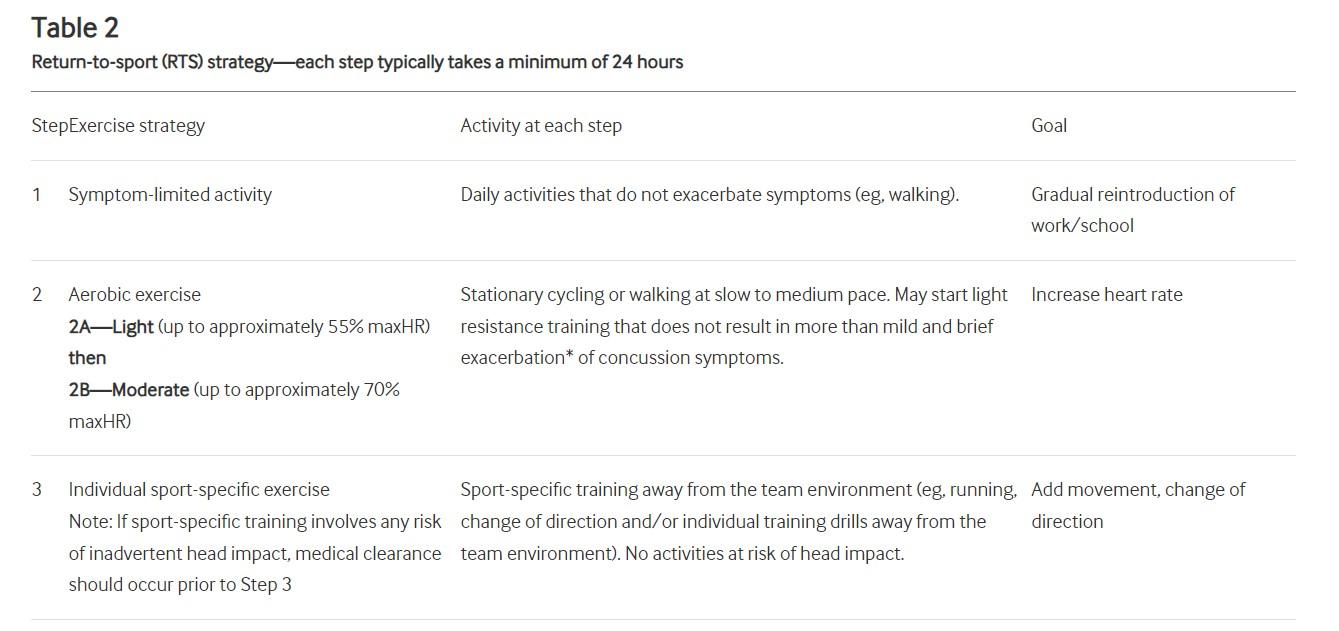
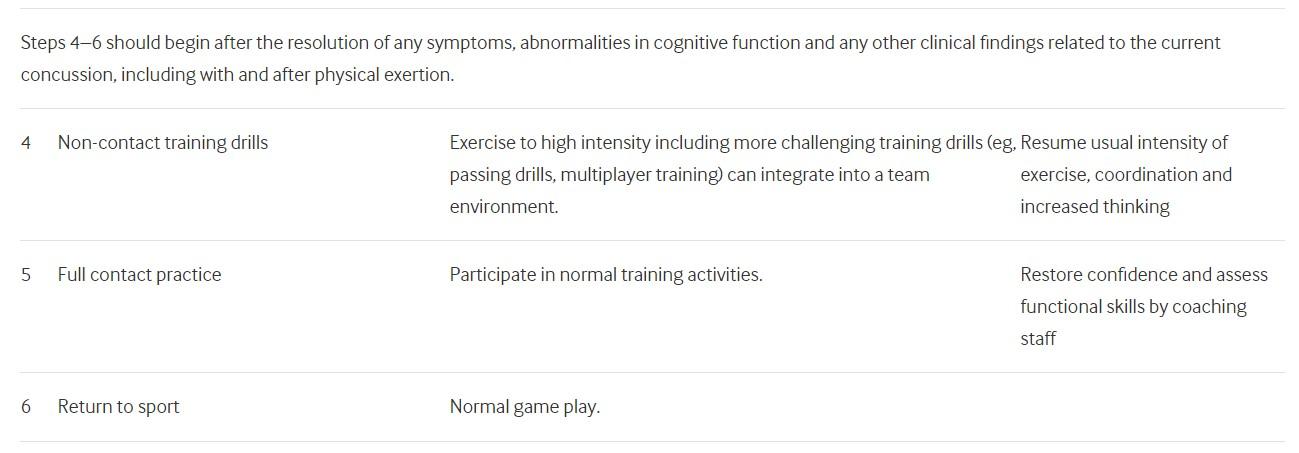
NOTE: If at any point the student-athlete becomes symptomatic
(more symptomatic than baseline), the team physician or designated
physician will be notified, and adjustments will be made to the
return-to-sport progression.
Prior to returning to full contact drills and competition, the
following steps must take place:
The student-athlete must retake the concussion testing that
was performed at the time of injury (SCAT6 or SCOAT6 and ImPACT)
and,
Based upon all test results and findings, the team
physician or the Health Center physician will declare the
student-athlete able to fully return to their sport.
Information may be transmitted to these health care
professionals electronically. Unrestricted return-to-sport should
not occur prior to unrestricted return-to-learn for concussions
diagnosed while the student-athlete is enrolled in classes. Prior
to receiving clearance to fully return to sport, the
student-athlete must sign an attestation form acknowledging that
they are attending class full-time and that they are not receiving
any further academic accommodations as a result of the
concussion.
Return to Learn Criteria
A student-athlete who has suffered a concussion will return to
the classroom/studying only as tolerated with modification of
schedule/academic accommodations, as indicated, with help from the
identified point-person in Athletics - typically either the
Director of Sports Medicine, or the Biola Athletic’s Concussion
Care Coordinator (ACCC), and the Health Center or Team Physician.
Campus resources and accommodations will be consistent with the
ADAAA and are administered through The Learning Center.
The student-athlete who has sustained a concussion will require
modified mental activity as they recover to a healthy state. It is
important to understand that return to Play and Return to Learn do
not always correlate in equity of time frames, although they often
parallel each other. There are no standardized guidelines for
returning the athlete to school, except that a student-athlete may
not resume full participation in sport prior to a full return to
the classroom. If the athlete develops increased symptoms with
cognitive stress, student-athletes may require academic
accommodations such as a reduced workload, extended test-taking
time, days off or a shortened school day. These accommodations
will be determined by the Learning Center based upon documentation
provided by the Health Center.
The below table is pulled from the Amsterdam Consensus
Statement on Sport Concussion regarding Return-to-Learn
Strategies.
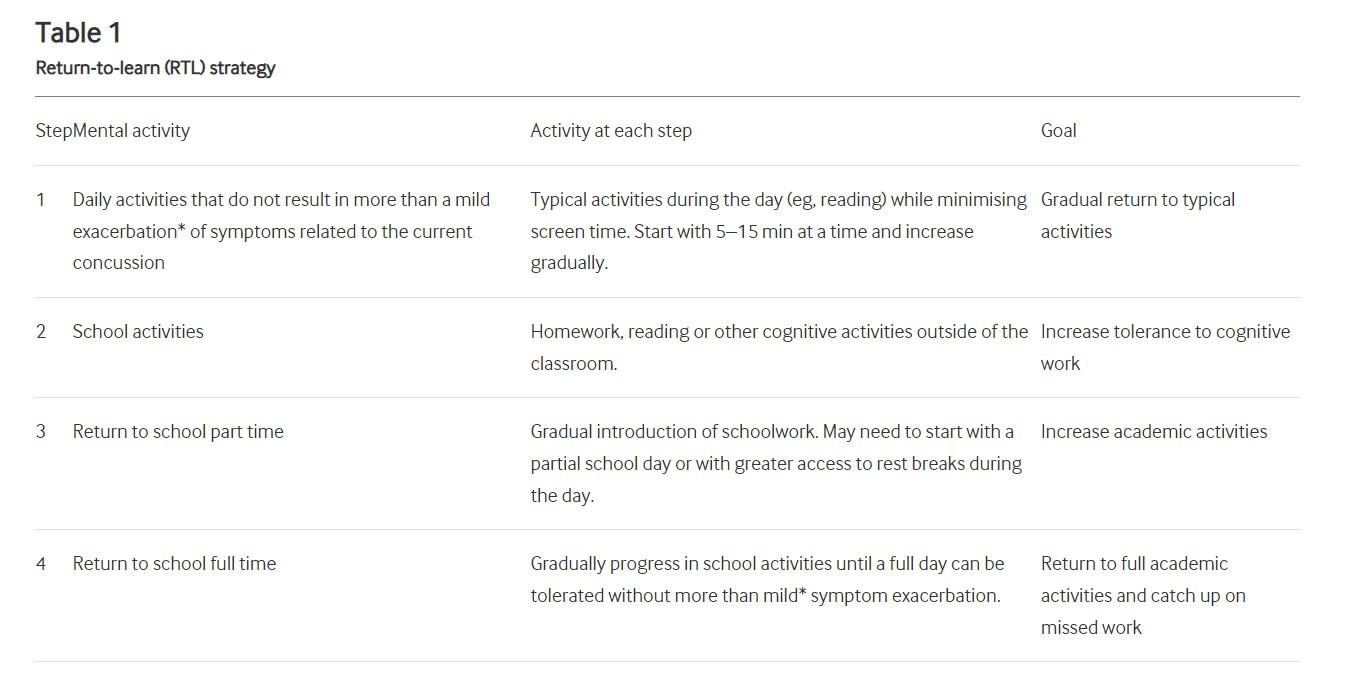
Returning the student to school, even if the day is shortened,
can be considered when the student can tolerate cognitive activity
or stimulation for approximately 30 to 45 minutes. This arbitrary
cutoff is based on the observation that a good amount of learning
takes place in 30-45 minute increments. Given that most
concussions resolve within three weeks of the injury, adjustments
may often be made in the individual classroom setting without
formal written plans such as a 504 plan or individualized
educational program (IEP). (2013-14 NCAA Sports Medicine Handbook,
p. 62) It is believed that light aerobic activity may actually be
stimulating to the mental recovery process. This protocol allows a
gradual increase in volume and intensity of classroom activity
during the Return to Learn process.
The student-athlete should not participate in classroom
activity on the same day as sustaining the concussion. Following
the day of sustaining the concussion, the student-athlete is then
allowed to return to school and academics in an individualized
manner following the guidance of their physician and the Health
Center. The student-athlete will be monitored for symptoms
throughout the recovery process.
Any student-athlete who has received a concussion will receive
the following support steps:
The student-athlete will then be instructed to schedule a
follow-up appointment with the Health Center. Additionally, the
student-athlete will receive a follow-up email from the ACCC with
general instructions and care recommendations.
The ACCC will also email the injured student-athlete’s
instructors to notify them that the student-athlete has received a
head injury and is in the process of working with the Health
Center and the Learning Center.
The Health Center will coordinate with the Learning Center
to determine any academic accommodations.
The Health Center will coordinate with the Athletic
Training staff to determine clearance for return to sport and
return to learn.
The student-athlete can progress to the graduated academic
return once symptoms improve while monitoring for symptoms
exacerbated by academic activities. If the student-athlete
completes all stages in the graduated protocol, then the team ATC
and team physician/Biola Health Center physician can allow the
student-athlete to return to school full-time.
When the student athlete has reached the point where they are
attending class full-time and are no longer receiving academic
accommodations (Stage 5 in the above progression), the
student-athlete will sign the Biola Athletics Completion of Return
to Learn Progression Attestation Form.
Overlap of RTS and RTL
The following chart is intended to clarify the parallel yet
distinct progression through RTS and RTL.
| Stage |
Location of Stage |
Academic (RTL) |
Description of RTL Stage |
Activity/ Sport (RTS) |
Description of RTS stage |
Tasks for ATC at each stage |
| 1 RTL |
Home/
Dorm |
Do Not Attend Class |
No mental exertion.No computer/phone, email, video games,
reading, homework, or testing. TOTAL REST until symptoms have
drastically improved or are within normal limits of baseline at
rest. Check in with ATC daily |
NO ACTIVITY |
TOTAL REST |
Daily Symptom Check In |
| 2 RTL |
Home/ Dorm |
Do NOT Attend Class |
Up to 30 minutes of mental exertion without triggering
symptoms. No prolonged concentration. Stay at home. No
driving.Check in with ATC daily |
Light Monitored Physical Activity as Tolerated |
Total Rest |
Daily Symptom Check In |
| 3 RTL |
School Part time |
Attend Class as able. May need to leave class early or attend
one per day. |
Homework for short periods of time with breaks. No exams.
Provide extra time, extra help, and modified assignments. |
Light Monitored Physical Activity as Tolerated |
Very light walking may be okay if directed by ATC and MD |
Daily Symptom Check In |
| 4 RTL / 1 RTS |
School: Part time/Full time.
Sport: monitored in ATR |
Attend Class Full Time |
Modified classroom exams. Moderate decreases of extra time,
extra help, and modification of assignments. |
Light aerobic activity |
15’-20’ of walking/ stationary cycling, no resistance
training. Continue to check in with ATC before and after
activity |
SCAT prior to activity, Daily Symptom Check in after
activity |
| 5 RTL / 2 RTS |
School: Full time
Sport: monitored on field/court |
Attend Class Full Time |
Normal Exams okay. No final exams. Continue to decrease extra
time/help/modification of assignments. May require more support in
academically challenging subjects |
Sport Specific Activity |
20’-30’ of dribbling, shooting, running, cutting, non-contact
solo work. Check in with ATC before and after activity |
Daily Symptom Check In |
| 3 RTS |
School: Full time
Sport: monitored on field/cour |
Attend Class Full Time |
Normal Exams okay. No final exams. Continue to decrease extra
time/help/modification of assignments. May require more support in
academically challenging subjects |
Non-Contact / walk through drills |
~45’ running set plays, non-live scrimmage. Continue to check
in with ATC before and after activity |
Daily Symptom Check In |
| 4 RTS |
School: Full time
Sport: monitored on field/cour |
Attend Class Full Time |
Normal Exams okay. No final exams. Continue to decrease extra
time/help/modification of assignments. May require more support in
academically challenging subjects |
Monitored Full-Contact Practice |
60’-90’ Full practice. Continue to check in with ATC before
and after activity |
Daily Symptom Check In. SCAT redone after full practice |
| 6 RTL / 5 RTS |
School: Full Time
Sport: field/court/area of competition |
Attend Class Full Time |
No Accommodations. Attend all classes, full homework. All
exams okay |
Return to Competition |
Full competition allowed after MD clearance is acquired. |
Athlete and ATC sign Completed RTL Attestation Form prior to
full competition. |
Following an initial period of relative rest (24–48 hours
following an injury at Step 1), athletes can begin a gradual and
incremental increase in their cognitive load. Progression through
the strategy for students should be slowed when there is more than
a mild and brief symptom exacerbation.
*Mild and brief exacerbation of symptoms is defined as an
increase of no more than 2 points on a 0–10 point scale (with 0
representing no symptoms and 10 the worst symptoms imaginable) for
less than an hour when compared with the baseline value reported
prior to cognitive activity.
Prolonged Symptoms of
Concussion
A student-athlete with atypical presentation or persistent
symptoms will be re-evaluated by a physician in order to consider
additional diagnoses, best management options, and consideration
of a referral. Additional diagnoses may include, among others:
fatigue and/or sleep disorder, migraine or other headache
disorders; mental health symptoms and disorders; ocular
dysfunction; vestibular dysfunction, cognitive impairment; and
autonomic dysfunction.
Specific recommendations include:
The term ‘persisting symptoms’ is used for symptoms that
persist >4 weeks across children, adolescents and
adults.
Persisting symptoms can be assessed using standardized and
validated symptom rating scales. However, evidence-based
recommendations regarding the use of other specific tests or
measures in the clinical diagnosis of persisting symptoms in any
age group are not possible based on existing research.
A multimodal clinical assessment, ideally by a
multidisciplinary team, is indicated to characterize individuals
with persisting symptoms, including the types, pattern and
severity of symptoms, and any associated conditions or other
factors that may be causing or contributing to the symptoms.
(Amsterdam, 2022)
If any student-athlete is having a prolonged inability to
return to normal academic classroom activity, they will be
referred to the team physician for further evaluation or referral.
In the absence of the team physician, the university's Health
Center physician will be consulted for further recommendations.
Any additional necessary academic accommodations will be
determined by the Biola Learning Center.
Prolonged symptoms may include emotional and spiritual
complications, The Biola Student Care Team ( https://www.biola.edu/student-care)
is best equipped to assist in these areas. The Student Care Team
collaborates care between the Health Center, the Biola Counseling
Center, and Pastoral Care. Pastoral Care is a unique resource
available to student-athletes who would like to confidentially
talk through struggles they may be facing. Another resource for
the student-athlete is the Faculty Athletic Representative (FAR),
who can be called upon to mediate any issues that arise between
academic faculty and the concussed student-athlete.
Limiting Exposure to Head Trauma
Biola is committed to protecting the health of and providing a
safe environment for each of its participating NCAA
student-athletes. To this end, and in accordance with NCAA
association-wide policy, Biola will limit student-athlete head
trauma exposure in a manner consistent with Interassociation
Recommendations: Preventing Catastrophic Injury and Death in
Collegiate Athletes. For example:
Biola athletic teams will adhere to existing ethical
standards in all practices and competitions.
Using playing or protective equipment (including the
helmet) as a weapon will be prohibited during all practices and
competitions.
Deliberately inflicting injury on another player will be
prohibited in all practices and competitions.
All playing and protective equipment (including helmets),
as applicable, will meet relevant equipment safety standards and
related certification requirements.
Sickle Cell Trait Testing
Introduction
Sickle cell disease is a mutation in hemoglobin, which in turn
affects the shape of red blood cells. Those with Sickle Cell trait
have only one abnormal gene from one of the parents and usually
have normal red blood cells. During intense exertion or exertion
at extreme conditions, those with Sickle Cell trait can change the
shape of the red cells from round to quarter-moon or “sickle.”
This change, exertional sickling, can pose grave risk for some
athletes. Exertional sickling causes a blockage of the blood
vessels resulting in damage to multiple organs including muscle
causing ischemic rhabdomyolysis, the rapid breakdown of muscles
starved of blood. Sickling can begin within 2–3 minutes
of any all-out exertion. Heat, dehydration, altitude and asthma
can increase the risk for and worsen sickling, even when exercise
is not all-out. Collapse due to exertional sickling is a medical
emergency and death can occur quickly. Due to the above risks, it
is important to know the Sickle Cell trait status of all
student-athletes.
Sickle
Cell Trait Testing/Screening, Notification, and Education
Procedures
In compliance with NCAA Bylaw 17.1.5.1, Biola Athletics
requires all student-athletes to have documentation of a Sickle
Cell solubility test (SST) as part of his or her pre-participation
physical examination. Prospective student-athletes participating
in tryout activities also must have documentation prior to
participation.
Documentation must be present before the
student-athlete is permitted to participate in any athletically
related activities including, but not limited to, tryouts,
practices, strength and conditioning sessions and/or competition
in any intercollegiate athletic events.
Testing Process:
If a student-athlete has not been tested for Sickle Cell trait
or if he or she is unable to access previous test results, the
student-athlete should make an appointment with their primary care
physician or local testing facility to be tested for Sickle Cell
trait.
As of today, all 50 states have newborn screening programs that
identify Sickle Cell trait status at birth. However, not all
states adopted screening in the same year. In the state of
California, if the student-athlete was born after Feb. 21, 1990,
results may be available from the student-athlete’s pediatrician.
It is recommended that the student-athlete call his or her
pediatrician prior to submitting any request to ask if they have
results on file. If not available, contact the state office of
public health. If the student-athlete was not born in California,
he or she should contact his or her pediatrician for results.
As noted above, the pediatrician should be called first to ask
if they have results on file. If not available, contact the
state.
After a student-athlete has received his or her results, he or
she must fax or email a copy of the documentation to the Director
of Sports Medicine/Athletics Health Care Administrator.
Positive
Test Notification, Counseling and Education Process
Student-athletes who are confirmed to have Sickle Cell trait
will meet with a Biola University team physician at the earliest
available opportunity for notification, education and
counseling.
The student-athlete, team physician and a Biola athletic
trainer must sign the Sickle Cell Notification Form at the time of
notification. If the student-athlete is a minor, his or her parent
or legal guardian will also be notified of the student-athlete’s
Sickle Cell status and must also sign the Sickle Cell Notification
Form.
A complete list of student-athletes with Sickle Cell trait and
other medical alert issues must be distributed to the following
individuals at the beginning of each semester:
Athletic training staff
Coaching staff of the student-athlete
Strength and conditioning staff (if applicable)
Student athletic trainers (if applicable)
Athletic Training
Personnel Education
In-service training and review will be conducted for
athletic training personnel at minimum on a yearly basis and/or as
needed.
In-service training and review will include, but will not
be limited to:
NCAA Division II and Conference policy review
Sickle cell trait background and review of
literature
Likely sickling settings
Signs and symptoms and differential diagnosis
Practical management and first aid
Case specific education
Coaching Staff Education
In-service training will be conducted with assistant
coaches with strength and conditioning responsibilities (if
applicable) and coaching staff personnel at minimum on a yearly
basis and/or as needed.
In-service training will include, but will not be limited
to:
NCAA and conference policy review
Sickle cell trait background and review of
literature
Likely sickling settings
Signs and symptoms and differential diagnosis
Practical management and first aid
Case specific education
Differential Diagnosis
| Sickling vs. Cramping: |
|
|
| |
Sickling |
Heat Cramps |
| Onset |
Usually immediate, with no early warning; may
occur early in workout |
Student-athlete usually feels
twitching/twinges in tired muscles
minutes to hours before onset |
| Pain |
Increasing pain and weakness in the working
muscles, esp. the legs, buttocks and/or low back; ischemic pain
from insufficient blood flow to working muscles |
"Burning" type pain |
| Collapse |
Athlete “slump to a stop” due to the legs becoming
weak, wobbly and no longer able to hold up the athlete; sometimes
will still be talking while on the ground |
“Hobble to a halt”; fully-contracted
muscles no longer work |
| Physical findings |
Soft, flaccid muscle tone |
Sustained, full contraction of
muscles (tetany) |
| Response |
Athlete may feel better after 10–15 minutes in a
cold tub, supplemental oxygen and fluids |
Usually takes longer to resolve,
even with aggressive cooling and
stretching of the affected muscles |
Conditioning Guidelines
Adjust the work/rest cycle to accommodate for environmental
(heat, altitude) or personal (illness, asthma, hydration) issues.
An adequate rest time is necessary in managing SCT
student-athletes. Adjustments to actual rest time should be made
based on recommendations from the athletic training staff based on
the specific activity being performed.
No punitive conditioning for SCT student-athletes
Medical staff and coaches should collaborate to determine
individual progressions for sports with SCT
student-athletes.
Practice/Game Guidelines
The staff athletic trainer and the student-athlete will
meet prior to the SCT student-athlete’s participation to discuss
and document sport-specific issues related to management of SCT
student-athletes during practices and games that are not addressed
by the statements listed above regarding conditioning. Management
decisions will be communicated to the student-athlete and all
appropriate coaches.
Sport-specific management guidelines for SCT
student-athletes should be sent to the team’s coaching staff, the
strength and conditioning coaches and the Director of Sports
Medicine/Athletics Health Care Administrator.
Management of Symptoms
The SCT student-athlete will report all symptoms
immediately to the athletic trainer or coach.
The medical staff and coaches should have a low threshold
for removal of SCT student-athlete from activity.
Discontinue activity at onset of symptoms (e.g., cramping,
pain, swelling, weakness, tenderness, fatigue, shortness of
breath, abdominal pain) or difficulty completing
repetitions.
Any SCT student-athlete that is identified as struggling or
performing below standard by a coach will be removed from the
drill.
Following removal from participation:
Check vital signs.
Cool the student-athlete, if necessary.
Continue self-hydration as able.
Administer high-flow oxygen (if available), preferably with
a non-rebreather facemask. Oxygen may be applied by M.D. or ATC
(with physician orders).
Activate emergency action plan for any signs and symptoms
related to decreased mental capacity or vital signs.
Communicate SCT status to EMTs and ER physicians so this
will be included in their evaluation and treatment plan.
Return to
Play Following Removal from Participation
Emergency Treatment
First Aid for Sickling Emergencies:
Consider any struggling, cramping or collapse as sickling
until proven otherwise.
Act fast! A sickling collapse is a medical
emergency.
Call EMS — someone from medical staff accompanies athlete
to hospital
Check vital signs/monitor ABCs
Give supplemental oxygen (if available)
Cool the student-athlete if necessary
Attach an AED
IV fluids (if available)
Referenced Documents:
Emergency
Care of the Injured Student-Athlete: General Steps
Coach or ATC (if on scene) should contact Campus Safety
immediately if a student-athlete is not breathing or is in cardiac
arrest. Coaches should have Campus Safety’s emergency phone number
in their cell phone: (562) 777-4000 or ext. 5111 from a campus
phone. He or she should have a second individual (assistant coach)
contact the team assigned AT via their personal cell phone or the
Director of Sports Medicine at (562) 944-0351 ext. 5942 or ext.
5942 from a campus phone.personal cell phone. All coaching staff
should have these phone numbers saved in “contacts” on their cell
phone.
AT/coach should perform required first aid/CPR.
AT should perform the secondary survey once patient’s vital
signs stabilize.
Athletic facilities staff, Campus Safety and coaches should
control the crowd and make sure the emergency personnel will be
able to access the site.
Discontinue patient care only on the direct order of the
EMS personnel, but remain present to assist as needed.
Find out the exact hospital where the patient will be
transported (see transportation section above). Arrange to
accompany the patient on approval of the senior staff member. Take
the student-athlete's emergency card to the hospital. If the
student-athlete’s parent is present, they will accompany the
student-athlete to the hospital. An assistant coach may also
accompany the student-athlete to the hospital. ATC is not to leave
competition or ATR if secondary coverage is unavailable.
ATC will contact the Director of Sports Medicine/Athletics
Health Care Administrator to inform him/her of the incident and
arrange notification of the student-athlete’s family.
Attending ATC will make initial contact with the
student-athlete’s emergency contact after diagnosis is
made.
At the hospital, be available to provide/assist with
information for the medical staff. Make every effort to be with
the student-athlete at all times.
Emergency Action
Plan for Specific Sites
Chase
Gymnasium: Volleyball and basketball venue
Emergency Personnel
A certified athletic trainer (ATC) will be on site for all
intercollegiate competition. In the event of an emergency during
practice an ATC may be reached in the Athletic Training Room (ATR)
located on the exterior southeast corner of the gymnasium
(Building #18 on campus map) or by phone at (562) 944-0351 x5942.
Campus Safety will be notified at (562) 777-4000 or ext. 5111 from
a campus phone in the event of an emergency. Campus Safety will
contact 911, activate the Emergency Medical System and notify the
Student Health Center. Campus Safety will escort emergency
personnel/ambulance to the gymnasium. Ambulance access will be by
ramp accessible through Parking Lot O near the northeast corner
or, alternately, Chase Way to the front entrance of Chase
Gymnasium (as determined by Campus Safety).
Venue Location
Located on the east end of Biola University’s campus, Chase
Gymnasium is located south of Parking Lot O and north of Parking
Structure “S” on University Drive. The ATR has an exterior entry
at the southeast corner of Chase Gymnasium on Chase Way off of
University Drive.
Emergency Communication
The ATC will have a cell phone during intercollegiate
competition and coaches will carry a cell phone during practices.
An emergency landline is located on the exterior northeast face of
the gymnasium. The Campus Safety emergency line is (562) 777-4000
or ext. 5111 from a campus phone.
Emergency Equipment
The following equipment will be available on the home sideline
during games/matches, and in the ATR during practices.
Automated External Defibrillator (AED, located inside gym
on northeast wall)
Decompression splints
Biohazard kit
Roles of the First Responder(s): ATC
during competition/coach during practice
Provide immediate and continued care of the injured or ill
student-athlete. Yield to and provide information to individuals
with higher medical training upon their arrival.
Activation of Emergency Action Plan
Call Campus Safety at (562) 777-4000 or ext. 5111 from a
campus phone.
Provide information to Campus Safety.
Name, age, sport, other personal information of
student-athlete
Exact location, number of persons injured, current
condition of injured, care being provided, other pertinent
information
Direct the retrieval of emergency equipment as
needed.
Request assistance of game management as needed for crowd
control.
Delineation of Medical
Assistance
The athletic training staff will assist only those varsity
athletes directly involved in practice and/or competition for home
and visiting teams.
All other medical aid (spectators, halftime entertainment,
etc.) will be directed by Campus Safety according to their normal
protocol.
Al Barbour
Field: Soccer and Track Complex
Emergency Personnel
A certified athletic trainer (ATC) will be on site for all
intercollegiate competition. In the event of an emergency during
practice an ATC may be reached in the Athletic Training Room (ATR)
located on the exterior southeast corner of the gymnasium
(Building #18 on campus map) or by phone at (562) 944-0351 x5942.
Campus Safety will be notified at (562) 777-4000 or ext. 5111 from
a campus phone in the event of an emergency. Campus Safety will
contact 911, activate the Emergency Medical System and notify the
Student Health Center. Campus Safety will escort emergency
personnel/ambulance to the soccer/track complex. Ambulance access
will be the ramp located at the southwest corner of the track
complex. Ambulances are not allowed on the track or
soccer field surfaces.
Venue Location
Located on the east side of Biola University’s campus, the Al
Barbour Field/track and field complex (Structure 16) is located
north of Parking Lot S on University Drive. The ATR is located on
the southeast corner of gymnasium (Building #18 on campus map) off
University Drive.
Emergency Communication
The ATC will have a cell phone during intercollegiate
competition and coaches will carry a cell phone during practices.
An emergency landline is located on the exterior northeast face of
the gymnasium. The Campus Safety emergency line is (562) 777-4000
or ext. 5111 from a campus phone.
Emergency Equipment
The following equipment will be available on the home sideline
during games/matches, and in the ATR during practices.
Automated External Defibrillator (AED also located inside
gym on northeast wall)
Decompression splints
Biohazard kit
Roles of the First Responder(s): ATC
during competition/coach during practice
Provide immediate and continued care of the injured or ill
student-athlete. Yield to and provide information to individuals
with higher medical training upon their arrival.
Activation of Emergency Action Plan
Call Campus Safety at (562) 777-4000 or ext. 5111 from a
campus phone.
Provide information to Campus Safety.
Name, age, sport, other personal information of
student-athlete
Exact location, number of persons injured, current
condition of injured, care being provided, other pertinent
information
Direct the retrieval of emergency equipment as
needed.
Request assistance of game management as needed for crowd
control.
Delineation of
Medical Assistance
The athletic training staff will assist only those varsity
athletes directly involved in practice and/or competition for home
and visiting teams.
All other medical aid (spectators, halftime entertainment,
etc.) will be directed by Campus Safety according to their normal
protocol.
Eagles Diamond: Baseball
Field
Emergency Personnel
A certified athletic trainer (ATC) will be on site for all
intercollegiate competition. In the event of an emergency during
practice an ATC may be reached in the Athletic Training Room (ATR)
located on the exterior southeast corner of the gymnasium
(Building #18 on campus map) or by phone at (562) 944-0351 x5942.
Campus Safety will be notified at (562) 777-4000 or ext. 5111 from
a campus phone in the event of an emergency. Campus Safety will
contact 911, activate the Emergency Medical System and notify the
Student Health Center. Campus Safety will escort emergency
personnel/ambulance to the baseball field. Ambulance access is
through a gate on the first baseline, via Sixth Street Way,
between the field and Hope Hall.
Venue Location
Located on the east side of Biola University’s campus, the
baseball field complex (location 65 on campus map) is located
south of Parking Lot H, on University Drive. The Athletic Training
Room is located on the southeast corner of gymnasium (Building #18
on campus map), off University Drive.
Emergency Communication
The ATC will have a cell phone during intercollegiate
competition and coaches will carry a cell phone during practices.
An emergency landline is located on the exterior northeast face of
the gymnasium. The Campus Safety emergency line is (562) 777-4000
or ext. 5111 from a campus phone.
Emergency Equipment
The following equipment will be available on the home sideline
during games/matches, and in the ATR during practices.
Automated External Defibrillator (AED also located inside
gym on northeast wall)
Decompression splints
Biohazard kit
Roles of the First Responder(s): ATC
during competition/coach during practice
Provide immediate and continued care of the injured or ill
student-athlete. Yield to and provide information to individuals
with higher medical training upon their arrival.
Activation of Emergency Action Plan
Call Campus Safety at (562) 777-4000 or ext. 5111 from a
campus phone.
Provide information to Campus Safety.
Name, age, sport, other personal information of
student-athlete
Exact location, number of persons injured, current
condition of injured, care being provided, other pertinent
information
Direct the retrieval of emergency equipment as
needed.
Request assistance of game management as needed for crowd
control.
Delineation of
Medical Assistance
The athletic training staff will assist only those varsity
athletes directly involved in practice and/or competition for home
and visiting teams.
All other medical aid (spectators, halftime entertainment,
etc.) will be directed by Campus Safety according to their normal
protocol.
Tennis Center
Emergency Personnel
A certified athletic trainer (ATC) will be on site for all
intercollegiate competition. In the event of an emergency during
practice an ATC may be reached in the Athletic Training Room (ATR)
located on the exterior southeast corner of the gymnasium
(Building #18 on campus map) or by phone at (562) 944-0351 x5942.
Campus Safety will be notified at (562) 777-4000 or ext. 5111 from
a campus phone in the event of an emergency. Campus Safety will
contact 911, activate the Emergency Medical System and notify the
Student Health Center. Campus Safety will meet and escort
emergency personnel/ambulance to the Tennis Center.
Emergency vehicle access
Campus Entrance 5 to Lot C off Biola Avenue (nearest cross
street is Roma Drive). Proceed through parking lot gate. Tennis
Center (and tennis parking lot) is located on the right as you
pass through gate.
Venue Location
Located on the southern end of Biola University’s campus, the
Tennis Center is located south of Parking Lot C. The ATR is in the
gymnasium building on Chase Way, off of University Drive.
Emergency Communication
The Athletic Training staff will have a cell phone during
intercollegiate competition and coaches will carry a cell phone
during practices. A campus phone is located outside the storage
shed at the tennis complex. The Campus Safety emergency line is
(562) 777-4000 or ext. 5111 from a campus phone.
Emergency Equipment
The following equipment will be available on the home sideline
during games, and in the Athletic Training Room during
practices.
a. Automated External Defibrillator (AED also located inside
gym on northeast wall)
b. Decompression splints
c. Biohazard kit
Roles of the First Responder(s): ATC
during competition/coach during practice
Provide immediate and continued care of the injured or ill
student-athlete. Yield to and provide information to individuals
with higher medical training upon their arrival.
Activation of Emergency Action Plan
Call Campus Safety at (562) 777-4000 or ext. 5111 from a
campus phone.
Provide information to Campus Safety.
Name, age, sport, other personal information of
student-athlete
Exact location, number of persons injured, current
condition of injured, care being provided, other pertinent
information
Direct the retrieval of emergency equipment as
needed.
Request assistance of game management as needed for crowd
control.
Delineation of
Medical Assistance
The athletic training staff will assist only those varsity
athletes directly involved in practice and/or competition for home
and visiting teams.
All other medical aid (spectators, halftime entertainment,
etc.) will be directed by Campus Safety according to their normal
protocol.
Freedom Field: Softball
Complex
Emergency Personnel
A certified athletic trainer (ATC) will be on site for all
intercollegiate competition. In the event of an emergency during
practice an ATC may be reached in the Athletic Training Room (ATR)
located on the exterior southeast corner of the gymnasium
(Building #18 on campus map) or by phone at (562) 944-0351 x5942.
Campus Safety will be notified at (562) 777-4000 or ext. 5111 from
a campus phone in the event of an emergency. Campus Safety will
contact 911, activate the Emergency Medical System and notify the
Student Health Center. Campus Safety will meet and escort
emergency personnel/ambulance to the softball complex.
Emergency vehicle access
Campus Entrance 5 to lot C off Biola Avenue (nearest cross
street is Roma Drive). Proceed through parking lot to removable
bollards located between portable buildings, designated (54 on
campus map). Pass between buildings and pass to left of sand
volleyball court (61 on campus map). Field access is through
outfield fence along the first baseline. Gurney only allowed
through the gate.
Venue Location
Located on the southern end of Biola University’s campus, the
Freedom Field Softball Complex is located southeast of Parking Lot
C. The ATR is in the gymnasium building on Chase Way, off
University Drive.
Emergency Communication
The ATC will have a cell phone during intercollegiate
competition and coaches will carry a cell phone during practices.
The nearest campus phone is located at the tennis complex. The
Campus Safety emergency line is (562) 777-4000 or ext. 5111 from a
campus phone.
Emergency Equipment
The following equipment will be available on the home sideline
during games, and in the Athletic Training Room during
practices.
Automated External Defibrillator (AED also located inside
gym on northeast wall)
Decompression splints
Biohazard kit
Roles of the First Responder(s): ATC
during competition/coach during practice
Provide immediate and continued care of the injured or ill
student-athlete. Yield to and provide information to individuals
with higher medical training upon their arrival.
Activation of Emergency Action Plan
Call Campus Safety at (562) 777-4000 or ext. 5111 from a
campus phone.
Provide information to Campus Safety.
Name, age, sport, other personal information of
student-athlete
Exact location, number of persons injured, current
condition of injured, care being provided, other pertinent
information
Direct the retrieval of emergency equipment as
needed.
Request assistance of game management as needed for crowd
control.
Lansing Pool:
Swimming and Diving Facility
Emergency Personnel
A certified athletic trainer (ATC) will be on site for all
intercollegiate competition. In the event of an emergency during
practice an ATC may be reached in the Athletic Training Room (ATR)
located on the exterior southeast corner of the gymnasium
(Building #18 on campus map) or by phone at (562) 944-0351 x5942.
Campus Safety will be notified at (562) 777-4000 or ext. 5111 from
a campus phone in the event of an emergency. Campus Safety will
contact 911, activate the Emergency Medical System and notify the
Student Health Center. Campus Safety will escort emergency
personnel/ambulance to the aquatic center. Ambulance access will
be the ramp located at the southwest corner of the track
complex.
Venue Location
Located on the south side of Biola University’s campus, the
Lansing Pool is located south of the gymnasium (Building #18 on
campus map). The ATR is located on the southeast corner of
gymnasium (Building #18 on campus map), off University Drive.
Emergency Communication
The athletic training staff will have a cell phone during
intercollegiate competition and coaches will carry a cell phone
during practices. An emergency phone is located on the northeast
face of wall of the pool deck.
Emergency Equipment
The following equipment will be available during meets, and in
the Athletic Training Room during practices.
Automated External Defibrillator (AED also located inside
gym on northeast wall)
Decompression splints
Biohazard kit
Roles of the First Responder(s): ATC
during competition/coach during practice
Provide immediate and continued care of the injured or ill
student-athlete. Yield to and provide information to individuals
with higher medical training upon their arrival.
Activation of Emergency Action Plan
Call Campus Safety at (562) 777-4000 or ext. 5111 from a
campus phone.
Provide information to Campus Safety.
Name, age, sport, other personal information of
student-athlete
Exact location, number of persons injured, current
condition of injured, care being provided, other pertinent
information
Direct the retrieval of emergency equipment as
needed.
Request assistance of game management as needed for crowd
control.
Delineation of
Medical Assistance
The athletic training staff will assist only those varsity
athletes directly involved in practice and/or competition for home
and visiting teams.
All other medical aid (spectators, halftime entertainment,
etc.) will be directed by Campus Safety according to their normal
protocol.
Emergency
Action Plan for Splash Aquatic Center
Emergency Personnel
A certified athletic trainer will not be present for most
practices. In the event of an emergency during a practice, follow
the procedures of the Splash Aquatic Center facility. Each coach
utilizing SAC should be familiar with the specific protocols of
the facility. Coaches should be familiar with the location of the
on-duty lifeguards. The coach should know the address of the
facility to give to the 911 operator. In the event of a non-life
threatening emergency, such as an orthopedic issue, the coach
should contact their team’s specific sport assigned athletic
trainer directly. The coach is responsible for having the phone
number of their athletic trainer.
Venue Location
13806 La Mirada Blvd, La Mirada, CA 90638
Emergency Communication
Coaches should have a cell phone with them at all times when
travelling off campus with their teams in order to summon
emergency help if needed.
Emergency Equipment
A member of the coaching staff should be certain that they have
their team’s athletic training kit with them when off site. The AT
kit contains basic first aid supplies, biohazard materials (such
as gloves), and a CPR mask.
Roles of the First Responder(s): AT
if with the team/Coach in absence of AT.
Provide immediate and continued care of the injured or ill
student-athlete. Yield to and provide information to individuals
with higher medical training upon their arrival.
Notify the facility staff (lifeguard) of the emergency so
that they may assist in implementing their emergency plans and
assist in directing emergency personnel to the correct
location
Activation of Emergency Action Plan (according to Splash
protocols, follow lifeguard instruction)
Call 911 (if instructed by lifeguard)
Provide information to 911 operator
Name, age, sport, other personal information of
student-athlete
Exact location, number persons injured, current condition
of injured, care being provided, other pertinent
information
Once the situation is resolved and the athlete is in the
care of medical personnel, the coach should notify their primary
AT ASAP to notify them of the incident.
Emergency Action
Plan for Off Campus
Emergency Personnel
A certified athletic trainer will not be present for most off
campus practices. In the event of an emergency during an
off-campus practice, follow the procedures of the practice
facility. Each coach utilizing an off campus site should be
familiar with the specific protocols of the facility. In most
cases, this will be a direct call to 911. The coach should know
the address of the facility to give to the 911 operator. In the
event of a non-life threatening emergency, such as an orthopedic
issue, the coach should contact their team's specific sport
assigned athletic trainer directly. The coach is responsible for
having the phone number of their athletic training.
Venue Location
Varies with team.
Emergency Communication
Coaches should have a cell phone with them at all times when
travelling off campus with their teams in order to summon
emergency help if needed.
Emergency Equipment
A member of the coaching staff should be certain that they have
their team’s athletic training kit with them when off site. The AT
kit contains basic first aid supplies, biohazard materials (such
as gloves), and a CPR mask.
Roles of the First Responder(s): ATC
if with the team/Coach in absence of ATC.
Provide immediate and continued care of the injured or ill
student-athlete. Yield to and provide information to individuals
with higher medical training upon their arrival.
Activation of Emergency Action Plan
Call 911
Provide information to 911 operator
Name, age, sport, other personal information of
student-athlete
Exact location, number persons injured, current condition
of injured, care being provided, other pertinent
information
Notify the facility staff of the emergency so that they may
assist in implementing their emergency plans and assist in
directing emergency personnel to the correct location.
Once the situation is resolved and the athlete is in the
care of medical personnel, the coach should notify their primary
AT ASAP to notify them of the incident.
Inclement
Weather and Air Quality Policy
Lightning Policy
The National Severe Storms Laboratory and the National Athletic
Trainers Association recommend determining an effective means of
monitoring local weather to help determine when cover should be
taken. The primary methodology is to use current technology to be
notified of impending inclement weather. WeatherBug App or Storm
Radar, a free app available through The Weather Channel can be
configured to notify individuals when lightning is entering a
predetermined mile radius. This, or an equivalent notification
system should be utilized by athletic training staff and
coaches.
The secondary means to detect lightning is the flash-to-bang
method. To determine flash to bang begin counting when sighting of
lightning flash. Counting is stopped when the associated bang
(thunder) is heard. Divide this count by five to determine the
distance to the lightning flash (in miles). Monitor local weather
reports each day before any practice or event. Be aware of
potential thunderstorms that may form during scheduled
intercollegiate athletics events or practices. Weather information
can be found through various means via local television news
coverage, the Internet, cable and satellite weather programming,
or the National Weather Service website at www.weather.gov.
Example: a flash-to-bang count of forty seconds equates to a
distance of eight (8) miles.
Criteria for Suspension of Activity
By the time it reaches 6 miles and/or the flash-to-bang count
approaches 30 seconds or less, all individuals should immediately
seek the recommended safe structure or location. An activity will
be postponed or suspended when a thunderstorm appears imminent
before or during an activity/contest (regardless of whether
lightning is seen or thunder heard) until the hazard has passed.
Signs of imminent thunderstorm activity are darkening clouds, high
winds, and thunder or lightning activity.
Chain of Command
The responsibility of the Director of Sports Medicine/Athletics
Health Care Administrator, (or in their physical absence, staff
athletic trainers) at Biola University will be to obtain weather
reports with any anticipation of inclement weather and inform the
head coach and game officials in charge and the visiting team’s
athletic trainer or head coach of concerns and any subsequent
change within the situation. Whenever possible the Director of
Sports Medicine/Athletics Health Care Administrator (or AT staff)
will advise the coaching staff and administration via email by
noon of the potential of inclement weather, including possible
lightning.
Whenever possible, the Director of Sports Medicine/Athletics
Health Care Administrator will advise the coach supervising the
activity as to the danger and proximity of lightning threat.
However, the responsibility still remains with the supervising
coaches to remove their teams or individuals from a field or event
site. With the information and background on lightning presented
in this policy, the coach or athletic trainer, or both, can make
an intelligent and safe decision regarding the removal of a team
or individuals from an athletic site or the stopping of play
during dangerous thunderstorm activity.
Practices
Upon the first sign of lightning or thunder activity a
certified athletic trainer will inform the coach of current
weather conditions and when the current “flash-to-bang” count
reaches 30 seconds the certified athletic trainer will inform the
coach that it is no longer safe to participate in outdoor
activities. If the decision is made to clear the field, then all
student-athletes, coaches, and staff members should seek shelter
at the recommended areas listed below.
Games
Prior to start of competition, the decision to delay start of
game due to adverse weather conditions will be decided by the
athletic trainer on site with assistance from the game management
team and sport officials following discussion. Once game has
begun, decision to postpone game due to adverse weather conditions
will be decided by the head official with input from the athletic
trainer and game management team. If the decision is made to clear
the field, then all student-athletes, coaches, fans and staff
members should seek shelter at the recommended areas listed below.
The responsibility of removing student-athletes from a practice
area due to the threat of lightning lies with the head coach of
that particular sport. In the event that the head coach is not
present, an assistant coach designated by the head coach will
assume responsibility. Game management should make an announcement
to spectators declaring evacuation conditions and instructing the
public to safe space (buildings or personal vehicles).
Appropriate Shelter/By Venue
A safe shelter location is any substantial, frequently
inhabited building. The building should have four solid walls (not
a dug out), including electrical and telephone. Secondary choice
for a safe location from the lightning hazard is a fully enclosed
vehicle with a metal roof and the windows completely closed. It is
important to not touch any part of the metal framework of the
vehicle while inside it during ongoing thunderstorms. It is not
safe to shower, bathe or talk on a landline phone while inside a
safe shelter during a thunderstorm (cell phones are OK). The list
below shows the designated locations for evacuating outdoor Biola
University outdoor athletics.
During evacuation, individuals who feel their hair stand on end
or skin tingle or hear crackling noises should assume the
lightning-safe position. The position is crouched on the ground,
weight on the balls of feet, feet together, head lowered and
covered. DO NOT LIE FLAT ON THE GROUND! You must minimize the
amount of contact that you have with the ground.
Recommended Evacuation Locations
| Sport |
Evacuation
Location |
Optional |
| Soccer/Track/Field |
Chase Gymnasium/locker rooms |
car/vehicle |
| Swimming pool |
Chase Gymnasium/locker rooms |
car/vehicle |
| Baseball |
Hope Hall |
car/vehicle |
| Softball |
Home locker room/Grove
buildings |
car/vehicle |
| Tennis |
Tennis office/Grove buildings |
car/vehicle |
| Cross Country |
Nearest building |
car/vehicle |
| Track Throws Facility |
Nearest building |
car/vehicle |
| Splash Aquatic Center (SAC) |
Nearest building |
car/vehicle |
Criteria for Return to Activity
If a game, practice or other activity has been suspended or
postponed, wait at least 30 minutes (5 miles away) after the last
sound of thunder or lightning flash before resuming an activity or
returning outdoors. Each time lightning is seen or thunder is
heard the 30-minute clock should be reset. The athletic trainer on
site is responsible for monitoring the weather.
Managing Victims of Lightning Strikes
In the event that a person is struck by lightning, proper care
should be given. Lightning strike victims do not remain connected
to a power source; they do not carry an electric charge and may be
safely handled. However, personal safety must be considered before
venturing into a dangerous situation to render care. If the
decision is made to render aid, the first priority should be to
move the victim to a safe location. It is imperative to treat
lightning victims promptly. In the case of a lightning strike
incident in which there are multiple victims, care should be
administered to the apparently “dead” first.
1. Activate the BU venue specific Emergency Action Plan and
EMS
2. Survey the scene for safety.
3. Carefully move the victim to a safe area, if needed.
4. Perform a primary evaluation.
- AED is safe to use when lightening is present.
5. Perform a secondary evaluation.
6. Treat for any necessary findings.
Air Quality Policy
Detection Method
The Director of Sports Medicine/Athletics Health Care
Administrator (and/or AT staff) will monitor the Air Quality Index
using www.scaqmd.gov for readings and statistics. South Coast Air
Quality Management District (SCAQMD) displays the recommended
guidelines for exercise based on the air quality reading for that
day. The Director of Sports Medicine/Athletics Health Care
Administrator and his staff will continually update the following
people in regards to air quality and recommendations for outdoor
activities.
BU senior director of athletics/game administrator
Sport specific head coaches and head strength
coach
Game officials/referees/umpires (if applicable)
Visiting team head coach and athletic trainer (if
applicable)
Air Quality Index
The Air Quality Index (AQI) is an index for reporting daily air
quality. It shows outdoor air quality and what associated health
care effects might be during various levels of physical activity.
The AQI focuses on health affects you may experience within a few
hours or days after breathing polluted air. The five major air
pollutants include: ground-level ozone, particle pollutants,
carbon monoxide, sulfur dioxide, and nitrogen dioxide. For each
pollutant the Environmental Protection Agency has established
national air quality standards to protect the public health. The
Athletic Training Staff will utilize the following table with
regards to the Air Quality Index to make recommendations for
activity restrictions.
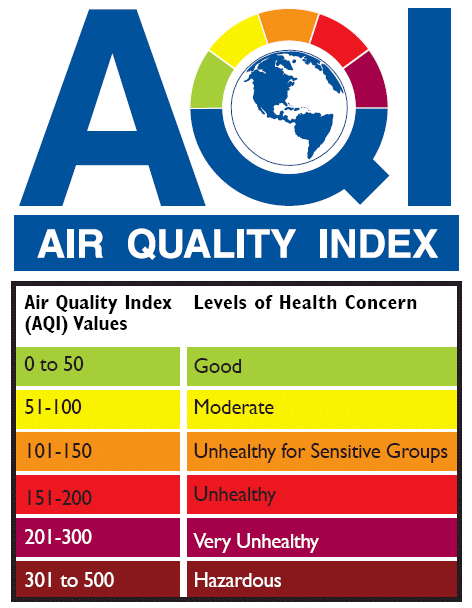 Image of an air quality index
chart
Image of an air quality index
chart
Smoke in the Air
During fires, the displayed AQI may not reflect the latest
smoke conditions in all areas. In any area where you can see or
smell smoke, everyone should avoid vigorous exertion and limit
outdoor exposure.
Chain of Command
The responsibility of the Director of Sports Medicine/Athletics
Health Care Administrator will be to obtain governmental reports
with any anticipation of poor air quality and inform the senior
director of athletics, game administrator, head coach, and/or the
game official in charge. The athletic trainer or the game
administrator will also inform the visiting team’s athletic
trainer and/or head coach. The athletic trainer or game
administrator will inform the visiting team’s athletic trainer
and/or head coach of any changes with the situation. The
responsibility remains with the head coaches to remove their teams
or individuals from a field or event site. With the information
and background on air quality presented in this policy in
conjunction with the student-athletes medical history, the coach
or athletic trainer, or both, can make an intelligent and safe
decision regarding the removal of a team or individuals from an
athletic site or the stopping of play during poor air quality.
Practices
The AT staff will inform all outdoor coaches of air quality
using the air quality index referenced above. It is the coach’s
responsibility to determine length and type of practice based upon
the recommendations of the Director of Sports Medicine/Athletics
Health Care Administrator. When the AQI reaches the “Very
Unhealthy” rating as listed above the Director of Sports
Medicine/Athletics Health Care Administrator will inform the
senior director of athletics and head coaches, that all
student-athletes should be removed from outdoor activity.
Games
Prior to the start of competition, decision to delay start of
game due to poor air quality will be decided by sports medicine
staff on site with assistance from the game management officials,
game administrator/senior director of athletics, and head coaches.
Once game has begun, decision to postpone game due to poor air
quality will be decided by the head official with input from the
athletic training staff, game administrator/senior director of
athletics, and game management officials.
Away Events
Biola Athletics will follow host institution’s established
protocol, unless Biola University athletics administration deems
otherwise. The responsibility of removing student-athletes from a
practice area due to poor air quality lies with the Biola
University head coach of that particular sport. In the event that
the head coach is not present, an assistant coach designated by
the head coach will assume responsibility.
Extreme Heat Policy
Activity in hot or humid environments can easily cause a number
of heat related illnesses such as heat cramps, heat exhaustion,
heat rash (or prickly heat), heat syncope (heat collapse), and
heat stroke (which can be fatal).
All coaching staff and athletes are educated annually regarding
the dangers of exercising in extreme heat, as well as the warning
signs of an individual suffering adverse reactions and what
actions to take when they recognize the signs in themselves or
others. The Director of Sports Medicine/Athletics Health Care
Administrator should regularly check weather forecasts to be aware
of predicted high temperatures. When high temperatures are
expected, notification should be sent to the senior director of
athletics, head coaches (including head strength coach), and
athletic training staff via email as early as possible to inform
them of impending extreme temperatures and possible need to modify
activities. Modification to practice and competitions may require
regular updates throughout the day. Updated notification should be
made via the most expedient method available whether email, text,
and/or phone or personal conversation.
Modifications to physical activity should follow the
recommendations of the National Weather Service according to the
Heat Index Chart below.
Specific thresholds with mandatory altering of physical
activity are:
“Extreme Caution” level- individuals with known respiratory or
other heat related illnesses, such as Sickle Cell Trait should be
closely monitored
“Danger” level- modifications must be made to practices and
competitions with warnings to all parties, “at risk” individuals
should be removed from activity
“Extreme Danger” level- cessation of all outdoor activities
If the practice time cannot be changed, encourage liberal
consumption of water and breaks during practice, about every 10-15
minutes. An electrolyte replacement drink should be consumed
during or immediately after practice.
Shade and dry clothing should be available to players and
staff throughout the practice or game.
Remember that protective gear, dark colored clothing, wet
clothing or plastic clothing becomes a virtual oven when
participating in activity during high heat index periods.
Encourage the liberal use of sunblock with SPF rating of
30.
Carefully monitor athletes new to the area, recovering from
illnesses, or who have a condition that may make them more
susceptible to high heat.
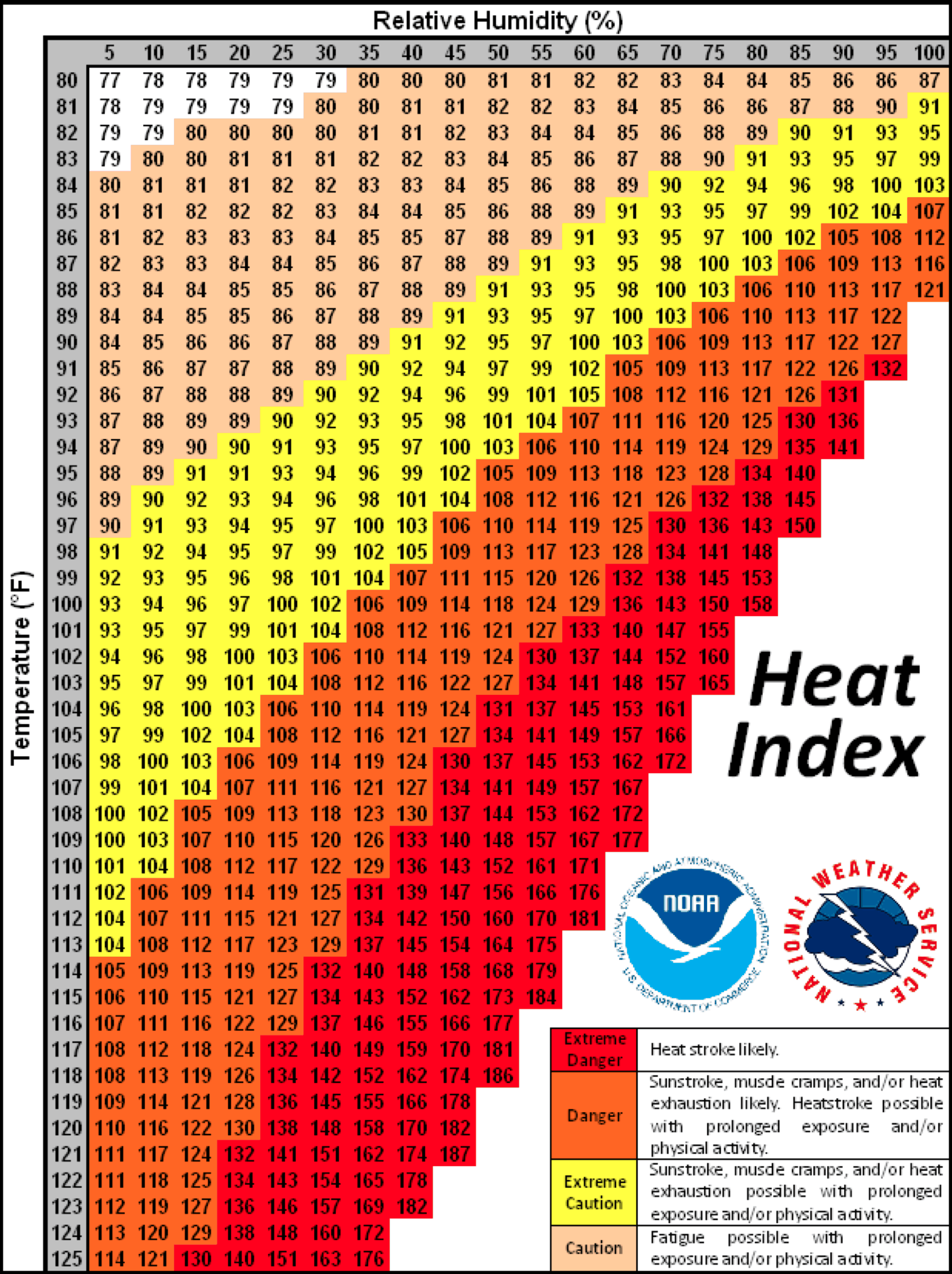 Image of a heat index
chart.
Image of a heat index
chart.
The Athletic Training Clinic (ATC) is located on the northeast
corner of Chase Gymnasium, and accessed by the hallway on the
north side of the building.. The ATC will open two hours prior to
the start of competition.
The ATC is equipped with a hydrocollator, ultrasound, electrical
stimulation unit, ice machine and hot and cold whirlpools.
If a visiting team is traveling without a certified athletic
trainer, they should be accompanied with written instructions for
all therapeutic treatments and an athletic training kit with all
the necessary tape and supplies.
A certified athletic trainer will be present for all home
competitions. Visiting team athletes should provide their own
water bottles. Limited cups, bench towels (depending on sport),
injury ice and a biohazard kit will be available at each bench.
Emergency equipment will be available behind the home
bench. Shower facilities are available for events on campus but
towels will not be provided.
For any special requests, please email john.wiese@biola.edu at
least 48 hours prior to the event.
Substance Abuse Program
As an institution and as a member of the PacWest Conference,
Biola University student-athletes are expected to conduct
themselves in a manner that is congruent with the NCAA Drug
Testing Policy as well as with the mission of the institution.
This chapter describes the staff obligations and program
administration for the Biola Athletics Substance Abuse
Program.
This program implements specific measures to ensure
student-athletes the highest level of accountability in upholding
the mission of Biola University and the NCAA. This policy is not
to be construed as a contract between the institution and the
student-athletes at Biola University. However, signed consent and
notification forms shall be considered affirmation of the
student-athlete’s agreement to the terms and conditions in this
policy.
Program Purpose and
Philosophy
The purpose of this program is to create an environment that
affords student-athletes the optimal opportunity to grow
spiritually, emotionally, athletically and academically during
their career at Biola. The athletics department and the
institution as a whole believe that the use of alcohol and banned
substances does not give student-athletes the best chance to
succeed in the three areas of growth stated above. Therefore, this
policy is designed to educate student-athletes about the adverse
effects of substance abuse, detect the use of banned substances by
Biola student-athletes, graciously discipline those who choose to
partake in the use of banned substances, and assist them to the
best of our ability in their recovery and rehabilitation.
A Biola student-athlete may be tested at any time, including
when academically ineligible or red-shirting. Biola University may
amend the policy at any time. This program is separate and
distinct from the NCAA Drug Testing program.
Prohibited Substances
Student-athletes participating in intercollegiate athletics are
prohibited from the use, purchase, possession, manufacture, and/or
distribution of any substances on the current NCAA banned drug
list, with the addition of alcohol and tobacco. Student-athletes
may not use the drugs specified by the NCAA regardless of whether
such use occurs before, during, or after the student-athlete’s
competitive season. In addition, pursuant to the Biola University
standards of conduct, the university requires that
student-athletes abstain from the use and possession of alcoholic
beverages and smoking/tobacco products. For procedures used by
Biola University to receive consent from student-athletes for
substance abuse screening, see the Biola
Athletics Substance Screening Program section.
It is the responsibility of the student-athlete to know what he
or she is putting into their body and seek answers through the
appropriate resources if they have questions.
The NCAA Banned Substance List is maintained at https://www.ncaa.org/what-we-do/health-safety-and-performance/anti-doping-and-substance-misuse-prevention/banned-substances/.
NCAA Tobacco Policy
The use of tobacco products by a student-athlete is prohibited
during practice and competition. A student-athlete who uses
tobacco products during a practice or competition shall be
disqualified for the remainder of that practice or competition
(Bylaw 17).
The use of tobacco products is also prohibited by all game
personnel (e.g., coaches, trainers, managers, and game officials)
in all sports during practice and competition. Uniform penalties,
as determined by the applicable rules-making committees and sports
committees with rules-making responsibilities, shall be
established for such use (Bylaw 11.1).
NCAA Banned
Drugs List (revised July 2026)
It is the responsibility of the student-athlete to check with
the appropriate or designated athletics staff before using any
substance. The NCAA bans the following classes of drugs:
- Stimulants
- Anabolic agents
- Beta blockers (banned for golf and rifle)
- Diuretics and masking agents
- Narcotics
- Peptide hormones, growth factors, related substances, and
mimetics
- Hormone and metabolic modulators
- Beta-2 agonists
This is not a complete or exhaustive list. Any substance
chemically or pharmacologically related to these classes is also
banned. The institution and the student-athlete shall be held
accountable for all drugs within the banned drug class regardless
of whether they have been specifically identified. Examples of
substances under each class can be found at https://www.ncaa.org/what-we-do/health-safety-and-performance/anti-doping-and-substance-misuse-prevention/drug-testing-program/.
There is no complete list of banned substances.
Drugs and procedures subject to
restrictions:
- Blood and gene doping
- Local anesthetics (permitted under some conditions)
- Manipulation of urine samples
- Tampering of urine samples
- Beta-2 agonists (permitted only by inhalation with
prescription)
NCAA
Nutritional / Dietary Supplements Warning
Before consuming any nutritional or dietary supplement product,
review the product with the appropriate or designated athletics
department staff. There are no NCAA-approved supplement
products.
- There are no NCAA-approved nutritional or dietary
supplements.
- Nutritional and dietary supplements, including vitamins and
minerals, are not well regulated and may cause a positive drug
test.
- Student-athletes have tested positive and lost their
eligibility using nutritional and dietary supplements.
- Many nutritional and dietary supplements are contaminated with
banned drugs not listed on the label.
- While third-party tested and low-level risk products may be
options, complete elimination of risk is impossible.
- All nutritional and dietary supplements are taken at the
student-athlete’s own risk.
Student-athletes should have any product checked by appropriate
athletics department staff before consuming. The NCAA subscribes
only to Drug Free Sport AXIS™ for authoritative review of label
ingredients in medications and nutritional or dietary supplements.
Contact AXIS at 816-474-7321 or https://axis.drugfreesport.com (access code:
ncaa2).
Examples
of NCAA Banned Substances in Each Drug Class
Note: there is NO complete list of banned substances. Do not
rely on this list to rule out any label ingredient.
| Class |
Examples |
Exceptions |
| Stimulants |
Amphetamine (Adderall), Caffeine and sources of caffeine
(e.g., green tea extract, guarana, yerba mate, etc.), Cocaine,
Dimethylbutylamine (DMBA; AMP), Dimethylhexylamine (DMHA;
Octodrine), Ephedrine, Heptaminol, Hordenine, Lisdexamfetamine
(Vyvanse), Methamphetamine, Methylhexanamine (DMAA; Forthane),
Methylphenidate (Ritalin), Mephedrone (bath salts), Modafinil,
Octopamine, Phenethylamine (PEAs) and derivatives, Phentermine,
Synephrine (bitter orange) |
Phenylephrine and Pseudoephedrine are not banned |
| Anabolic agents |
Androstenedione, Boldenone, Clenbuterol, Clostebol, DHCMT
(Oral Turinabol), DHEA, Drostanolone, Epitrenbolone,
Etiocholanolone, Methandienone, Methasterone, Nandrolone
(19-nortestosterone), Oxandrolone, SARMs (Ligandrol LGD-4033;
Ostarine; RAD140; S-23), Stanozolol, Stenbolone, Testosterone,
Trenbolone |
|
| Beta blockers (banned for golf and
rifle) |
Atenolol, Metoprolol, Nadolol, Pindolol, Propranolol,
Timolol |
|
| Diuretics and other masking agents |
Bumetanide, Canrenone (Spironolactone), Chlorothiazide,
Furosemide, Hydrochlorothiazide, Probenecid, Triamterene,
Trichlormethiazide |
Finasteride is not banned |
| Narcotics |
Buprenorphine, Dextromoramide, Diamorphine (heroin), Fentanyl
and derivatives, Hydrocodone, Hydromorphone, Meperidine,
Methadone, Morphine, Nicomorphine, Oxycodone, Oxymorphone,
Pentazocine, Tramadol |
|
| Peptide hormones and analogues |
BPC-157, Growth hormone (hGH), Human Chorionic Gonadotropin
(hCG), Erythropoietin (EPO), IGF-1 (colostrum; deer antler
velvet), Ibutamoren (MK-677), TB-500 |
Insulin, Synthroid, and Forteo are not banned |
| Hormone and metabolic modulators |
Anti-Estrogen (Elacestrant, Fulvestrant); Aromatase Inhibitors
(Anastrozole/Arimidex; ATD androstatrienedione; Formestane;
Letrozole); PPAR-d (GW1516/Cardarine; GW0742); SERMs
(Clomiphene/Clomid; Raloxifene/Evista; Tamoxifen/Nolvadex) |
|
| Beta-2 agonists |
Albuterol, Formoterol, Higenamine, Salbutamol, Salmeterol,
Vilanterol |
|
Anabolic agents are sometimes listed as a chemical formula
(such as 3,6,17-androstenetrione).
Information about ingredients in medications and nutritional or
dietary supplements can be obtained by contacting Drug Free Sport
AXIS at 816-474-7321 or https://axis.drugfreesport.com (access code:
ncaa2). The linked NCAA online list of banned substances will
always be up to date and is the list for which each
student-athlete will be held responsible. Student-athletes are
also responsible for reporting any prescription or
over-the-counter medications they are taking to an athletic
trainer.
Biola
Athletics Substance Screening Program
This program has three major components: education, substance
screening, and discipline.
Education
The senior director of athletics and/or the director of sports
medicine (athletics health care administrator) will explain the
Biola Athletics Substance Screening Program to each
student-athlete at the annual fall all-sports meeting.
Each student-athlete is required to sign and return the NCAA
Drug-Testing Consent Form and the Student-Athlete Consent and
Authorization Agreement Form prior to participation in practice or
competition. If the student-athlete is under the age of 18, the
parent or legal guardian must also sign the forms. Failure to
return these forms results in the student-athlete being ineligible
to practice or compete.
Procedure
Biola University conducts substance screening throughout the
academic year. The basis for the screening process is informed
consent (based on the forms submitted to Biola) and third-party
testing. On-campus screenings may occur throughout the year.
Subsequent tests may be conducted at the discretion of the senior
director of athletics. A student-athlete will be notified of
required screening at least 24 hours prior to the test by the
Biola site coordinator, director of sports medicine, associate
athletic director for compliance and communication, or senior
director of athletics, via Teamworks Hub.
Selection of participants is determined by random sampling and
individualized reasonable suspicion.
Random sampling. A random sample of
student-athletes from current team rosters will be selected for up
to a total of 5 percent of the entire student-athlete population.
Student-athletes may be tested multiple times due to the random
nature of the selection process.
Individualized reasonable suspicion. The
Reasonable Suspicion reporting form is included in the appendices
for reference. Circumstances for selection upon reasonable
suspicion may include (but are not limited to):
- Observed changes in performance or behavior (physical or
emotional), for example, missing class. Observations may come from
the senior director of athletics, athletic trainers, head coaches,
assistant coaches, Student Development staff, resident director,
and/or faculty.
- Arrest on charges related to use and/or possession of banned
substances.
- Suspected manipulation of specimens (for example, dilution of
sample).
- Proven history of positive results.
- Presence or possession by a student-athlete of illegal or
controlled drugs or drug-related paraphernalia.
- Observation by a designated administrator, coach, or support
staff through the sense of smell, sight, or sound.
If a student-athlete fails to report to the testing site within
60 minutes of the designated report time, fails to produce a
specimen at the time of testing, or manipulates the integrity of
the specimen or collection process, it will be considered a
positive test. The student-athlete will be subject to the
appropriate sanctions.
Student-athletes may also be selected for testing under any of
the following circumstances:
- Post-season / championship screening. Any
participant or team likely to advance to post-season championship
competition may be subject to additional testing. Testing may be
required of all team members or individual student-athletes at any
time within thirty (30) days prior to the post-season competition.
If a student-athlete tests positive, they will not be allowed to
compete at the post-season event and will be subject to the
sanctions herein.
- Re-entry testing. A student-athlete whose
eligibility has been suspended as a result of a drug and alcohol
violation may be required to undergo re-entry drug and/or alcohol
testing prior to regaining eligibility. The senior director of
athletics or designee arranges re-entry testing after the
counselor or specialist involved indicates that re-entry is
appropriate.
- Follow-up testing. A student-athlete who has
returned to participation following a positive drug test may be
subject to follow-up testing. Testing will be unannounced and
required at a frequency determined by the senior director of
athletics or designee in consultation with the counselor or
specialist involved.
- Pre-season screening. Student-athletes are
subject to pre-season drug testing and may be notified by the
senior director of athletics or designee at any time prior to
their first competition.
Specimen collection. Details regarding
specimen collection are provided for reference in the appendix on
Drug Free Sport’s Collection Guidelines.
Medical exception process. Biola University
recognizes that some banned substances are used for legitimate
medical purposes. Accordingly, the Department of Athletics allows
exceptions for student-athletes with a documented medical history
demonstrating a need for regular use of such a substance.
Exceptions may be granted for substances in the following classes:
stimulants, beta-blockers, diuretics, and peptide hormones.
Student-athletes are required to inform their athletic trainer
of all medications (prescribed and over-the-counter) they are
taking, via the Medical History Form submitted for Medical
Clearance.
In the event a student-athlete tests positive, the assistant
athletic director of sports medicine, in consultation, will review
the student-athlete’s medical record to determine whether a
medical exception should be granted.
Discipline
First Violation
In the case of a first positive test, the following sanctions
occur:
- The student-athlete is referred to Student Development to
discuss the violation and next steps. There will be a minimum
two-week suspension from participation in practice, competition,
and travel.
- The student-athlete may begin participation again at the
conclusion of seven days (since notification of the positive test)
depending on the recommendation of the assessment team and written
evidence received by the senior director of athletics. In some
cases, the team physician must also clear the student-athlete for
participation.
- The student-athlete is automatically enrolled in the substance
screening program.
- Any offense may be grounds for revoking of athletic
scholarship. The senior director of athletics and head coach may
make decisions on scholarship removal.
- Depending on the seriousness of the offense, the
student-athlete may also face further consequences, including but
not limited to expulsion from the university. See the Biola
Student Handbook section titled Alcohol, Tobacco &
Drugs for more information on university sanctions.
Second Violation
In the case of a second positive test, the following sanctions
occur:
- The student-athlete is referred to Student Development to
discuss the violation and next steps. The student-athlete will, at
minimum, be suspended from participation in practice, competition,
and travel for the rest of the current season.
- The student-athlete may be terminated from any future
participation in Biola Athletics.
- The student-athlete may also face further consequences,
including but not limited to expulsion from the university. See
the Biola Student Handbook section titled Alcohol, Tobacco
& Drugs for more information on university
sanctions.
Decisions for both first and second violations are made by the
Dean of Community Life & Title IX Coordinator or designee, who
consults with athletics department administration as necessary.
Biola will not cover any costs in addition to the initial
substance screening incurred during this disciplinary process. The
same punishment and actions apply for a student-athlete who is
caught outside of the Biola Athletics Substance Screening Program
in conjunction with Student Development.
Appeal Process
When a sanctioned student-athlete disputes the outcome of a
disciplinary procedure, that student (the “Appellant”) may
request, through the Dean of Community Life & Title IX
Coordinator, that an Appeal Hearing Committee review the decision.
Sanctions may or may not be postponed or suspended pending the
outcome of this appeal, at the discretion of the dean.
The Appellant may appeal
on the basis of:
- Inaccurate findings — the available facts
used in determining sanctions were inaccurate or incomplete.
- New evidence has become available.
- An unfair or inequitable process.
The following are not within the scope of the
appeal process:
- The interpretation or judgment of university administrators
regarding the meaning or implementation of the written
regulations, standards, or policies of the university.
- The written regulations, standards, or policies of the
university themselves.
- The determined sanctions from the disciplinary procedure.
To initiate an appeal hearing, the Appellant submits the
following, in writing, to the dean:
- A request for a hearing, submitted within five working days
from the time the Appellant was informed of the disciplinary
decisions.
- A statement including all relevant issues and evidence to be
considered. Issues or evidence not included will not be considered
in the appeal hearing.
- A list of material witnesses, if any, and the essence of their
proposed contribution. These are not character witnesses but
individuals with first-hand knowledge of the situation in appeal.
Their testimony is limited to the specified matters.
The dean then forms an Appeal Hearing Committee made up of one
member of the Student Care Team (serving as non-voting
facilitator) along with three faculty or staff members selected by
the dean. If no members of the Student Care Team are available,
the dean may select a replacement from Biola faculty or staff.
The Appeal Hearing Committee will, within 15 working days of
receipt of the appeal request, review and evaluate the original
adjudication and the information the Appellant has presented.
Based on the nature of the appeal, the committee has discretion
whether to call the Appellant and/or witnesses to appear. If
called, they will be notified at least two days in advance. The
committee may record the appeal hearing.
The committee will issue its decision in writing to the parties
involved within a reasonable time (usually within 10 working days)
of the conclusion of the appeal process. The decision is final and
no further appeal is possible.
Formal rules of evidence are not followed in appeal
proceedings, and past conduct may be considered. No particular
procedural model is required; however, the committee will attempt
to structure the procedure to facilitate a reliable determination
of the truth and to be fair and reasonable.
During periods other than regular semesters (summer, Christmas,
interterm), the dean reserves the right to alter the timing of the
appeals process as necessary due to faculty, staff, or appellant
availability.
Assistance
in Overcoming Alcohol and Other Drug Abuse
If a student-athlete needs help or knows someone with an
alcohol, drug, or substance-related problem, the Biola Counseling
Center, the Student Health Center, resident directors, deans,
faculty, and other university personnel will provide assistance to
those who come forward seeking help. The Counseling Center
provides confidential consultations with trained psychologists and
marriage-and-family therapists at extremely low cost, and makes
referrals to outside counseling and treatment services.
Confidentiality
Any information concerning a student-athlete’s alleged or
confirmed improper use of banned substances is restricted to
institutional personnel identified within this document and to
parents or legal guardians. Biola Athletics follows HIPAA
guidelines to ensure the utmost confidentiality.
Counseling
See the section on the Biola Counseling Center.
NCAA Drug Testing Program
Biola student-athletes are subject to drug testing at any time.
In addition to the Biola University Athletics Substance Screening
Program, the NCAA has its own drug testing program that Biola is
required to follow. The NCAA sets and updates the testing
frequency, notification timelines, and sanctions for this program
independent of Biola; refer to the
NCAA drug testing program page for the current, authoritative
rules.
If Biola is selected for testing, the senior director of
athletics, site coordinator, and one additional athletic
administrator will receive advance notification from Drug Free
Sport. After Drug Free Sport has randomly selected
student-athletes for drug testing, the site coordinator will
receive the roster of selected student-athletes and is responsible
for notifying student-athletes of their selection.
Student-athletes must be notified in person or via direct
communication.
Any student-athlete who refuses to sign the Roster Sign-in Form
or the Custody and Control Form, fails to arrive at the collection
station at the designated time without justification, fails to
provide a urine sample according to protocol, leaves the
collection station before providing a specimen according to
protocol, or attempts to alter the integrity or validity of the
urine specimen or collection process, will be treated as if there
was a positive test for a banned substance other than a street
drug.
A positive NCAA drug test carries mandatory NCAA sanctions — a
period of ineligibility and loss of a season of competition, with
more severe sanctions for a second violation — along with an
appeal path through the NCAA’s Committee on Competitive Safeguards
and Medical Aspects of Sports and the Committee on Student-Athlete
Reinstatement. See the NCAA drug testing program link above for
the current sanction structure, since the NCAA sets and revises
these thresholds directly.
The list of NCAA banned drugs is subject to change, and the
student-athlete shall be held accountable for all banned drug
classes on the current list. The list is located on the NCAA
website (see the link above), and a copy is provided in this
manual and posted in the Athletic Training Clinic.
For authoritative information on NCAA banned substances,
medications, and nutritional supplements, contact Drug Free Sport
AXIS at 816-474-7321 or https://axis.drugfreesport.com (access code:
ncaa2).
Before consuming any nutritional or dietary supplement product,
review the product and its label with athletics department staff.
Dietary supplements are not well regulated and may cause a
positive drug test result. Any product containing a dietary
supplement ingredient is taken at the student-athlete’s own
risk.
NCAA Ethical Conduct
In addition to the university's expectations, the NCAA has
specific guidelines for unethical conduct. All athletics staff
members and student-athletes must compete with honesty and
sportsmanship at all times to represent the honor and dignity of
fair play. A coach, administrator, or support staff member who is
found to have engaged in unethical conduct shall be held
responsible for their actions.
Unethical conduct consists of, but is not limited to:
Refusal to furnish information relevant to an investigation
of a possible violation of an NCAA regulation when requested to do
so by the NCAA or the individual's institution;
Knowing involvement in offering or providing a prospective
or an enrolled student-athlete an improper inducement or extra
benefit or improper financial aid; (Revised: 1/9/96)
Knowingly furnishing or knowingly influencing others to
furnish the NCAA or the individual's institution false or
misleading information concerning an individual's involvement in
or knowledge of matters relevant to a possible violation of an
NCAA regulation; (Revised: 1/13/10)
Receipt of benefits by an institutional staff member for
facilitating or arranging a meeting between a student-athlete and
an agent, financial advisor or a representative of an agent or
advisor (e.g., "runner"); (Adopted: 1/9/96, Revised:
4/26/06)
Knowing involvement in providing a banned substance or
impermissible supplement to student-athletes, or knowingly
providing medications to student-athletes contrary to medical
licensure, commonly accepted standards of care in sports medicine
practice, or state or federal law. This provision shall not apply
to banned substances for which the student-athlete has received a
medical exception per Bylaw 18.2.1.2.8; however, the substance
must be provided in accordance with medical licensure, commonly
accepted standards of care and state or federal law; (Adopted:
1/9/06, Revised: 4/26/06, 5/29/08, 10/19/10)
Failure to provide complete and accurate information to the
NCAA, the NCAA Eligibility Center or the institution's athletics
department regarding an individual's non-professional status.
(Adopted: 1/5/07)
Fraudulence in connection with entrance or placement
examinations;
Engaging in any athletics competition under an assumed name
or with intent otherwise to deceive
Dishonesty in evading or violating NCAA
regulations;
Knowledge and/or involvement in arranging for fraudulent
academic credit or false transcripts for a prospective or an
enrolled student-athlete;
Providing information to individuals involved in organized
gambling activities concerning intercollegiate athletics
competition;
Soliciting a bet on any intercollegiate or professional
team;
Accepting a bet on any team representing the institution;
or
Knowingly participating in sports wagering activities or
providing information to individuals involved in or associated
with any type of sports wagering activities concerning
intercollegiate, amateur or professional athletics
competition.
PacWest
Principle of Sportsmanship and Ethical Conduct
PacWest Bylaw 8.1 - It shall be the responsibility of each
institution to ensure that all individuals employed by or directly
associated with the athletic programs of that institution conduct
themselves in a sportsmanlike manner when representing their
institution, especially at intercollegiate athletic contests.
8.1.1 - Unsportsmanlike and/or unethical conduct may subject an
individual to disciplinary action by the Commissioner and/or the
individual member institution(s) involved. The institution that
the offending individual is associated with may also be subject to
disciplinary action if it is found that the institution's
policies, action, or failure to act substantially contributed to
the individual's misconduct.
8.1.2 - Acts of unsportsmanlike and/or unethical conduct may be
reviewed by the Commissioner and/or the individual member
institution(s) involved. Individual penalties and/or discipline
may be determined by the Commissioner and/or the individual member
institution(s) involved.
8.1.3 - If the Commissioner is incapacitated or unable to
fulfill his/her duties, the Conference office staff member
responsible for Compliance duties shall continue Conference
operations by reviewing acts of unsportsmanlike and/or unethical
conduct and levy appropriate penalties in such cases until the
Executive Board has the opportunity to vote on an interim
Commissioner.(Revised 5/25/23)
8.1.4 - Acts of unsportsmanlike and/or unethical conduct may
include, but are not limited to, a student-athlete, coach or other
institutional representative who:
Strikes or physically abuses an official, opposing coach or
player;
Intentionally incites participants or spectators to violent
or abusive action;
Uses obscene gestures or profane or unduly provocative
language or action toward officials, opponents, or
spectators;
Publicly criticizes any game official, Conference
personnel, another institution or its personnel;
Engages in negative recruiting by making statements to a
prospective student-athlete, his/her parents, high school coach,
or other persons interested in the prospective athlete which are
unduly derogatory of another member institution, its personnel, or
its athletic program or;
Any other acts or conduct not specifically described herein
that bring disrepute on the Conference or one of its member
institutions.
Student-Athlete/Coach
Conflict & Feedback
Biola Athletics encourages all student-athlete/coach conflicts
to be settled between the parties involved. If a student-athlete
has a strong reaction to things occurring in his or her training
and competition — either positive or critical — he or she is
advised to connect directly with a member of his or her coaching
staff. If the experience is significant, student-athletes share it
directly with the senior director of athletics, associate athletic
directors, or faculty athletics representative for evaluation of
any incident or concerns and consideration of appropriate
responses.
At the close of the academic year, athletics administration
gathers both quantitative and qualitative feedback. Every
student-athlete will receive a Student-Athlete Well-Being Survey
to share their experience in the areas of equity and inclusion,
compliance, academics, sports medicine, coaching, and overall
Biola experience. There are also random sampling qualitative
interviews within each sports program with a member of the
administrative team and exit surveys sent through the Office for
Student Success. Annually, all feedback is reviewed by the senior
director of athletics, Faculty Athletics Representative, and the
senior associate athletic director. In addition, the data is
evaluated by staff in the University Analytics Office and
presented to the Athletics Advisory Council. Biola Athletics is
committed to the vision for student-athlete transformation by
executing the highest-quality intercollegiate program. These
surveys and interviews assist in highlighting areas of strength
and areas for improvement.
While not all of the items on the evaluation relate to the
coaches’ interaction with the team, it may be helpful to
understand the types of standards that are applied to the overall
evaluation of the coaching staff. These standards include:
Develops the team to reflect Biola’s mission and readily
demonstrates student development goals, athletics department
objectives, and team success.
Develops a spiritual focus consistent with university goals
that promote individual student-athletes' spiritual growth, team
involvement in service and character development, and involvement
in athletics department activities that support the spiritual
growth of all student-athletes.
Informs all team members of specific eligibility
regulations and counsels team members regarding their
responsibility to maintain eligibility. The coach should be alert
to potential problems and may request information from faculty
members.
Coordinates hiring of support personnel (assistant coaches,
managers, etc.) with the senior associate athletic director as
approved in the current budget. The head coach is responsible for
recommending hiring of individuals that fit well with the mission
of the university.
Accepts full responsibility for student-athletes' conduct
and appearance during home or away events and while on
trips.
Actively works toward influencing the student-athletes’
conduct, public image and spirit of cooperativeness in accord with
the university objectives. If university regulations have been
violated, the coach must inform the director of athletics and
disciplinary measures will be taken in consultation with the dean
of students.
Reviews NCAA rules with student-athletes when necessary and
reinforces the importance of compliance.
Ensures team's compliance with NCAA rules related to
playing and practice seasons, including weekly countable
athletically related activity logs.
Educates student-athletes regarding NCAA regulations
governing employment.
All full-time and head coaches must be CPR, AED, and first
aid certified.
Hazing Policy
There is a strict no hazing policy at Biola University, as
outlined in the Biola Student Handbook:
Hazing is defined as an act which endangers the mental or
physical health or safety of a student, or which destroys or
removes public or private property, for the purpose of initiation
or admission into, affiliation with, or continued membership in a
group or organization. The law of California makes it a criminal
offense for anyone to participate in hazing. Biola policy is based
upon the proposition that students are entitled to be treated with
consideration and respect. Biola regulations on hazing are
synonymous with state law as stated below (Calif. Penal Code
§245.6):
It shall be unlawful to engage in hazing, as defined in
this section.
"Hazing" means any method of initiation or pre-initiation
into a student organization or student body, whether or not the
organization or body is officially recognized by an educational
institution, which is likely to cause serious bodily injury to any
former, current, or prospective student of any school, community
college, college, university, or other educational institution in
this state. The term "hazing" does not include customary athletic
events or school-sanctioned events.
A violation of this section that does not result in serious
bodily injury is a misdemeanor, punishable by a fine of not less
than one hundred dollars ($100), nor more than five thousand
dollars ($5,000), or imprisonment in the county jail for not more
than one year, or both.
Any person who personally engages in hazing that results in
death or serious bodily injury as defined in paragraph (4) of
subdivision (f) of Section 243 of the Penal Code is guilty of
either a misdemeanor or a felony, and shall be punished by
imprisonment in county jail not exceeding one year, or by
imprisonment pursuant to subdivision (h) of Section 1170.
The person against whom the hazing is directed may commence
a civil action for injury or damages. The action may be brought
against any participants in the hazing, or any organization to
which the student is seeking membership whose agents, directors,
trustees, managers, or officers authorized, requested, commanded,
participated in, or ratified the hazing.
Prosecution under this section shall not prohibit
prosecution under any other provision of law.
Any students engaging in hazing will be subject to a
disciplinary process.
The NCAA defines hazing as any act committed against someone
joining or becoming a member or maintaining membership in any
organization that is humiliating, intimidating or demeaning, or
endangers the health and safety of the person. Hazing includes
active or passive participation in such acts and occurs regardless
of the willingness to participate in the activities. Hazing
creates an environment/climate in which dignity and respect are
absent.
The NCAA provides this comparison of “Hazing vs. Team Building”
to help student-athletes better understand the differences:
|
|
|
- Promotes respect and dignity
|
|
|
|
|
|
|
|
|
|
- Is a shared positive experience
|
Any student-athlete who has been subject to or
witnesses any activity that could be hazing should report it
immediately to a university official (e.g., the faculty athletics
representative or Vice President of Student
Development).
Equity and Respect for
All
Biola University is committed to the principles of equity and
treating all individuals with dignity and respect. Coaches and
student-athletes will participate as requested in an athletics
department assessment in these areas, as initiated by the NCAA
Additionally, per NCAA guidelines, Biola Athletics will
identify an Athletics Diversity & Inclusion Designee who
serves as the primary point of contact for receiving and
distributing information on diversity and mutual respect. The
athletics diversity and inclusion designee, known as the ADID,
will serve as the point of contact between the NCAA national
office, athletics department, conference office, and campus when
information about inclusive programs, emerging issues, and other
related initiatives needs to be shared.
Student Health Center
All enrolled students, regardless of insurance status, are
eligible for Health Center services. Services include
M.D. appointments, nurse practitioner appointments, nurse
appointments, immunizations, free self-care products, health
education, travel-related services, and health care and health
education pamphlets.
Campus Safety
The Campus Safety department's main responsibility is to
provide for the safety and protection of our students, staff, and
visitors. They are the primary law enforcement agency on campus,
and their officers have full police officer powers of arrest while
on duty.
Campus Safety officers are armed with firearms while on duty.
All officers are equipped with tasers, OC spray, and batons. In
addition to state-mandated training courses, officers have 10
in-service trainings per year that cover emergency preparedness,
physical skills, and customer service. Armed officers receive
firearms training at least 4 times per year, as well as biannual
active shooter response training.
Biola Counseling Center
(BCC)
BCC provides psychotherapy for individuals, couples, and
families as well as marital and premarital counseling.
Psychological testing and evaluation are also provided. If the
need arises, the center also provides psychotherapy and
psychoeducation groups that offer opportunities for interpersonal
learning, information acquisition, and the normalization of
emotional struggles through mutual sharing.
The majority of BCC therapists are affiliated with Biola’s
Rosemead School of Psychology as clinical faculty, postdoctoral
students, or doctoral students supervised by licensed clinical
psychologists. Counselors seek to help clients develop a rich
understanding of their personal life story so that, through
increased self-understanding, the individual becomes better
equipped to navigate and cope with the challenges of daily life.
Some of the most common issues encountered by clientele include
depression, anxiety, loneliness, low self-esteem, and difficulties
with establishing and maintaining relationships. BCC therapists
are equipped to help clients address these difficulties through
the enhancement of emotion management, appropriate interpersonal
boundaries, self-awareness and interpersonal and situational
problem solving skills.
In order to receive further information or to make an
appointment, contact the La Mirada office at (562) 903-4800.
Special reduced rates are available for Biola University
students.
Spiritual Direction
Spiritual direction involves meeting with another Christian to
give prayerful attention to the personal relationship with God. In
spiritual direction, an individual will receive help discerning
how God is speaking, how to respond to him, and how to live out a
relationship with him. Biola undergraduate students can receive
spiritual direction for free at ISF.
How to sign up for spiritual direction
To sign up for individual spiritual direction:
Go to the Institute for Spiritual Formation website and follow
the instructions for setting up Spiritual Direction:
https://www.biola.edu/talbot/academics/isf/spiritual-direction
How to get credit for spiritual direction
Undergraduate students who come to spiritual direction are
eligible to receive 1 chapel credit per meeting (unless they are
coming for a class requirement). Chapel credit forms are available
at the ISF Front Desk or at the Chapel Accountability office.
The Office of Student Accessibility (OSA) exists to provide
students with academic assistance and support through a range of
services. Tutoring and academic mentors are available, as are
individualized ADA care plans and guidance for those diagnosed
with medical, psychological, learning, or physical conditions.
When entering our center, whether in person or remotely, students
can expect to be met by caring, professional staff who work hard
to provide safe, personalized advocacy in a confidential and
welcoming environment.
Location and Contact Information
OSA is located in the north end of Rose Hall and has walk-in
hours Monday through Thursday. Appointments are strongly
encouraged. Phone: (562) 906-4542
Our mission is to support students, faculty, and staff in their
writing. Our team of peer consultants provides help with any
writing assignments, research reports, graduate theses, conference
presentations, and conversational English. We provide feedback for
writing projects at any stage—from outlines and early drafts to
revisions and final edits—in a friendly, supportive environment,
both face-to-face and online. We draw our philosophy from Stephen
North: we strive to develop strong writers, rather than just
strong writing. We work to support writers in their work, while
letting them maintain control and ownership over their writing.
You can create an account with us and make an appointment today
using our online scheduler.
Residence Life
Biola University cares deeply about the development of the
student body. Through a comprehensive Residence Life program,
residential student-athletes are cared for on and off the field of
competition.
The Office of Housing & Residence Life is designed to
support student life in and out of the classroom. Beginning with
your first engagement with campus housing and for the duration of
your time living on campus, our office is here to support student
needs.
Student-Athlete Housing
At Biola University, our goal is to ensure that our
student-athletes have a holistic college experience. The on-campus
dorm life can be one of the most meaningful parts of the college
experience for a Biola student.
Student-athletes will go through the normal housing process
like other students and will not receive preferential treatment.
Student-athletes may choose to room with another student-athlete,
but they must still go through the normal housing approval
process.
No staff member of the Athletic Department will be allowed to
live in the same residence as a student-athlete except when the
staff member is an immediate family member.
Institutional financial aid, when applicable, may be used to
cover the cost of Biola-owned housing. Institutional financial aid
may not be used to pay for non-Biola-owned housing.
Civic Engagement Policy
The Biola Athletic Department supports our student-athletes in
being active citizens in La Mirada, the greater Los Angeles area,
the State of California, and their home states and countries. As
an athletic department, we encourage our student-athletes to be
involved in civic engagement opportunities as they see fit.
NCAA Division II Legislation dictates that Civic Engagement Day
is the first Tuesday after the first Monday in November
(17.1.6.8). In sports participating in their championship segment
during that time, the head coach must notify the compliance office
whether they are providing a day off on the legislated civic
engagement day or utilizing the exception (17.1.6.8.1) to provide
a day off within 15 days before or after the civic engagement
day.
This use of this exception should be noted in the Declaration
of Playing & Practice season workflow submitted before the
championship segment begins. A specific day should be designated
as an off day, and the head coach is responsible for making it
clear to the team that the day off is intended to give them space
to participate in civic engagement activities.
For a student-athlete participating in a sport during their
championship segment who must practice on civic engagement day,
the head coach will collaborate with any student-athlete who
requests time off from practice to participate in civic engagement
opportunities. Reasonable effort and accommodations will be made
to allow the student-athlete to participate. Ultimately, it will
be the head coach's discretion to determine if the student-athlete
can miss practice time. For sports not in their championship
segment, coaches must provide the required day off from CARA
activity for the civic engagement day (17.1.6.8).
Aside from team activity covered under 17.1.6.8.1, the Sport
Performance Center will be closed on Civic Engagement Day.
Voluntary lifts will not be available in Athletic Department
facilities.
Student-athletes can view non-partisan voting resources curated
by the NCAA at https://ncaaorg.s3.amazonaws.com/committees/d2/saac/D2SAAC_CivEngRes.pdf.
Biola University is committed to abide by NCAA rules and
regulations as they relate to all aspects of its athletics
program. In addition to ensuring that all of its coaches,
administrators, university faculty and staff and student-athletes
are aware of and follow NCAA rules, Biola University is also
responsible for educating individuals who are boosters. Compliance
with NCAA rules requires the effort of everyone associated with
Biola Athletics and requires a shared responsibility for the
education of and compliance with NCAA, PacWest and university
policies and procedures.
Principle of
Institutional Control
It is the responsibility of Biola University to control its
intercollegiate athletics program in compliance with the rules and
regulations of the NCAA. The institution’s president is
responsible for the administration of all aspects of the athletics
program, including approval of the budget and audit of all
expenditures.
The institution’s responsibility for the conduct of its
intercollegiate athletics program includes responsibility for the
actions of its staff members and for the actions of any other
individual or organization engaged in activities promoting the
athletics interests of Biola University.
Shared Responsibilities
It is the responsibility of Biola University to control its
intercollegiate athletics program in compliance with the rules and
regulations of the Association. Biola University’s accepted
responsibility for the conduct of its intercollegiate athletics
program includes responsibility for the actions of its staff
members and for the actions of any other individual or
organization engaged in activities promoting the institution.
Biola University must have procedures whereby persons inside
and outside the athletics department exercise oversight
responsibilities that monitor and evaluate the efficiency of the
compliance program. The oversight and monitoring of the program
should be ongoing, rather than activated in response to
allegations of wrongdoing. To accomplish this goal, Biola
University has appointed individuals to serve on the Compliance
Committee, which is chaired by the associate athletic director for
compliance/communication, and will meet regularly to assess
compliance efforts. These individuals will be expected to be
operating on behalf of the institution with respect to those
responsibilities that are logically within the scope of their
positions. This committee will provide ongoing self-study and
administrative accountability in the area of athletic
compliance.
Biola
University Athletics Compliance Committee
The Compliance Committee (CC) includes individuals with
hands-on compliance responsibilities from the Office of the
Registrar, Office of Undergraduate Admissions, Financial Aid
Office, Academic Advising, faculty athletics representative (FAR).
The associate athletic director for compliance/communication
chairs the committee.
Responsibilities
of the Compliance Committee (CC)
The associate athletic director for
compliance/communication is responsible for educating the members
of the CC on NCAA rules.
The CC will meet annually to discuss NCAA rules education
and updates, as well as revision and refinements of compliance
policies and procedures for the institution.
The CC will meet annually to ensure everyone involved in
the processes (and those that have to carry out the processes)
have a resource for reference.
The CC will annually conduct a comprehensive evaluation of
the compliance program and make changes as necessary so they can
be implemented as soon as possible.
The CC will be able to demonstrate and document the steps
in each process for outside entities that may review or audit the
institution’s athletic compliance program.
The CC will approve all changes to the Compliance
Manual.
The CC is ultimately responsible for the effectiveness and
efficiency of the overall compliance program.
CC Members
| Title |
Name |
Contact Number |
| Associate athletic director for
compliance/communication |
Neil Morgan |
(562) 903-4889 |
| Senior director of athletics (ex
officio) |
Dr. Bethany Miller |
(562) 777-4082 |
| Faculty Athletics
Representative |
Jeff McHugh |
(562) 944-0351, x 5737 |
| University Registrar (ex
officio) |
Cassandra Heath |
(562) 944-0351, x5310 |
| Registrar primary contact |
John Woolard |
(562) 392-4481 |
| Senior Director of Financial Aid (ex
officio) |
Geoff Marsh |
(562) 903-4742 |
| Financial Aid Specialist |
Rachel Chu |
(562) 906-4157 |
| Associate Director of Undergraduate
Admissions |
Amber Nakamura |
(562) 944-0351 x5366 |
| Director of Traditional
Undergraduate Admissions (ex officio) |
Kayla Zuniga |
(562) 944-0351 x5349 |
| Associate Director of Academic
Advising |
Jamie Sommerville |
(562) 906-4576 |
| Director, Athletics Development (ex
officio) |
Katie Simonson |
katie.simonson@biola.edu |
Individual
Compliance Responsibilities
**Senior Director of Athletics** The senior director of
athletics ensures full compliance with NCAA and conference
regulations and is responsible for the integrity of the athletics
program. Specific responsibilities include:
Establishing and communicating the institution’s commitment
to rules compliance.
Establishing organizational lines of authority to emphasize
oversight and accountability.
Maintaining ongoing evaluations of staff members’
commitments to and documentation of compliance.
Arranging periodic self-studies of Biola Athletics and
annual audits of the compliance program.
Include NCAA rules in Biola Athletics
publications.
Communicating with officers of booster organizations to
review NCAA rules.
Reviewing contest schedules where applicable.
Evaluating potential NCAA rule violations and notifying the
president of violations.
Declaring student-athletes who violate NCAA rules
ineligible.
Communicating the institution’s commitment to rules
compliance to student-athletes.
Supporting and encouraging a comprehensive rules education
program.
Generating and promoting NCAA legislative
proposals.
Providing information addressing NCAA rules to athletic aid
agreement signees.
Serving as an ex-officio member of the Compliance
Committee.
Serving as an ex-officio member of the Athletics Advisory
Council.
Associate
Athletic Director for Compliance/communication
The associate athletic director for compliance/communication is
responsible for the overall development, implementation, and
review of Biola University’s Athletics compliance program. The
associate athletic director for compliance/communication is also
responsible for the daily operation of the compliance program
including rules education, interpretation, and monitoring of
compliance areas as well as student success and academic
matriculation of student-athletes. The associate athletic director
for compliance/communication shares responsibility for the
integrity of the athletics program and assists the senior director
of athletics in establishing a culture of compliance by ensuring
full compliance with national, conference and institutional
regulations. Specific responsibilities include:
Reviewing coaches’ declaration of playing, practice seasons
and schedules of contests.
Conducting an all student-athlete orientation at the
beginning of each academic year.
Reviewing all student-athlete NCAA, conference and
institutional compliance forms, including the NCAA Drug-Testing
Consent Form and Student-Athlete Statement.
Assisting with compilation and reporting of the NCAA Equity
in Athletics Disclosure Act each year.
Coordinating the education of prospective student-athletes,
enrolled student-athletes, coaches, college personnel, and
representatives of athletics interests with regard to NCAA,
conference and institutional rules.
Educating coaches and staff with compliance
responsibilities to use the Teamworks Compliance & Recruiting
compliance software.
Coordinating, preparing and maintaining NCAA financial aid
reports in conjunction with the Financial Aid Office.
Monitoring financial aid limits offered based on team
budgets.
Serving as department liaison with the NCAA Eligibility
Center.
Receiving final Eligibility Center eligibility decisions
and working with the university registrar to ensure those
decisions are accurately reflected on PacWest Eligibility
sheets.
Coordinating student-athlete initial and continuing
eligibility certification with the FAR and university registrar.
Share status with coaches.
Reviewing and auditing off-campus recruiting contact and
evaluation requests.
Reviewing academic transcripts and IRL status to approve
official visit requests.
Monitoring the number of official visits provided in all
sports.
Interpreting NCAA rules for coaches and staff.
Monitoring permissible recruiting materials in accordance
with NCAA bylaws.
Monitoring the NCAA Transfer Portal and entering
student-athletes within seven days of written request.
Reviewing, and auditing weekly practice/competition (CARA)
logs.
Maintaining participation records and determining seasons
of competition utilized by student-athletes.
Identifying potential NCAA rules violations and reporting
them to the senior director of athletics and FAR.
Leading investigations of reported secondary NCAA rule
violations.
Reviewing summer regulations regarding athletics
participation, camps and employment for coaches and
student-athletes.
Coordinating the Athletic Scholarship Agreement program for
incoming student-athletes.
Coordinating the release of ASA signees with the Sports
Information Office, Financial Aid Office and the Office of
Undergraduate Admissions.
Monitoring outside scholarships with the Financial Aid
Office.
Coordinating the processing of initial and annual renewal,
reduction, cancellation or non-renewal of athletic grants-in-aid
with the Financial Aid Office.
Serving as department liaison with the Office of
Undergraduate Admissions, Financial Aid Office, Office of the
Registrar, Academic Advising and FAR.
Serving as the chair of the Compliance Committee.
Serving as an ex-officio member of the Athletics Advisory
Committee.
Coordinating all NCAA appeals/waiver requests.
Monitoring employment of student-athletes according to NCAA
bylaws.
Assisting the Financial Aid Office in determining
student-athletes’ eligibility status for the NCAA Special
Assistance Fund.
Serving as an advisor to the Student-Athlete Advisory
Committee.
Monitoring compliance with NCAA bylaws regarding
complimentary admissions to athletics events.
Overseeing compliance with NCAA bylaws regarding
camps/clinics.
Director, Athletics Development
The director of Athletics Development is responsible for
knowledge, implementation and documentation of NCAA and
institutional fundraising policies and procedures. The director of
Athletics Development’s compliance responsibilities include:
Monitoring student-athletes, monitoring they do not miss
class for any fundraising activity.
Overseeing monetary gifts given directly to the head coach
are handled appropriately and processed and credited to the proper
account.
Collaborating with the Eagles Athletic Association and/or
the Office of Advancement.
Working with coaches when hosting a parent or alumni
event.
Providing information for donors, parents and alumni
information regarding Biola Athletics and NCAA
compliance.
Overseeing and coordinating athletics
sponsorships.
Advocating for fundraising efforts.
Head/Assistant Coaches
The Coaches are responsible for knowledge, implementation and
documentation of NCAA rules and regulations in the areas of
eligibility, recruiting, financial aid, playing and practice
seasons and awards and benefits. Coaches share responsibility for
the integrity of the athletics program and assist the senior
director of athletics in establishing a culture of compliance by
ensuring full compliance with national, conference and
institutional regulations. Coaches are expected to fully cooperate
and participate in compliance related policies and procedures
within Biola University and NCAA guidelines. For specific
compliance responsibilities, see job description. Each coach must
annually complete the NCAA Coaches’ Certification coursework
assigned in the NCAA Learning Portal.
Faculty Athletics
Representative
The FAR shares responsibility for the integrity of the
athletics program and assists Athletics in establishing a culture
of compliance by ensuring full compliance with national,
conference and institutional regulations. The FAR’s rules
compliance responsibilities include:
Serves as an Athletic Certifying Officer for the
institution--certifies the academic and overall eligibility of
each student-athlete each semester.
Serves as a member of the Financial Aid Appeals
Committee.
Chairs the Athletics Advisory Council
Serves as a member of the Compliance Committee
Assists in the education for athletics for
student-athletes, coaches, and staff.
Assists with appeals to restore the eligibility of
student-athletes. Appeals must be submitted in the name of the
institution by the FAR, President, or AD in accordance with NCAA
Bylaws.
Assists with any institutional request for a waiver of
division membership requirements in accordance with NCAA
Bylaws.
Assists with all NCAA waivers and secondary NCAA
violations. The FAR is included in notifications from the NCAA
that an official inquiry is being initiated to determine whether
rules violations have occurred.
Assists with the rules enforcement and appeals
process.
Selects student-athletes for compliance mini-audits
conducted by the Compliance Committee.
Office of the Registrar
The individual(s) in the Office of the Registrar assigned to
eligibility is/are responsible for verifying the term-by-term and
annual credit hour requirements, progress towards degree, GPA
requirements, full-time status, declaration of major, seasons used
and for reviewing the overall eligibility rosters for all
teams.
The specific responsibilities of the Office of the Registrar
liaison(s) include, but are not limited to:
Monitoring athletics certification as it relates to
transfer students, missed semesters of attendance or delayed
enrollment.
Determining continuing eligibility for returning
student-athletes.
Monitoring and certifying full-time enrollment.
Monitoring designation of academic degrees.
Determining Biola University student-athletes’ progress
towards degree and good academic standing.
Evaluating and certifying all transfer credits accepted by
Biola University and calculating two-year college transfer grade
point average.
Maintaining accurate written and electronic procedures for
certifying eligibility and compliance.
Serving as a member of the CC.
Financial Aid Office
The individual(s) in the Financial Aid Office assigned the duty
of awarding athletically related financial aid is/are responsible
for monitoring all athletics aid, institutional aid and outside
aid awarded.
The financial aid liaison or director must assume the following
responsibilities:
Determining the institution’s cost of attendance, including
the Board of Trustees-approved tuition and fee charges.
Determining the institution’s full grant-in-aid.
Working closely with the associate athletic director for
compliance/communication to determine countable financial aid, per
NCAA regulations.
Processing initial and annual renewal/non-renewal of
athletic grant-in-aid.
Verifying student financial aid eligibility and other
conference reports.
Ensuring athletic scholarships and financial aid is awarded
properly and with the rules of the conference and National Office
affiliation.
Responsible for Biola University’s
communication/correspondence regarding athletically related
financial aid and other institutional aid.
Gathering information, in coordination with the senior
director of athletics, for Appeals Committee hearings for those
student-athletes who have their aid reduced or not
renewed.
Monitoring financial aid limits and requirements.
Ensuring financial aid data is inputted and updated in the
institutional system, including athletics grants-in-aid,
institutional grants and all other aid, to ensure current data is
imported into the Teamworks Compliance & Recruiting compliance
software.
Maintaining accurate written procedures for certifying
compliance.
Serving as a member of the CC.
Office of
Undergraduate Admissions
The individual(s) in the Office of Undergraduate Admissions
assigned as liaison(s) is/are responsible for ensuring that all
student-athletes are admitted under the same standards as the
general student applicant. The associate athletic director for
compliance/communication is responsible for sending all
appropriate paperwork to the Office of Undergraduate Admissions
and monitoring admissions status and for maintaining communication
between Biola Athletics and the Biola University Office of
Undergraduate Admissions.
The specific responsibilities of the Office of Undergraduate
Admissions liaison(s) include, but are not limited to:
Reviewing prospective student-athlete’s admissions
materials and advising Biola Athletics regarding admission
status.
Ensuring prospective student-athletes are admitted under
the same standards as all other prospective students.
Reviewing potential financial aid offers with all
prospective students.
Assisting with educating prospective student-athletes and
members of the Biola University Office of Undergraduate Admissions
staff about the NCAA Eligibility Center, referring prospective
student-athletes to the NCAA Eligibility Center.
Providing coaches, annually, with information about Biola
University admissions events.
Serving as a member of the CC.
Academic Advising
Responsible to equip, educate and inspire students to establish
curricular and life goals and achieve academic success and value
while on their academic journey.
The Advising Center’s specific responsibilities include, but
are not limited to:
Helping students declare a major.
Assisting students in selecting classes.
Developing customized academic plans.
Selecting courses for first-semester freshmen and transfer
students.
Assisting students on academic probation develop a plan for
success.
Answering major-specific questions.
Monitoring and proactively advising academically at-risk
student-athletes
President
The President is responsible for and the final authority for
the conduct of the intercollegiate athletics program at Biola
University and the actions of any committee involved with Biola
Athletics.
Specific responsibilities of the president include, but are not
limited to:
Regular meetings with the FAR, the vice president for
student development and the senior director of athletics.
Knowledge of NCAA rules and institutional
violations.
Verifies and submits institutional appeals to the
Student-Athlete Reinstatement Committee in accordance with NCAA
bylaws along with the FAR and senior director of
athletics.
Signs all appropriate NCAA documents.
Sports Medicine Staff
The athletic trainers are responsible for assisting with the
NCAA drug testing program on campus, provide athletic training and
rehabilitation services in accordance with institutional and
conference policy, as well as contributing to educating
student-athletes in these areas. Athletic Trainers share
responsibility for the integrity of the athletics program and
assist the senior director of athletics in establishing a culture
of compliance by ensuring full compliance with national,
conference and institutional regulations. The sports medicine
staff is responsible for the following:
Monitoring compliance with NCAA Bylaws regarding
documentation for medical hardship waivers.
Providing student-athletes and coaches with rules education
regarding use of banned substances and drug testing.
Providing student-athletes and coaches with rules education
regarding NCAA and institutional insurance programs.
Supervising and monitoring ineligibility for the use of
banned drugs consistent with NCAA Bylaws.
Assisting in compliance with NCAA Bylaws regarding daily
and weekly hour limitations.
Monitoring the medical clearance process for
student-athletes, including NCAA Physical Examination and Sickle
Cell Solubility Test requirements.
The enforcement policies and procedures are an essential part
of the athletics program at Biola University and require full and
complete disclosure by all Biola University representatives of any
relevant information requested by the NCAA enforcement staff,
Committee on Infractions or Infractions Appeals Committee during
the course of an inquiry.
It is the policy of Biola University to self-report to the NCAA
any instances where athletic compliance has not been achieved.
Staff Members of the Athletics Department and any staff member who
represents athletics interests will report any knowledge of
violations of NCAA legislation involving Biola University.
Types of Violations
The two-level violation structure ranges from severe breaches
of conduct to incidental infractions. The structure is designed to
focus most on conduct breaches that seriously undermine or
threaten the integrity of the NCAA Constitution and its
bylaws.
All violations other than secondary violations are major
violations, specifically including those that provide an extensive
recruiting or competitive advantage. Major violations are
investigated by NCAA enforcement staff, and can lead to severe
penalties against the school and involved individuals.
A secondary violation is a violation that is isolated or
inadvertent in nature; provides or is intended to provide only a
minimal recruiting, competitive or other advantage; and does not
include any significant impermissible benefit (including, but not
limited to, an extra benefit, recruiting inducement, preferential
treatment or financial aid). If an institution commits several
secondary violations, the violations may be collectively
considered a major infraction. Secondary violations occur
frequently, are usually resolved administratively and are not
typically made public.
Reporting Procedures The following procedures
outline the process for reporting and investigating both secondary
and major violations:
Any student-athlete, coach, staff member or anyone one else
who becomes aware of behavior or actions that might lead to a
violation or any alleged violation shall immediately
report the information to the associate athletic director for
compliance/communication. If the associate athletic director for
compliance/communication is the one involved in the alleged
violation the alleged violation shall be reported to the senior
director of athletics or the faculty athletics representative
(FAR).
The associate athletic director for
compliance/communication will immediately notify the senior
director of athletics and FAR, via email, that an investigation
has been opened.
The associate athletic director for
compliance/communication shall make a comprehensive record of what
is reported including dates, times, circumstances, events, names
and any other relevant information. A preliminary inquiry and
research of interpretations will be conducted to obtain complete
information regarding the alleged violation.
The associate athletic director for
compliance/communication will then communicate with the FAR and
the senior director of athletics the findings of the investigation
to discuss the issue and determine if a violation has occurred. If
the associate athletic director for compliance/communication, FAR
and senior director of athletics cannot reach a consensus on a
violation then the vice president for student development will be
consulted.
If it is determined that no violation has occurred, no
further action will be taken.
If it is determined that a violation has occurred, the
associate athletic director for compliance/communication will
discuss corrective and disciplinary actions with the FAR and
senior director of athletics.
All violations will be submitted to the NCAA via
Request/Self-Reporting Online (RSRO) and an electronic version of
the RSRO report will be sent to the Senior Associate
Commissioner/SWA at the PacWest Conference. As needed, the
associate athletic director for compliance/communication will also
follow up on any cases involving restoration of eligibility with
the NCAA.
In the case of a major violation, the FAR and senior
director of athletics will inform the vice president for student
development and president prior to submitting the violation(s) to
the PacWest Conference.
All major violations will be reported to the president (via
the FAR and/or the senior director of athletics), vice president
for student development (via the associate athletic director for
compliance/communication), FAR, Compliance Committee and senior
director of athletics.
The entire coaching staff will be made aware of any
violation by using the violation as a training opportunity in
compliance/rules education meetings.
A copy of the violation and letter of
admonishment/reprimand is a part of the coach’s performance
evaluation as well as any Biola University employee involved in
athletics interest or NCAA compliance. The senior director of
athletics and the coach’s supervisor keeps these reports on
file.
If a possible major violation is reported against any
athletics administrator, the Office of the President will appoint
a vice president or legal counsel to investigate the allegations.
They will follow the process for investigating an NCAA violation
and present the findings to the president. The Office of the
President will work with the associate athletic director for
compliance/communication to prepare the proper paperwork for the
PacWest Conference and the NCAA. They will make contact with the
NCAA Enforcement Staff for recommendations, sanctions and/or
fines.
If a student-athlete needs to be reinstated, the FAR and
associate athletic director for compliance/communication will
submit the necessary documents for NCAA reinstatement.
The Compliance Committee will review the violation report
monthly. This report is also accessible to the CC in a secure
Google Drive.
A violation report will be submitted to the president
monthly.
A violation report will be submitted to the Athletics
Advisory Council once per semester.
All representatives of Biola University shall cooperate fully
with the NCAA enforcement staff, Committee on Infractions,
Infractions Appeals Committee and Management Council to further
the objectives of the NCAA and its infractions program.
Media Relations Plan
Biola University has a Reputational Risk Communication Plan
outlining a response to identified scenarios that could adversely
impact operations, financial stability and reputation, which
includes a NCAA major infraction. In the event of a NCAA major
infraction, the Vice President of Enrollment Management will be
contacted immediately after Biola’s president is informed in order
to initiate the steps outlined in the plan. The Crisis
Communications Team will take the lead in managing messaging,
media relations, social media and institution-wide
communication.
Education and knowledge of institutional, conference and NCAA
rules are the first steps in maintaining compliance and upholding
the integrity of Biola University. Coaches and staff are expected
to know and keep current on NCAA rules, to use the current NCAA
Manual as a reference point and to ask for interpretations before
acting when the rules or situation appears vague. The rules
education program is intended to prepare coaches and staff to
identify areas where compliance problems may exist and to identify
infractions, should they occur.
Rules education is a critical component and is designed to
educate the athletics department, student-athletes,
representatives of athletics interests and other key departments
at Biola University and in the community on the NCAA Division II
rules, regulations, interpretations, new legislation (proposed and
adopted) and any other relevant information. The associate
athletic director for compliance/communication will be responsible
for rules education.
The most up-to-date version of the Student-Athlete Handbook and
the Biola Athletics Department Operations and Compliance Manual is
posted on the Biola Athletics website.
Athletics Staff
All athletics staff members should attend any scheduled
compliance meetings.
The associate athletic director for compliance/communication is
responsible for distributing educational materials to staff
members, as needed.
All Biola University Athletics staff will be provided with the
following resources:
NCAA Division II Manual (electronic copy)
Access to the NCAA Learning Portal for training materials,
resources
Written communication from the associate athletic director
for compliance/communication related to rules updates
Biola University Student-Athlete Handbook (electronic
copy)
Biola Athletics Department Operations & Compliance
Manual (electronic copy)
Coaching Staff
All head and full-time assistant coaches are required to attend
any scheduled compliance meetings. If a coach is unable to attend,
he or she must contact the senior director of athletics and the
associate athletic director for compliance/communication in
advance to receive any missed information.
Head coaches are responsible to promote an atmosphere of
compliance within their sports programs and to monitor the
activities regarding compliance of all assistants and other staff
members involved with their programs who report directly or
indirectly to the coach.
All coaches will be given access to the following
resources:
NCAA Division II Manual (electronic or hard copy)
Access to the NCAA Learning Portal for training materials,
resources
Written communication from the associate athletic director
for compliance/communication related to rules updates
Biola University Student-Athlete Handbook (electronic
copy)
Biola Athletics Department Operations & Compliance
Manual (electronic or hard copy)
Student-Athletes
The associate athletic director for compliance/communication
will meet with the student-athletes prior to the start of the
academic year and distribute information related to rules
compliance at the end of the academic year.
Some of the issues the student-athletes will be informed of
include, but are not limited to:
- Eligibility (refer to NCAA Bylaw 14)
Awards and benefits (refer to NCAA Bylaw 16)
Outside competition
Employment
Substance abuse/drug testing
Playing and practice seasons/Countable Athletically Related
Activity logs
Fundraising
Name, Image & Likeness legislation
The associate athletic director for compliance/communication
will also use emails, meetings with the Student-Athlete Advisory
Committee and scheduled appointments to educate student-athletes
on NCAA rules and regulations.
Prospective
Student-Athletes (PSAs)
Head coaches and the associate athletic director for
compliance/communication share responsibility for educating PSAs.
Specific information for PSAs can be found on the Biola Athletics,
Office of Compliance website.
Head coaches or designee will provide relevant rules
information to PSAs and their families while they are visiting the
campus (whether during an unofficial or official visit).
Head coaches or designee will be responsible for
communicating with each PSA their status with the Eligibility
Center. The associate athletic director for
compliance/communication will work with each head coach or his/her
designee as to what information is to be communicated to each
PSA.
High School PSAs are encouraged to work with their guidance
counselor at their high school to ensure they are taking the
correct approved core courses for NCAA Eligibility.
PSAs are also encouraged to use NCAA resources (website,
brochures, etc.) or contact the NCAA with specific
questions.
The associate athletic director for
compliance/communication will send introductory emails to PSAs who
sign with the institution or submit an enrollment
deposit.
International PSAs should be certain they utilize the NCAA
Eligibility Center Guide To International Academic Standards For
Athletics Eligibility.
Boosters
Biola is responsible for the conduct of its intercollegiate
athletics program, which includes responsibility for the acts of
boosters. A booster is an individual who is known (or who should
have been known) by a member of the institution's executive or
athletics administration to:
Have participated in or to be a member of an agency or
organization, including corporate entities (e.g., apparel and
equipment companies), promoting the institution's intercollegiate
athletics program;
Have made financial contributions to the athletics
department or to an athletics booster organization of that
institution;
Be assisting or to have been requested (by the athletics
department staff) to assist in the recruitment of prospective
student-athletes;
Be assisting or to have assisted in providing benefits to
enrolled student-athletes or their families; or
Have been involved otherwise in promoting the institution's
athletics program.
Any individual participating in any of the activities listed
above are considered a booster, and once so identified as a
booster, it is presumed the person retains that identity
indefinitely.
Rules education meetings for institutional staff and boosters
will be conducted on an as-needed basis. Departments at Biola
University are encouraged to invite all personnel interested in
Biola Athletics to attend. The associate athletic director for
compliance/communication will meet to review relevant rules and
regulations with each department.
The associate athletic director for compliance/communication
will also publish information for faculty, staff, boosters, alumni
and fans on the Office of Compliance portion of the Biola
Athletics website.
The Biola Athletics compliance weblink is provided on the
Eagles Athletic Association website for the education of
boosters.
Any individual (e.g., athletics department staff member,
student-athlete, university employee, booster or member of the
community) may request a rules interpretation. Those needing a
rules interpretation are advised to submit their question(s) to
the associate athletic director for compliance/communication for
clarification on the issue. Rules interpretation requests should
be submitted in writing.
Rules
Interpretation Request Procedure
All coaches and staff members must direct all
compliance/rules interpretation questions to the associate
athletic director for compliance/communication.
Coaches can submit their requests with all the important
information to the associate athletic director for
compliance/communication by email. If the question is discussed
verbally, the associate athletic director for
compliance/communication will ask the coach to follow up the
discussion with an email.
If the associate athletic director for
compliance/communication cannot provide a definitive
interpretation the question will be forwarded, in writing, to the
PacWest Conference Senior Associate Commissioner/SWA or the NCAA.
Only designated Biola University representatives may contact the
NCAA or PacWest offices regarding NCAA regulations.
Once an official interpretation has been received, the
associate athletic director for compliance/communication will
contact the individual who requested the interpretation and/or
send a written response. Coaches must wait for final official
interpretation from the associate athletic director for
compliance/communication before taking action. If relevant, the
interpretation will be communicated to all coaches and staff as an
educational opportunity.
The average turnaround time for an official rules
interpretation by the associate athletic director for
compliance/communication is approximately one to three business
days.
The associate athletic director for
compliance/communication will keep a copy of a follow-up email
outlining the question and the response.
The Office of Undergraduate Admissions is responsible for
ensuring that all student-athletes are admitted under the same
standards as the general student applicant and for entering
admissions information into the campus database.
The following are the admissions guidelines for offering
athletic aid. Check transcripts and test scores (if applicable)
and IRL standing before offering athletic scholarships.
Office of
Undergraduate Admissions
Application Procedure
- Visit
this webpage for a full breakdown of the university
application procedure. Biola PSAs are subject to the same
admission requirements as the general student body.
Admission Guidelines
FULL
UNDERGRADUATE ADMISSIONS GUIDELINES
FULL
TRANSFER ADMISSIONS GUIDELINES
GENERAL
ADMISSIONS WEBPAGE
GENERAL GRADUATE
ADMISSIONS WEBPAGE
Freshmen
Defined as students who have not taken college credits
post-high school graduation or are graduating in May or June of
their incoming year.
All freshman student-athletes must meet the general
admissions requirements for Biola University and those prospective
student-athletes must also meet NCAA athletics certification and
initial eligibility requirements. First-year students will have
both cumulative GPA and test scores considered.
The head coach must verify that the prospective
student-athlete (PSA) is registered with the NCAA Eligibility
Center (EC) and placed on the Institutional Request List (IRL) for
the correct enrollment period. The head coach is responsible for
informing the prospective student-athlete to select a sport in the
EC and to complete the athletics certification section.
The head coach will flag the PSA as “high level interest,”
in Teamworks Compliance & Recruiting, which will notify the
Biola University Office of Undergraduate Admission of the PSA in
the admissions application pool.
The head coach is responsible to ask for, and to receive, a
copy of high school transcripts and test scores and placing them
in the PSA’s profile, in Teamworks Compliance & Recruiting, to
make sure that these grades and exam scores fit within the general
admissions requirements.
The PSA is responsible for submitting to the Biola
University Office of Undergraduate Admissions a completed
university application, official high school transcripts, official
standardized test scores and any other required
documentation.
Transfers
Biola considers any student who has taken college credits
post-high school graduation, and who is not a first-time freshman,
as a transfer. Any student who has completed less than 15 college
credits, post-high school, is considered a transfer freshman.
All transfer student-athletes must meet the general
admissions requirements for Biola University. Transfer
student-athletes must meet NCAA eligibility requirements.
Once the transfer has registered with the NCAA Eligibility
Center, the head coach is responsible for placing the PSA on the
Institutional Request List (IRL) for the correct enrollment
period. The student-athlete should be marked as a transfer
student.
The head coach will flag the PSA as “high level interest,”
in Teamworks Compliance & Recruiting, which will notify the
Biola University Office of Undergraduate Admission of the PSA in
the admissions application pool.
The PSA is responsible for submitting a completed transfer
admission application.
The head coach is responsible to ask for, and receiving, a
copy of college transcripts, high school transcripts (if needed)
and test scores (if needed) and for making sure that these grades,
credits and exam scores fit within the general admissions
requirements and loading them into the PSA’s profile in Teamworks
Compliance & Recruiting.
All official transcripts must be submitted to the Office of
Admissions and the official transcript evaluation will be done by
the Office of the Registrar. For eligibility purposes, incoming
transfers shall have all official transcripts from previous
colleges/universities sent as directed by the office of admissions
and/or office of the registrar.
International Students
All international student-athletes must meet general
admissions requirements for Biola University and all NCAA
eligibility requirements. International student-athletes must have
foreign “course by course” credential evaluation prior to
admission.
The head coach must verify that the PSA is registered with
the NCAA Eligibility Center, and the head coach is responsible for
placing the PSA on the Institutional Request List (IRL) for the
correct enrollment period.
The head coach will flag the PSA as “high level interest,”
in Teamworks Compliance & Recruiting, which will notify the
Biola University Office of Undergraduate Admissions of the PSA in
the admissions application pool.
The PSA is responsible for submitting a completed admission
application.
PSAs are required to have their foreign transcripts
evaluated by a service that is accredited by the National
Association of Credential Evaluation Services. A detailed or
course-by-course report is required and submitted directly to the
Biola Undergraduate Admissions Office.
The head coach is responsible to ask for and receive a copy
of college transcripts, high school transcripts (if needed) and
test scores (if needed) and for making sure that these grades,
credits and exam scores fit within the admissions department’s
recruitment guidelines. Head coach is also responsible for
uploading these to the PSA’s profile in Teamworks Compliance &
Recruiting.
All prospective international student-athletes must be
admitted and their qualifier status and athletics certification
must be cleared through the NCAA Eligibility Center and the
institution prior to receiving an F-1 Student Visa from Biola
University.
NCAA Eligibility
Biola University is required to use the NCAA Eligibility Center
to determine the initial eligibility and athletics certification
status of student-athletes.
Biola University shall not permit a student-athlete to
represent it in intercollegiate athletics competition unless the
student-athlete meets all applicable eligibility requirements and
the institution has certified the student-athlete’s eligibility.
Establishing a student-athlete’s eligibility is based on a
combination of NCAA, conference and university regulations. The
Office of the Registrar, specifically the Athletics Compliance
Coordinator, serves as the certifying officer and determines
continuing eligibility. The PacWest Academic Eligibility Report
Forms are signed by the liaison from the Office of the Registrar,
the senior director of athletics, head coach and the faculty
athletics representative, who certify that they are accurate. To
be eligible for competition the student-athlete must meet the
minimum NCAA requirements, as well as the scholastic regulations
required to remain enrolled at Biola University.
NCAA Initial Eligibility
Review
In order to avoid potential breakdowns in the initial
eligibility review process, an initial eligibility review shall
take place for all prospective student-athletes prior to the
offering of athletically related financial aid.
The automation of the initial eligibility review process in
Teamworks Compliance & Recruiting provides a platform for
Admissions, coaches and athletics administration to be transparent
and included in the initial eligibility review process. With any
turnover of the coaching staff, the initial eligibility review
will still be able to be accessed via the Academic Evaluation
module in the PSA’s profile in Teamworks Compliance &
Recruiting, with final decisions available as well as the IRL
located in the Eligibility Center portion of the NCAA Portal. Head
coaches to educate any new staff members in the initial
eligibility review process and NCAA rules regarding initial
eligibility.
Education
At the first compliance meeting each year, the Compliance
Office will conduct an educational session regarding initial and
continuing eligibility requirements.
- Discuss pertinent best practices provided by the NCAA and
PacWest Conference.
Coaches are responsible for educating any PSAs they are
recruiting about the initial eligibility requirements making use
of NCAA resources.
For international, homeschool and PSAs with diagnosed
learning disabilities the initial eligibility review process
occurs regardless of any other factors.
Deficiency Recognition
Offers of Athletic Aid
Follow-up
Once the deficiencies have been communicated with the PSA,
the Compliance Office will work with the coach to ensure the PSA
has followed up with the recommendations made during the initial
eligibility review.
Any deficiencies identified during the fall semester will
be communicated to the PSA. The coach and Compliance Office will
follow-up with the PSA in December to ensure the PSA is working to
overcome the deficiencies prior to enrolling at Biola
University.
Any deficiencies identified during the spring semesters
will be communicated to the PSA. The coach and Compliance Office
will follow-up with the PSA immediately to ensure the PSA is
working to overcome the deficiencies prior to enrolling at Biola
University.
NCAA Eligibility
Certification of eligibility must occur prior to allowing a
student-athlete to represent the institution in intercollegiate
competition (see Bylaw 14.01.2). A violation of this bylaw in
which the institution fails to certify a student-athlete’s
eligibility prior to allowing them to represent the institution in
intercollegiate competition shall be considered an institutional
violation per article 4 of the NCAA Constitution.
The head coach will finalize their roster in Teamworks
Compliance & Recruiting no later than August 1. This roster
should include every current student-athlete (including those
receiving athletic aid and not participating). When a coach wishes
to add a student-athlete to his/her roster, he/she must notify the
associate athletic director for compliance/communication via the
appropriate workflow in Teamworks Compliance & Recruiting (New
Student Aid Request, Walk-on, Change of Roster - Add to
Squad).
The associate athletic director for
compliance/communication will notify the Office of the Registrar
that the rosters in Teamworks Compliance & Recruiting are
accurate on August 1.
The Office of the Registrar will track each
student-athlete’s eligibility on the PacWest Conference Academic
Eligibility Report Form, which will be kept on file in the Office
of the Registrar. This form will provide a specific academic
historical record for eligibility purposes for each
student-athlete.
The Office of the Registrar will certify all aspects of the
student-athlete’s eligibility criteria (e.g., full-time semesters
used, nine-hour requirement, 24-hour requirement, progress toward
degree and GPA) for returning, new incoming, and transfer
student-athletes, as defined by NCAA.
The Office of the Registrar will be prepared to certify
eligibility according to the following timeline each
semester.
| Fall Semester |
Eligibility Sheet Viewing
Access |
Eligibility Review with
Coaches |
Eligibility Signature
Date |
| Fall Sports (cross country, soccer,
m water polo, and volleyball▪) |
Four weeks prior to the first day of
the fall semester |
One week prior to the established
eligibility signature date |
No later than 24 hours prior to
first competition or departure from campus for first competition
(including scrimmages) |
| Winter Sports (basketball and swim
and dive) |
Three weeks prior to the first day
of the fall semester |
One week prior to the established
eligibility signature date |
No later than 24 hours prior to
first competition or departure from campus for first competition
(including scrimmages) |
| Spring sports (baseball, softball, w
water polo, tennis and track and field) |
Two weeks prior to the first day of
the fall semester |
One week prior to the established
eligibility signature date |
No later than 24 hours prior to
first competition or departure from campus for first competition
(including scrimmages) |
| Spring
Semester |
Eligibility Sheet Viewing
Access |
Eligibility Review with
Coaches |
Eligibility Signature
Date |
| Winter Sports (basketball and
swimming and dive) |
Wednesday prior to the start of the
spring semester |
At least three days prior to the
established eligibility signature date. |
No later than 24 hours prior to
first competition or departure from campus for first competition
(including scrimmages) |
| Spring sports (baseball, softball, w
water polo tennis and track and field) |
At least seven days prior to the
established eligibility signature date. |
At least three days prior to the
established eligibility signature date. ⧫ |
No later than 24 hours prior to
first competition or departure from campus for first competition
(including scrimmages) |
| Fall Sports (cross country, soccer,
m water polo and volleyball) |
At least seven days prior to the
established eligibility signature date. |
At least three days prior to the
established eligibility signature date. ⧫ |
No later than 24 hours prior to
first competition or departure from campus for first competition
(including scrimmages) |
▪ During a fall festival year the dates will be one week
earlier, for volleyball and soccer only
⧫ or five days prior to first competition, whichever is
earlier
NOTE: International tours require unique, specific eligibility
certification cycles. These dates will be agreed upon by the
Office of the Registrar in conjunction with the associate athletic
director for compliance/communication.
Once each sport’s individual student-athlete’s eligibility has
been determined on the PacWest Eligibility Report Form, it will be
reviewed and signed by the Office of the Registrar, faculty
athletics representative, the senior director of athletics and
head coach. This form reflects the number of seasons used,
semester of initial collegiate enrollment, total semesters of
full-time enrollment, eligibility status, the number of full-time
semesters at all institutions, acknowledgment of full-time status,
transfer eligibility information, continuing eligibility
information, the nine-hour rule, overall cumulative GPA and degree
program designation. An electronic version of all signed PacWest
Eligibility Sheets will be sent to the PacWest Conference not less
than 24 hours prior to the first competition and the original
document will be kept on file with the senior director of
athletics.
The Compliance Office will notify the head coach, senior
director of athletics, university registrar and student-athlete
immediately, in writing, if there is any change in the
student-athlete's eligibility status for practice, competition or
financial aid.
Responsibility
of the Office of the Registrar
The Office of the Registrar is responsible for verifying the
24-hour credit requirement, nine-credit hour requirement, progress
towards degree, GPA requirements, full-time status, full-time
semesters used, declaration of major, and for reviewing the
overall eligibility rosters for all teams.
The Office of the Registrar assumes responsibility for the
following:
Designating student-athletes as such in Banner and set the
financial aid eligibility flag each term;
Determining continuing eligibility for returning
student-athletes;
Monitoring and certify full-time enrollment;
Monitoring designation of academic degree;
Determining student-athletes’ progress towards degree and
good academic standing;
Evaluating and certifying all transfer credits accepted by
Biola University and calculating two-year college transfer
GPA.
Academic Eligibility
A Biola University student-athlete
must meet academic eligibility standards set by both Biola
University and the NCAA Division II in order to practice, compete,
and receive athletically related financial aid. The standards
below are NCAA requirements; Biola may impose additional academic
expectations.
Full-time Enrollment
To be eligible for practice or competition, a student-athlete
shall be enrolled in a minimum full-time program of studies
leading to a baccalaureate or equivalent degree as defined by the
institution. Undergraduate programs shall not be less than 12
semester hours, regardless of the institution’s definition of a
minimum full-time program of studies.
The only exception is for student-athletes who are going to
graduate at the end of the semester and require fewer than 12
credits to graduate that semester. In that case, the
student-athlete only needs to take the number of credits required
to graduate that semester.
Nine-Hour Rule
All undergraduate student-athletes, including transfers, are
required to earn a minimum of nine hours applicable to their
degree in the previous full-time term of attendance to be eligible
for competition in the next semester.
This rule does not apply to graduate students or to a student
seeking a second bachelor’s degree. If a student is in the final
year of their degree program, the nine hours may be acceptable
toward any of the institution’s degree programs as long as the
student is carrying the necessary credit hours to complete the
degree at the end of the next two semesters.
24-Hour Rule
Once a year, student-athletes are certified as having passed 24
credit hours in the previous two semesters of attendance. This
rule applies every year of a student-athlete’s enrollment.
Beginning with the third year of enrollment (fifth semester),
once a student-athlete has designated a specific degree program,
only credit hours that count toward the requirements of that
designated degree program may be applied toward the
student-athlete’s progress-toward-degree credit count.
A student-athlete not meeting the 24-hour requirement may be
able to restore eligibility by attending summer school.
10-Semester Rule
Student-athletes must complete their four seasons of college
competition within 10 full-time semesters at any collegiate
institution in which the student-athlete was enrolled in a minimum
full-time program of study as determined by the collegiate
institution. The Biola University academic year is based on
semesters.
Good Academic
Standing and GPA Requirements
“Good academic standing” is defined differently by each
institution. Biola University defines good academic standing as
any student not on Academic Probation (for the purposes of
tracking program GPA requirements).
During the first semester of academic study, first-time
freshmen must earn at least a 2.00 GPA, regardless of the number
of credits taken, to remain in good academic standing. The minimum
GPA as required by the NCAA is 2.00 to remain in good academic
standing.
Any undergraduate student failing to maintain the minimum
grade-point average required by their academic program after the
completion of 6 or more credits in a term will be placed on
Academic Probation. Post-baccalaureate or graduate students
failing to maintain the minimum cumulative GPA required by their
program after 4 or more credits will be placed on Academic
Probation. Doctoral students failing to maintain the minimum
cumulative GPA after 3 or more credits will be placed on Academic
Probation.
Students on Academic Probation must adhere to the stipulations
of their probation as outlined in their notice of Academic
Standing. These limitations can include restrictions on the number
of credits they may take per term (generally a limit of 13 credits
for undergraduate students and 9 credits for graduate students).
Undergraduate students on Academic Probation must register for and
successfully complete GNST 001. Undergraduate students on
first-term probation are required to meet with the Office of
Academic Advising.
Students on Academic Probation who do not successfully remove
themselves at the end of two consecutive terms will be
academically disqualified. Any undergraduate student taking 6 or
more credits in a term who receives less than a 1.0 term GPA will
be academically disqualified. The same threshold applies to
graduate (4+ credits) and doctoral (3+ credits) students.
Academic requirements vary by academic program at the graduate
level. To maintain academic eligibility and access to
intercollegiate athletic competition, Biola graduate
student-athletes must meet all of their degree program’s academic
requirements. Graduate students on academic probation are not
eligible for intercollegiate athletic competition. Academic
standing is assessed by the Office of the Registrar prior to the
start of each regular academic term.
Designation of Degree
Program
A student-athlete shall designate a program of studies leading
toward a specific baccalaureate degree at the certifying
institution by the beginning of the third year of enrollment
(fifth semester) and thereafter shall make progress toward that
specific degree.
The designation of degree is documented on the Undergraduate
Major/Concentration Change Form via the Office of the
Registrar.
Progress Towards Degree
The Office of the Registrar reviews degree audits and
university transcripts for all student-athletes after each
semester to ensure satisfactory progress toward a degree.
Each semester, all students are required to schedule an
appointment to meet with their academic advisor to discuss courses
for the following semester. All students must submit a Graduation
Petition to the Office of the Registrar during their junior year
and meet with their Graduation Counselor to ensure they are taking
the proper courses for completion of their degree.
Staff Certification
Procedures
This section describes the institutional workflow for
certifying continuing eligibility. The thresholds and rules above
are set by the NCAA; the procedures below are Biola’s internal
mechanics for monitoring and certifying compliance.
Roster establishment
The associate athletic director for compliance and
communication will notify the Office of the Registrar that all
student-athletes identified by sport have been placed on the
roster in Teamworks Compliance & Recruiting by August 1 or
earlier.
The associate athletic director for compliance and
communication is responsible for maintaining the roster in
Teamworks Compliance & Recruiting so student-athletes can be
viewed by the Office of the Registrar, recorded in the
institutional database (Banner), and have their full-time
enrollment monitored.
Full-time enrollment
monitoring
A credit minimum and maximum is placed on each
student-athlete’s account preventing them from dropping below 12
credits or exceeding 18 credits for each semester. After
registration is closed, students must contact the Office of the
Registrar if the add/drop periods have concluded.
If a student is dropped below full-time status, the Office of
the Registrar will immediately notify the senior director of
athletics and the associate athletic director for compliance and
communication. The senior director of athletics, associate
athletic director for compliance and communication, the Office of
the Registrar, the Financial Aid Office, and accounting can access
reports identifying any student-athlete who drops below 12
credits.
Prior to each semester the associate athletic director for
compliance and communication, the senior associate athletic
director, and the designee in the Office of the Registrar review
registration and enrollment reports daily until the
enrollment/withdraw period concludes. Coaches are notified
throughout if student-athletes are below full-time or if
enrollment has not been completed.
The head coach and the student-athlete are immediately
notified, by the compliance office in writing, that the
student-athlete has been declared ineligible and must cease
participating in practice and competition. The student-athlete
cannot receive benefits incidental to participation (e.g., travel
with the team).
It is the head coach’s responsibility to make certain that the
student-athlete does not practice, compete, or receive incidental
benefits until notified by the associate athletic director for
compliance and communication that the student-athlete has enrolled
as a full-time student and has been reinstated by the NCAA (if
necessary).
Nine-hour certification
The Office of the Registrar will:
- Check the credit hours earned for all student-athletes at the
end of each term, and again at the beginning of the second
semester following a semester of ineligibility.
- Check the official transcript of transfers to determine if the
nine-hour rule has been met at the previous institution.
- Notify the associate athletic director for compliance and
communication and the Faculty
Athletics Representative of each student-athlete’s eligibility
status.
The associate athletic director for compliance and
communication notifies the head coach and the student-athlete if
the nine-hour minimum has not been met. It is the head coach’s
responsibility to make certain that the student-athlete does not
compete if the standard has not been met.
24-hour certification
- The Office of the Registrar checks the credit hours earned and
GPA for all student-athletes at the end of each academic year and
again at the end of each semester for those found ineligible.
- The Office of the Registrar notifies the associate athletic
director for compliance and communication and the Faculty
Athletics Representative of each student-athlete’s
eligibility.
- The associate athletic director for compliance and
communication immediately notifies the head coach if the 24-hour
minimum has not been met.
- It is the head coach’s responsibility to make certain that the
student-athlete does not compete if the standard has not been
met.
GPA certification
- The Office of the Registrar checks the grade-point averages of
all student-athletes at the end of each term. Any student-athletes
who have fallen below the required cumulative GPA are placed on
academic probation for the following semester.
- The Office of the Registrar certifies cumulative GPAs once per
semester, prior to the student-athlete’s first competition of the
semester.
- The Office of the Registrar notifies the associate athletic
director for compliance and communication, the senior director of
athletics, and the Faculty Athletics Representative of each
student-athlete’s eligibility status using the PacWest Academic
Eligibility Form.
- The associate athletic director for compliance and
communication notifies the head coach of the student-athlete’s
status.
It is the head coach’s responsibility to make certain that the
student-athlete does not compete if the standard has not been
met.
Designation of degree
program
The Office of the Registrar will check to identify any
student-athletes who have completed their fourth semester and have
yet to declare a major, and notify the associate athletic director
for compliance and communication.
Student-athletes are required to have an Undergraduate
Major/Concentration Change Form signed by their academic
department and the Assistant Director of Specialized Advising
before submitting it to the Office of the Registrar.
The Office of the Registrar documents all
change-of-degree-program decisions in Banner. Changes of major are
effective in the subsequent term of enrollment. Once updated in
Banner, Teamworks Compliance & Recruiting reflects the change
in the student-athlete’s profile and the Athletic Department is
notified.
Progress Towards Degree
(PTD)
The Office of the Registrar reviews degree audits and
university transcripts for all student-athletes after each
semester to ensure satisfactory progress toward a degree. The
Office of the Registrar, the Associate Director of Academic
Advising, and the Faculty Athletics Representative follow up with
any student-athlete currently on academic probation to make sure
they are registering for appropriate classes for the upcoming
semester or summer term, in communication with the
student-athlete’s advisor.
The Office of the Registrar notifies the associate athletic
director for compliance and communication of any student-athlete
not making satisfactory progress toward a degree. The associate
athletic director for compliance and communication notifies the
head coach.
It is the head coach’s responsibility to make certain that the
student-athlete does not compete if the standard is not met.
Exceptions
The responsibility to determine if a student-athlete meets any
of the exceptions listed below resides with the Office of the
Registrar, the associate athletic director for compliance and
communication, and the Faculty Athletics Representative.
Exceptions may include:
- Missed-term exception
- Mid-year enrollee exception
- Non-recruited, non-participant exception
- Graduate student exception
- Two-year non-participation exception
- Medical absence waiver
- International competition
Student-athletes may utilize summer school credits if they need
the additional credits to fulfill the degree or grade point
average requirements. For courses taken at another institution,
all transferable courses will be transferred back to the
certifying institution.
The following procedures will be observed:
The Office of the Registrar, Academic Advising and the
associate athletic director for compliance/communication will
check the credit hours earned for all student-athletes at the end
of each term.
It is the head coach’s responsibility to make certain that
the student-athlete understands his/her academic
standing.
Student-athletes must submit the External Coursework/Summer
School Pre-Approval form in Teamworks Compliance & Recruiting,
confirming the course(s) taken will be beneficial. This approval
verifies the courses will transfer, fulfill academic requirements,
count towards PTD and how the course will affect academic
eligibility.
The Office of the Registrar is responsible for approving
the External Coursework/Summer School Pre-Approval form in
Teamworks Compliance & Recruiting before student-athletes
enroll in summer courses.
- Through the approval process, the Office of the Register is
reviewing summer school enrollment to ensure courses taken during
summer school apply toward progress towards degree
requirements.
Seasons of Competition Student-athletes are
not eligible to participate in more than four seasons of
intercollegiate competition in one sport. The associate athletic
director for compliance/communication is responsible for tracking
participation.
Redshirt
“Redshirt” is not an official NCAA term, however, it is
currently a common practice at many NCAA institutions. A
“redshirt” season refers to a year in which a student-athlete does
not participate in any competition, including scrimmages, with
outside competition, regardless of time, during a
championship-segment season in an intercollegiate sport.
In men’s and women’s soccer, men’s and volleyball, a
student-athlete may engage in outside competition during the
segment of the playing season that does not conclude with the NCAA
championship without using a season of competition, provided the
student-athlete was academically eligible during the segment in
the same academic year that concludes with the NCAA championship.
In baseball, and softball, a student-athlete may engage in outside
competition during the segment of the playing season that does not
conclude with the NCAA championship without using a season of
competition. Prior to participating against outside competition
during the nonchampionship segment, student-athletes shall be
certified as eligible (e.g., athletics certification, enrolled
full time).
During a year in which the student-athlete does not use a
season of competition, if eligible to do so, a student-athlete can
practice with his or her team and may be eligible to receive
athletic aid. NCAA Division II student-athletes have 10 full-time
semesters or 15 quarters of full-time enrollment in order to
participate as a student-athlete. Of these 10 full-time semesters
or 15 full-time quarters, a student-athlete only has four years of
athletics eligibility (seasons of competition) in which he or she
can participate against outside competition. Because of this,
there is an extra year of time and some student-athletes, in
consultation with their coaches, choose to use this extra time as
a “redshirt” year. Participating in any amount of competition
during a championship segment, regardless of the duration, negates
the ability to redshirt. The only exception to this rule is NCAA
Bylaw 14.4.3.4.1.7 which permits students in their first year of
collegiate enrollment to participate in up to 30 percent of the
team’s allowable competition without using as season.
The head coach is responsible for determining and monitoring
the playing status of each of their student-athletes. The head
coach has the responsibility to clarify the role of each
student-athlete on the team. If the intention of a student-athlete
is to redshirt, the head coach must make sure the student-athlete
understands what it means to be a redshirt and what the
expectations are for him/her as a redshirt. Student-athletes can
redshirt for various reasons and should make that intent clear to
their coaching staff prior to the start of competition. The head
coach is also responsible to make decisions that do not
disadvantage the student-athlete as it relates to a season of
competition.
If a head coach and student-athlete agree that a redshirt year
is desired and participation in an intercollegiate sport shall not
take place during an academic year, the head coach will discuss
the following topics with the student-athlete:
Student-athlete’s role on the team as a redshirt.
Outline expectations: athletic, academic, and other
expectations.
Expectations to participate in team activities.
A redshirt may participate in all team activities (if all
NCAA eligibility requirements are met) including
practice.
Depending on the sport, the student-athlete might be able
to participate in outside competition during the non-championship
segment (see above).
Conduct: Student-athlete must comply with all team,
department and university policies.
Athletic apparel and equipment: to be issued only after the
Compliance Office has cleared the student-athlete to begin team
activities.
Redshirts are permitted to sit on the team bench during
home games dressed in team-issued warm-ups unless he/she does not
meet NCAA eligibility requirements to do so and provided the
student is not missing class or other academic
requirements.
Travel:
Redshirts can travel as a part of the official travel
party, for local contests, as long as there will be no missed
class time and the cost to include the redshirt is minimal (a
meal).
Redshirts are not allowed to travel part of a team’s travel
party to away contests that are out of pod, unless granted an
exception by the senior director of athletics or senior associate
athletic director.
If a redshirt student-athlete wishes to travel on their own
to support their team as a spectator, they may do so at their own
expense. They may not participate in any part of the official
travel itinerary and cannot receive any team benefits (travel,
meal, team activities on the road, sitting on the bench,
etc.).
Complementary admissions and ticket benefits will be
available to those student-athletes who have met all NCAA
eligibility requirements to receive complimentary admission and
tickets.
Student-athletes with questions regarding their redshirt status
will be directed to the head coach or to the Compliance
Office.
Once the coach has met with the student-athlete and a decision
has been made for a student to redshirt, the head coach will
notify the Compliance Office. The Compliance Office will then
assign the Redshirt Expectations Agreement Form in Teamworks
Compliance & Recruiting to the student-athlete to review and
approve. The head coach will then be assigned the form to review
and approve. Once the head coach and student-athlete approve the
Redshirt Expectations Agreement Form the Compliance Office will
notify the Sports Information Office and will note the redshirt
status in Teamworks Compliance & Recruiting.
NCAA Transfer Eligibility
Two-Year Transfers
Refer
to Bylaw 14.3 in the Division II NCAA Manual for the regulations
governing college transfers.
The procedures for recruiting two-year college transfer
student-athletes are the following:
The head coach is responsible for informing junior college
transfer student-athletes that they must apply to Biola University
and have official transcripts from each institution previously
attended sent to the Office of Undergraduate Admissions.
The head coach is also responsible for informing two-year
transfers that they must update their athletics certification with
the NCAA Eligibility Center or register with the NCAA Eligibility
Center and complete all tasks.
A coach may submit the Unofficial Transfer Transcript
Evaluation Form, via Teamworks Compliance & Recruiting,
requesting that the Office of the Registrar review the PSA’s
transcripts to determine what courses would transfer and if the
PSA would be academically eligible. This process is NOT intended
to give an official answer on how long it will take for a PSA to
graduate. That can be accomplished via a graduation plan made with
academic advising after the PSA is accepted and submits and
enrollment deposit.
The associate athletic director for
compliance/communication will send a Historical Questionnaire to
the transfer student-athlete and all completed Historical
Questionnaires will be sent to the Office of the Registrar. NOTE:
This process will take place annually when new student-athletes
are assigned forms in Teamworks Compliance &
Recruiting.
Upon receipt of a transfer student-athlete’s application
and the submission of official transcripts to the institution, the
Office of the Registrar evaluates the transcripts, confirms
transferable degree credits, verifies terms of attendance and
calculates GPA in accordance with NCAA rules.
Upon receipt of a transfer student-athlete’s application
and the submission of official transcripts to the institution, the
associate athletic director for compliance/communication will
confirm the results of the information from the NCAA Eligibility
Center and the other schools the transfer student-athlete has
attended and then compares this with the information provided by
the student on the Historical Questionnaire and via transfer
tracers.
The associate athletic director for
compliance/communication will work with the Office of the
Registrar to confirm whether the transfer student-athlete is
eligible or not. If the transfer student-athlete is found to be
ineligible, the associate athletic director for
compliance/communication will inform the head coach.
For transfer student-athletes who are beginning their fifth
full-time term or later, the Office of the Registrar will verify
that the student-athlete has declared a major and is enrolled in
courses that will count toward the designated degree
program.
The Office of the Registrar will notify the Assistant
Director of Specialized Advising of any student-athlete that has
not declared a major or is not enrolled in courses that will count
toward the designated degree program.
Four-Year Transfers
A Biola Athletics staff member may not make contact with a
student or student-athlete of another NCAA four-year collegiate
institution without first verifying the student-athlete has been
added to the NCAA Transfer Portal by the student-athlete's current
institution.
Permission to contact is not required for a student-athlete at
an NAIA institution or other non-NCAA member institution.
See Bylaw 13.1.1.3 for prohibition against contacting
student-athletes of another four-year collegiate institution.
The head coach will notify the associate athletic director
for compliance/communication that they are interested in
contacting a student-athlete currently enrolled at a four-year
institution. If the student-athlete is currently attending a NCAA
institution the head coach will verify the student-athlete is
listed in the NCAA Transfer Portal.
If the student-athlete is not listed in the NCAA Transfer
Portal, there shall be no contact with the PSA.
After verifying the student-athlete is listed in the NCAA
Transfer Portal, the associate athletic director for
compliance/communication will notify the head coach that he/she
may contact the transfer student-athlete and initiate the
recruiting process. If the student-athlete is not in the transfer
portal, the head coach may not make ANY contact with the
student-athlete.
The head coach is responsible for informing the prospective
four-year transfer student-athletes that they must apply to Biola
University and have official transcripts from each institution
previously attended sent to the Office of Undergraduate
Admissions.
A coach may submit the Unofficial Transfer Transcript
Evaluation Form, via Teamworks Compliance & Recruiting,
requesting that the Office of the Registrar review the PSA’s
unofficial transcripts to determine what courses would transfer
and if the PSA would be academically eligible. This process is NOT
intended to give an official answer on how long it will take for a
PSA to graduate. That can be accomplished via a graduation plan
made with academic advising after the PSA is accepted and submits
and enrollment deposit.
The associate athletic director for
compliance/communication will send a Historical Questionnaire to
the transfer student-athlete and will forward all completed
Historical Questionnaires to the Office of the Registrar. NOTE:
This process will take place annually when new student-athletes
are assigned forms in Teamworks Compliance &
Recruiting.
Upon receipt of transcripts, a transfer tracer and the
Historical Questionnaire, the Office of the Registrar and
associate athletic director for compliance/communication will
review all documents to determine viability of the transfer for
the prospective student-athlete based on eligibility status and
seasons of eligibility used at the end of last term at the former
institution. If the transfer prospect is viable, then the
associate athletic director for compliance/communication will
inform the head coach of the viability of the transfer.
The head coach is also responsible for informing four-year
prospective transfer student-athletes that they must update their
athletics certification with the NCAA Eligibility Center or
register with the NCAA Eligibility Center and complete all
tasks.
Upon receipt of a transfer student-athlete’s application
and the submission of official transcripts to the institution, the
Office of the Registrar evaluates the transcripts, confirms
transferable degree credits and verifies terms of
attendance.
Upon receipt of a transfer student-athlete’s application
and the submission of official transcripts to the institution, the
associate athletic director for compliance/communication will
confirm the results of information from the NCAA Eligibility
Center and the other schools the transfer student-athlete has
attended and will compare them with information provided by the
student-athlete on the Historical Questionnaire and via transfer
tracers.
The associate athletic director for
compliance/communication and the Office of the Registrar will work
together to confirm whether the transfer student-athlete is
eligible or not. If the transfer student-athlete is found to be
ineligible, the associate athletic director for
compliance/communication will inform the head coach.
For transfer student-athletes who are beginning their fifth
full-time term, or later, the Office of the Registrar will verify
that the student-athlete has declared a major and is enrolled in
courses that will count toward the designated degree
program.
The Office of the Registrar will notify the liaison for
Academic Advising of any student-athlete that has not declared a
major or is not enrolled in courses that will count toward the
designed degree program.
Procedures for recruiting four-year college transfer are as
follows:
Each coach must notify the associate athletic director for
compliance/communication of any prospective student-athlete (PSA)
who seeks a transfer to Biola University prior to them making
contact or sending communication to the PSA.
The head coach is responsible for verifying the PSA is
active in the NCAA Transfer Portal. If the PSA is not active in
the transfer portal they may not contacted. Non NCAA-member
schools do not participate in the NCAA Transfer Portal and those
PSAs may be contacted any time.
The associate athletic director for
compliance/communication will add the Transfer Tracer Form from
the PSA’s current institution to the PSA’s profile in Teamworks
Compliance & Recruiting, so it is accessible to the head coach
and the Office of the Registrar.
Refer to NCAA Bylaw 14.3.5 in the Division
II NCAA Manual for further information governing four-year
college transfers.
Transferring Out
The procedures for requesting a transfer release are the
following:
A student-athlete must fill out the Student-Athlete Request
for Release Form, via Teamworks Compliance & Recruiting. If
the student-athlete has already been removed from Teamworks
Compliance & Recruiting, they must send written notification
via email to their coach and the associate athletic director for
compliance/communication.
The associate athletic director for
compliance/communication will communicate other necessary steps to
the student-athlete, including the link and procedure to complete
the NCAA-mandated education module.
The associate athletic director for
compliance/communication will contact the head coach and senior
director of athletics with notification. The associate athletic
director for compliance/communication must add the student-athlete
to the NCAA Transfer Portal within seven days of receiving the
written request from the student-athlete.
The associate athletic director for
compliance/communication will add the student-athlete to the NCAA
Transfer Portal. The student-athlete and head coach will be
notified of the student-athlete being added to the NCAA Transfer
Portal.
Recruiting is any solicitation of a prospective student-athlete
or his or her relatives or legal guardian(s) by a Biola University
staff member or by a representative of Biola University’s
athletics interests for the purpose of securing the prospect’s
enrollment and ultimate participation in Biola University’s
intercollegiate athletics program. Monitoring the recruitment of
prospective student-athletes (PSAs) is the responsibility of each
head coach and the associate athletic director for
compliance/communication. The associate athletic director for
compliance/communication will conduct checks of recruiting
activity on prospective student-athlete profiles in Teamworks
Compliance & Recruiting.
A member of the Biola athletics staff (non-coach) or a booster
shall not recruit a prospective student-athlete. They are
prohibited from:
Making in person, off-campus recruiting contacts
Observing a prospective student-athlete’s contest, not on
his or her own initiative
Contacting a prospective-student athlete while observing
prospective student-athletes’ contest
- Visiting the prospective student-athlete's educational
institution to pick up film/videotape or transcripts pertaining to
the evaluation of the prospective student-athlete
Making telephone calls with a prospective
student-athlete
Making contact with the prospective student-athlete’s
relatives or legal guardians
Contacting a prospective student-athlete's coach, principal
or counselor in an attempt to evaluate the prospective
student-athlete
Directing enrolled student-athletes to make off-campus,
in-person contact or written/electronically transmitted
correspondence with the prospective student-athlete
Making arrangements for or giving or offering to give any
financial aid or other benefits to a prospective student-athlete
or their relatives or friends.
The recruitment of a prospective student-athlete by a member of
the Biola athletics staff (non-coach) or a booster is in violation
of NCAA legislation and may result in the student-athlete becoming
ineligible to represent Biola in intercollegiate athletics.
Please refer to Bylaw 13 in the NCAA Division II Manual for
further definition and application of recruiting rules and
boosters.
Recruiting
The head coach or designee(s) is responsible for documenting
all PSAs in the Teamworks Compliance & Recruiting recruiting
software.
The head coach or designee(s) is responsible for adding new
prospects, so that each prospect is on the Institutional Request
List (IRL) within the NCAA Eligibility Center.
In-person recruiting contact with a PSA must be after June 15
prior to their junior year in high school. In-person contact is
also restricted during NCAA legislated Dead Periods and during the
date when a PSA signs an athletic aid agreement. Communication
(phone calls, emails, text messages, social media direct messages)
can be made at any time.
After first contact, the coaching staff should keep track of
all significant contact, evaluations and telephone calls must be
documented in Teamworks Compliance & Recruiting. Coaches are
encouraged to have all PSAs complete a recruiting questionnaire to
ensure accurate information is entered into their recruiting
profile. All PSAs must have a high school graduation year
indicated in Teamworks Compliance & Recruiting.
Coaches Certification
According to NCAA rules, all coaches are required to pass the
annual Coaches Certification modules in the NCAA Division II
Learning Portal before engaging in any off-campus recruiting
activities or participating in any CARA activities. If additional
athletics department staff is going to be engaged in off-campus
recruiting, those individuals must also pass the assigned
modules.
The Coaches Certification procedures are as follows:
Each year in April the NCAA makes available a series of
modules in the NCAA Learning Portal, titled “YEAR” NCAA Division
II Coach Certification.
All coaches (paid and volunteer) must complete these
modules to 100 percent prior to July 31 in order to maintain their
ability to recruit off-campus and participate in CARA.
The associate athletic director for
compliance/communication will ensure all coaches are enrolled in
this curriculum and will monitor completion. Head coaches are
responsible for withholding any staff who’ve not been
certified.
Any coach added to the staff after July 31 will be withheld
from any CARA and/or off-campus recruiting until they’ve reached
100 percent completion of that year’s NCAA Coach
Certification.
This certification must occur on an annual basis and shall
include a requirement that coaches complete designated educational
modules as a condition before being permitted to:
Engage in off-campus recruiting of PSAs; and
Direct, supervise or observe countable athletically related
activities (CARA).
Recruiting Actions
The following actions by Biola University staff or members of
the athletics department cause a prospective student-athlete to be
identified as a PSA at the institution:
Providing the prospect with an official visit;
Having an arranged, in-person, off-campus encounter with
the prospective student-athlete or the prospective
student-athlete's relatives or legal guardian(s);
Initiating or arranging a telephone contact with the
prospective student-athlete, the prospective student-athlete's
relatives or legal guardian(s) on more than one occasion for the
purpose of recruitment; or
Issuing an institution's written offer of athletically
related financial aid to a prospective student-athlete.
Telephone Calls
All electronically transmitted human voice exchange (including
video conferencing and video phones) shall be considered telephone
calls.
Procedures for telephone recruiting calls are as follows:
Coaches may make recruiting calls from personal cell phones
or from home phones only if they agree to provide Biola Athletics
with their personal phone records if requested. Coaches are not
permitted to make recruiting calls from any phone not listed in
Teamworks Compliance & Recruiting. It is highly encouraged the
coaches use the Teamworks Compliance & Recruiting mobile app
to automatically log all recruiting phone calls.
The head coach is responsible for ensuring all information
pertaining to the PSA, including the telephone conversation, is
recorded in Teamworks Compliance & Recruiting. This includes
the date and time of each telephone call to each PSA, along with
the telephone number and comments regarding the telephone call,
including whether a message was left.
The associate athletic director for
compliance/communication will conduct periodic audits of all
telephone logs and forward the name of any coach who is not
compliant with the telephone call guidelines to the senior
director of athletics.
Telephone calls are permitted with prospective student-athletes
at any time. There shall be no limit to the number of telephone
calls made to a prospective student-athlete or the prospective
student-athlete's relatives or legal guardian(s).
Telephone calls to a PSA, or the prospect's relatives or legal
guardian(s) may not be made during the conduct of any of Biola
University’s intercollegiate athletics contests, in that sport,
until the competition has concluded and the team has been
dismissed by the coach.
Institutional staff members may receive telephone call placed
by a prospective student-athlete, at the prospective
student-athlete's own expense, at any time.
Electronic Transmissions
Electronically transmitted correspondence (e.g., instant
messaging, text messaging) may be sent to prospective
student-athletes at any time.
All electronically transmitted correspondence shall be sent
directly to the prospective student-athlete [or the prospective
student-athlete’s relatives or legal guardian(s) and coaches] and
shall be private between only the sender and recipient (e.g., no
use of chat rooms, message boards, posts to “walls”). There shall
be no limit on the number of electronic transmissions sent by
institutional staff members to a prospective student-athlete [or
the prospective student-athlete’s relatives or legal
guardian(s)].
Color attachments and hyperlinks may be included with
electronically transmitted correspondence sent to a prospective
student-athlete, provided there is no cost (e.g., subscription
fee) associated with sending the item attached or linked to the
electronically transmitted correspondence.
Electronically transmitted correspondence may not be sent to a
prospective student-athlete [or his or her relatives or legal
guardian(s)] during the conduct of any of the Biola
intercollegiate athletics contests in that sport from the time the
institution’s team reports on call at the competition site at the
direction of the coach until the competition has concluded and the
team has been dismissed by the coach.
Procedures for contacts and evaluations are as follows:
All coaches are responsible for knowing the specifics of
their respective sports’ recruiting calendars and for abiding by
the recruiting calendar in all recruiting activities.
Coaches are responsible for contacting the associate
athletic director for compliance/communication with questions
regarding their recruiting calendar.
The head coach and associate athletic director for
compliance/communication are responsible for monitoring all
recruiting activities involving off-campus contacts by all coaches
certified to recruit off-campus for that sport.
The head coach is responsible for ensuring all information
pertaining to the PSA and the coach contact is recorded in
Teamworks Compliance & Recruiting.
The associate athletic director for
compliance/communication will conduct periodic audits of all
contact and evaluation entries and the associate athletic director
for compliance/communication is responsible for forwarding the
name of any head coach who is not compliant with the contact
guidelines to the senior director of athletics.
Recruiting Off-Campus
Before engaging in any kind of recruiting activities
off-campus, each coach is required to abide by the following
procedures:
Any off-campus recruiting by boosters or any other person
who has not completed the year’s NCAA Division II Coach
Certification modules is prohibited.
The coach must notify the associate athletic director for
compliance/communication, via the Off-Campus Recruiting Trip
Request Form in Teamworks Compliance & Recruiting at least 24
hours prior to any off-campus recruiting activities. Emergency
situations and exceptions will be dealt with on an individual
basis. Coaches are expected to plan ahead and avoid last-minute
requests.
During the recruiting activity any contact or evaluation of
a PSA should be included in Teamworks Compliance & Recruiting.
The coach can easily enter the details of the contact in the
Teamworks Compliance & Recruiting mobile app.
Within one week of returning to campus from recruiting
activities, the coach must submit all receipts to the senior
associate athletic director and/or the athletics business
manager.
The senior associate athletic director and/or athletics
business manager will work with the associate athletic director
for compliance/communication as needed to verify charges
incurred.
Official Visits
Procedures for official visits are as follows:
The head coach identifies a prospective student-athlete
(PSA) that he/she would like to bring to campus for an official
visit.
Prior to requesting an official visit, the head coach must
request recent copies of transcripts from the PSA and attach them
to the PSA’s profile in Teamworks Compliance &
Recruiting.
The head coach will verify with the PSA that they are
registered with the NCAA Eligibility Center. To add the PSA to the
Institution Request List (IRL) the coach must do the
following:
If the PSA is not registered with the Eligibility Center,
the head coach must contact the PSA to have them register with the
Eligibility Center.
If the PSA is registered with the Eligibility Center, the
head coach (or designee) is responsible for adding the PSA to the
IRL.
An official visit cannot occur until the PSA is registered
with the Eligibility Center and added to the team’s IRL.
The head coach (or designee) will complete an initial
academic evaluation in Teamworks Compliance & Recruiting if no
prior initial eligibility review has been completed by Admissions
or an Academic Qualification status is not listed on the
IRL.
Coach completes the Official Visit Request Form, via
Teamworks Compliance & Recruiting, with all of the required
documents. This should be done at least one week
prior to the visit. The visit request form must include a detailed
itinerary for the entire visit.
If the PSA is staying with a student host, the coach must
meet with the student host prior to the official visit to discuss
the student host instructions, and the student host must complete
the Student Host Instruction Form in Teamworks Compliance &
Recruiting before the PSA arrives on-campus. The student host must
also complete the appropriate guest form with the university
housing and residence life department.
When the PSA arrives on-campus, the 48-hour time limit
begins.
A PSA may be housed on-campus overnight per Student Life
policy and must be registered with Residence Life via the
appropriate online Guest Registration Form on myaccount.biola.edu.
The head coach or student host must contact the resident director
of the housing unit and provide the PSA’s name and dates of the
visit.
The institution is allowed to provide a PSA with three
meals per day.
If the PSA is planning to attend an athletic event, the
coach must submit the prospective student-athletes’ name via
Teamworks Compliance & Recruiting complimentary ticket process
at least 24 hours prior to the athletic event. This will add the
PSA’s name to the Complimentary Admissions Pass List, which is
submitted to the sports information office.
An institution may provide a prospective student-athlete
and those persons accompanying the prospective student-athlete on
the visit with complimentary admissions to a campus athletics
event. Such complimentary admissions are for the exclusive use of
the PSA and those persons accompanying the PSA on the
visit.
Seating is limited to the general seating area of the
facility utilized for conducting the event. Providing seating
during the conduct of the event (including intermission) for the
PSA or the PSA's parents/legal guardian or spouse in the
facility's press box, special seating boxes or bench area is
specifically prohibited.
After the event, the signed pass lists will be given to the
associate athletic director for compliance/communication for
review.
PSAs are not eligible for complimentary tickets, reduced
tickets or pass lists for NCAA Championships and Conference
Tournaments.
At the conclusion of the visit the PSA must sign the
Official Visit Recruiting Form and the coach must upload the
signed form to the PSAs profile in Teamworks Compliance &
Recruiting. This form provides important information that
indicates what is and is not permissible during the visit and
verifies what occurred during the visit.
The PSA concludes the official visit within the 48-hour
limit and leaves campus.
The associate athletic director for
compliance/communication will review all official visit
documentation.
Official visits are not permitted during a dead
period.
Unofficial Visits
The procedures for unofficial visits are as follows:
The head coach identifies a PSA that he/she intends to
invite on an unofficial visit.
Coaching staff or department personnel may not provide
transportation except transportation to view practice and
competition sites in the prospective student-athlete's sport,
other institutional facilities and to attend an institution's home
athletics contest (on or off campus).
When the PSA comes on the unofficial visit, the institution
is allowed to provide meals on or off campus.
If the PSA is planning to attend an athletic event, the
coach must submit the prospective student-athletes’ name via
Teamworks Compliance & Recruiting complimentary ticket process
at least 24 hours prior to the athletic event. This will add the
PSA’s name to the Complimentary Admissions Pass List, which is
submitted to the sports information office.
An institution may provide a prospective student-athlete
and those persons accompanying the prospective student-athlete on
the visit with complimentary admissions to a campus athletics
event. Such complimentary admissions are for the exclusive use of
the PSA and those persons accompanying the PSA on the
visit.
Seating is limited to the general seating area of the
facility utilized for conducting the event. Providing seating
during the conduct of the event (including intermission) for the
PSA or the PSA's parents/legal guardian or spouse in the
facility's press box, special seating boxes or bench area is
specifically prohibited.
After the event, the signed pass lists will be given to the
associate athletic director for compliance/communication for
review.
Any complimentary admission tickets to an athletic contest
must be documented.
PSAs are not eligible for complimentary tickets, reduced
tickets or pass lists for Championships and Conference
Tournaments.
The head coach is responsible for ensuring all information
pertaining to the PSA is recorded and the Unofficial Visit Form is
submitted to the associate athletic director for
compliance/communication within 72 hours post visit.
The associate athletic director for
compliance/communication will review all unofficial visit
documentation.
Unofficial visits are not permitted during a dead
period.
The head coach must submit the Tryout Form and required
documents to the associate athletic director for
compliance/communication and the form must be approved by the
associate athletic director for compliance/communication and the
designated athletic trainer prior to the PSA participating in a
tryout.
A tryout must occur at the regular university competition or
practice facilities. Competition against team members is
permissible during the academic year. An unenrolled prospective
student-athlete’s tryout cannot last more than two hours. Biola
University student-athletes can participate in these tryouts so
long as the time spent is counted within their weekly hour
limitations of athletic related activities. No coaching activities
may occur with Biola University student-athletes while they are
participating in the tryout.
Prospects
The following procedures apply to tryouts for PSAs:
Not more than one tryout per PSA, per institution, per sport
shall be permitted.
The tryout for a high school or two-year college PSA may be
conducted at any time.
Four-year transfer student-athletes may try out after the
conclusion of the sport season, provided authorization through the
notification of transfer process (per Bylaw 13.1.1.3) has been
obtained
The coach identifies PSAs who are going to be invited for a
tryout.
The coach must verify with each PSA that he/she has
exhausted eligibility and/or is not in the traditional season of
the sport and must notify the associate athletic director for
compliance/communication that the PSA is eligible for a
tryout.
Prior to participation the head coach or designee sends
information to each PSA specifying the requirements for a tryout,
including transcripts, a recent physical exam, Sickle Cell test
results and Biola University Participation Waiver.
Each PSA is required to undergo a medical examination or
evaluation administered or supervised by a physician (e.g., family
physician, team physician). A nurse practitioner whose state
medical licensure allows for health care practice independent of
physician supervision may complete the medical examination without
supervision by a physician.
- The examination or evaluation must be administered within one
year prior to participation in the tryout.
The examination or evaluation shall include a sickle cell
solubility test (SST), unless documented results of a prior test
are provided to the institution.
Prior to the tryout the head coach or designee must submit
all required documents and Tryout Form, via Teamworks Compliance
& Recruiting, to the associate athletic director for
compliance/communication and athletic training staff for
approval.
The tryout will be canceled if any of the required
documents (recent physical, Sickle Cell test results, Biola
University participation waiver and transcripts) are missing or if
the proper approval has not been received from the associate
athletic director for compliance/communication and the designated
athletic trainer prior to that start of the tryout.
PSAs must be added via a comment to the Countable
Athletically Related Activity (CARA) log.
Current
Enrolled Students (Non-Recruited Walk-On)
For the purposes of these procedures, a definition of a
non-recruited walk-on is a non-recruited Biola University student
joining a team after the first permissible practice.
The current enrolled student must meet with the coach and
receive the coach’s approval to try out. The coach is also
responsible for informing the current enrolled student that he/she
must bring proof of a physical examination (within the past six
months), Sickle Cell test results and Biola University
Participation Waiver before a tryout may occur. Before a tryout
can occur it must be approved by the associate athletic director
for compliance/communication and the designated athletic
trainer.
The length of the tryout shall not exceed 14-consecutive
calendar days and the student must be added via a comment to the
CARA Log.
If the current enrolled student is offered a roster spot,
the coach must notify the associate athletic director for
compliance/communication immediately using the appropriate add to
roster workflow in Teamworks Compliance & Recruiting.
The head coach must confirm that she/he has spoken with the
walk-on and is willing to provide a roster spot.
The associate athletic director for
compliance/communication must confirm that the walk-on is enrolled
as a full-time student in the current semester.
The walk-on will be assigned all applicable workflows in
Teamworks Compliance & Recruiting and Teamworks AMS to
complete compliance intake forms and medical clearance.
Once the walk-on has completed the required documents and
has been cleared by the associate athletic director for
compliance/communication, he/she becomes a student-athlete and may
practice only. The walk-on will have 45 days to be
cleared by the Eligibility Center and/or the Office of the
Registrar for competition.
The associate athletic director for
compliance/communication will add the walk-on to the roster in
Teamworks Compliance & Recruiting and the NCAA Financial Aid
Form Summary.
The associate athletic director for
compliance/communication will notify the head coach, athletics
department, Office of the Registrar and Financial Aid Office of
the roster change via the Change in Roster form/Walk-On Form in
Teamworks Compliance & Recruiting.
The Office of the Registrar will certify the walk-on for
competition according to Biola University academic
requirements.
The Eligibility Center, Office of the Registrar and the
associate athletic director for compliance/communication will
complete athletics certification.
After academic eligibility and athletics certification have
been completed, the associate athletic director for
compliance/communication will notify the walk-on, head coach and
athletics department that he/she is eligible for
competition.
The Office of the Registrar will add the walk-on to the
PacWest Eligibility Report Form. Once the Office of the Registrar
completes the form, the associate athletic director for
compliance/communication will obtain the required signatures and
submit the form to the PacWest Conference office.
The associate athletic director for compliance/communication is
responsible for monitoring the playing and practice seasons for
all Biola University intercollegiate teams through playing season
declarations and CARA logs both in and out of season. All playing
and practice season documentation will be submitted by the head
coach via Teamworks Compliance & Recruiting through the
Declaration of Playing Season Form and CARA Logs.
Declaration of Playing
Season
The head coach is responsible to submit their Declaration
of Playing Season Form, season calendar and contest schedule (all
in Teamworks Compliance & Recruiting) by the dates below:
Fall & winter sports — by June 1 (cross country,
volleyball, soccer, swimming and basketball, m water
polo)
Spring sports — by June 30 (baseball, softball, track
& field, w water polo and tennis)
In the event of a change after the initial submission all
schedules and athletic event changes must be submitted via the
Athletic Event Change form in Teamworks Compliance &
Recruiting and must be approved by the sports information office,
the senior director of athletics and the associate athletic
director for compliance/communication.
- It is the entire athletics department’s responsibility to
ensure each team is abiding by their submitted
championship/non-championship dates for practice and
competition.
Find the important playing and practice season legislation in
NCAA Division II Bylaw 17. This includes start dates, end dates,
total days allowed in championship segment, minimum and maximum
number of competition, exemption information and more.
Countable hours must be recorded on a daily basis for each
student-athlete regardless of whether the student-athlete is
participating in an individual or team sport. Any countable
individual or group athletically related activity must count
against the time limitation for each student-athlete who
participates in the activity but does not count against time
limitations for other team members who do not participate in the
activity.
Countable athletically related activities include any required
activity with an athletics purpose, involving student-athletes and
at the direction of, or supervised by, any member or members of an
institution’s coaching staff (including strength and conditioning
coaches) and must be counted within the weekly and daily
limitations noted in NCAA Bylaw 17. Administrative activities
(e.g., academic meetings, compliance meetings) shall not be
considered as countable athletically related activities. [See
Bylaw 17 for further information regarding the exception for
summer workouts in fall championship sports (including golf and
tennis, for those institutions that conduct the championship
segment during the fall).]
The following activities are considered countable athletically
related activities for the purpose of practice hour
limitations:
Practice (no more than four hours per day)
Athletic meetings with a coach that are initiated or
required by the coach
Competition (countable competition counts as three hours
regardless of actual length - scrimmages/exhibitions count as
actual length)
Field, floor, or on-court activities
Setting up offensive and defensive alignments
On-court or on-field activities called by any member of the
team and confined to members of the team at the request of the
coaching staff
Required weight training and conditioning
activities
Required participation in camps/clinics
Visiting the competition site in golf or cross
country
Participation outside the regular season in individual
skill-related instructional activities with a member of the
coaching staff
Discussion or review of film
Participation in a physical activity class for
student-athletes only and taught by athletics staff
See Figure 17-3 for full listing of Countable Athletically
Related Activities.
All coaches (paid and volunteer) who direct, supervise or
observe CARA must complete designated educational modules in the
NCAA Learning Portal PRIOR to engaging in CARA
activity. There is a 14-day grace period for newly hired coaches
who wish to engage in CARA before completing the required
educational modules. (see Ed Column associated with Bylaw
11.6.1.1)
NCAA Limitations
Daily and Weekly Hour Limitations — Playing
Season/Championship Segment
A student-athlete’s participation in countable athletically
related activities (see Bylaw 17) shall be limited to a maximum of
four hours per day and 20 hours per week.
Weekly Hour Limitations—Outside of Playing
Season
In sports outside of their championship segment, during the
academic year, only a student-athlete’s participation in weight
training, conditioning, team activities and/or skill instruction
shall be permitted, as follows:
- In winter championship sports, a student-athlete’s
participation in weight training, conditioning, team activities
and/or skill instruction shall be limited to a maximum of eight
hours per week, of which not more than four hours per week may be
spent on team activities and/or skill instruction, as
follows:
In basketball, from Sept. 7 or the institution’s fourth day
of classes for the fall term, whichever is earlier, through the
day before the start of the team’s 20-hour-per-week segment, which
begins 35 days prior to the team’s first countable
competition.
In swimming and diving and track and field, from Sept. 7 or
the institution’s fourth day of classes for the fall term,
whichever is earlier, through the institution’s declared start
date of practice.
In spring championship sports, from Sept. 7 or the
institution’s fourth day of classes for the fall term, whichever
is earlier, through the day before the institution’s declared
start date of the non-championship segment, a student-athlete’s
participation in weight training, conditioning, team activities
and/or skill instruction shall be limited to a maximum of eight
hours per week, of which not more than four hours per week may be
spent on team activities and/or skill instruction;
In fall championship sports, from the beginning of the
institution’s second term of the academic year (e.g., winter
quarter, spring semester) through the day before the institution’s
declared start date of the non-championship segment, a
student-athlete’s participation in weight training, conditioning,
team activities and/or skill instruction shall be limited to a
maximum of eight hours per week, of which not more than four hours
per week may be spent on team activities and/or skill
instruction;
In National Collegiate Championships sports, from the
beginning of the institution’s academic year through the day
before the institution’s declared start date of practice, a
student-athlete’s participation in weight training, conditioning,
team activities and skill instruction shall be limited to a
maximum of eight hours per week, of which not more than four hours
may be spent on team activities and/or skill instruction;
and
Following the institution’s final contest or date of
competition in the segment that concludes with the NCAA
championship, a student-athlete is prohibited from engaging in
countable athletically related activities for a period of
14-consecutive calendar days. Between the end of the 14- day break
period or the end of the non-championship segment, and one week
prior to the beginning of the institution’s final examination
period, a student-athlete’s participation in weight training,
conditioning, team activities and/or skill instruction shall be
limited to a maximum of eight hours per week, of which not more
than four hours per week may be spent on team activities and/or
skill instruction set forth in Bylaw 17.
Non-championship Segment Athletically Related
Activities
Student-athletes and members of the coaching staff shall not
engage in countable athletically related activities outside the
championship segment, except for the following;
In baseball, cross country, soccer, softball, and volleyball
the daily and weekly hour limitations, during the non-championship
segment, shall be limited to a maximum of four hours per day and
15 hours per week.
During the segment in which the NCAA championship segment
does not occur, student-athletes may participate in any practice
or competition activities by other legislation provided such
activity is restricted to a period of 45-consecutive calendar
days, omitting vacation and examination days officially announced
on the institution’s calendar and days during which the
institution is closed due to inclement weather, as long as no
practice or competition occurs on such days.
The 45-consecutive calendar days must be within the dates
set forth by Bylaws 17.2.5 and 17.2.6, and shall not commence
prior to September 7 or the institution's fourth day of classes,
whichever is earlier.
The days in which practice and competition are prohibited
may be exempted from the period of 45-consecutive calendar
days.
In tennis, during the non-championship segment, a
student-athlete’s participation in countable athletically related
activities shall be limited to a maximum of four hours per day and
20 hours per week.
In tennis, during the segment in which the NCAA
championship segment does not occur, student-athletes may
participate in any practice or competition activity as permitted
by other legislation provided such activity is restricted to a
period of 60-consecutive calendar days, omitting vacation and
examination days officially announced on the institution’s
calendar and days during which the institution is closed due to
inclement weather, as long as no practice or competition occurs on
such days.
The 60-consecutive calendar days must be within the dates
set forth by Bylaws 17.2.5 and 17.2.6, and shall not commence
prior to September 7 or the institution's fourth day of classes,
whichever is earlier.
The days in which practice and competition are prohibited
may be exempted from the period of 60-consecutive calendar
days.
During the non-championship segment, all athletically related
activities, in all sports, shall be prohibited during two calendar
days per week. In team sports, student-athletes are not permitted
to miss class for competition within the non-championship
segment.
Skill Instruction – Outside of Playing
Season
Participation by student-athletes in individual skill-related
instruction is permitted outside the institution’s declared
playing season in accordance with Bylaw 17.
Conditioning
Activities – Outside of Playing Season
Conditioning drills, as permitted in Bylaw 17 that simulate
game activities are permissible, provided no offensive or
defensive alignments are set up and no equipment related to the
sport is used. In swimming and diving, a student-athlete may be
involved with in-pool conditioning activities and
swimming-specific equipment (e.g., starting blocks, kickboards,
pull buoys) may be used.
Practice Prohibited
After Competition
Practice may not be conducted at any time (including vacation
periods) after competition, except between contests, rounds or
events during a multiday or multi-event competition (e.g.,
double-headers in softball or baseball, rounds of golf in a
multi-day tournament).
The following activities are not considered countable
athletically related activities for the purpose of practice hour
limitations:
Compliance meetings
Meetings with a coach that are initiated by the
student-athlete
Drug/alcohol educational meetings or life skills related
meetings
Study hall, tutoring, or academic meetings
Student-Athlete Advisory Committee (SAAC) meetings
Voluntary weight training not conducted by a coach
Voluntary sport-related activities, no attendance taken, no
coach present, no report to the coaches
Traveling to/from the site of competition
Training room activities
Recruiting activities (e.g., student host)
Pregame and post-game meals
Attending banquets
Fundraising activities or public relations/promotional
activities or community service/engagement projects
Bible studies
Captain’s practice (at the direction of the captain or
players only), no report of attendance to the coaches
CARA Logs Auditing
Procedures
The procedures for documenting weekly athletically related
activities are as follows:
Each program is responsible for submitting a weekly CARA
Log to the associate athletic director for
compliance/communication via Teamworks Compliance & Recruiting
by Tuesday at 7:00 p.m. from the previous week.
Biola University has defined the week as Sunday through
Saturday (Sunday is the day off). Teams may declare a different
start date should that work better for their schedule, but this
change must be initiated prior to the start of a segment.
For each day, the head coach is responsible for indicating
the date and the length of all team activity in the following
areas: practice, competition, team meeting, conditioning, weight
training and film review.
Required approvals, via Teamworks Compliance &
Recruiting, for the CARA logs are as follows:
Championship segment (in-season) — Coach, designated
student-athlete representative and the associate athletic director
for compliance/communication’s approval
Non-championship segment (out of season) — Coach,
designated student-athlete representative, and the associate
athletic director for compliance/communication’s
approval.
If no countable hours for the week are recorded only the
associate athletic director for compliance/communication’s
approval is necessary.
The associate athletic director for
compliance/communication reviews all weekly CARA logs.
Occasional team practice checks will be conducted by the
associate athletic director for compliance/communication to ensure
compliance within the NCAA bylaws of the playing and practice
legislation.
The senior director of athletics and sport supervisor is
notified of any missing forms or violations.
The associate athletic director for
compliance/communication will investigate all possible
violations.
Weekly CARA Reports
The head coach is responsible for completing and submitting all
CARA logs in a timely manner to allow the selected student-athlete
to review and approve the CARA Log by Tuesday at 7:00 p.m. from
the previous week (Sunday-Saturday). Once submitted by the head
coach and approved by the selected student-athlete the associate
athletic director for compliance/communication will review the
CARA Log.
In order for any athletically related activity to be considered
voluntary, all of the following conditions must be met:
The student-athlete must not be required to report back to
a coach or other athletics department staff member (e.g., strength
coach, trainer, manager) any information related to the activity.
In addition, no athletics department staff member who observes the
activity (e.g., strength coach, trainer, manager) may report back
to the student-athlete's coach any information related to the
activity;
The activity must be initiated and requested solely by the
student-athlete. Neither the institution nor any athletics
department staff member may require the student-athlete to
participate in the activity at any time. However, it is
permissible for an athletics department staff member to provide
information to student-athletes related to available opportunities
for participating in voluntary activities (e.g., times when the
strength and conditioning coach will be on duty in the weight room
or on the track). In addition, for students who have initiated a
request to engage in voluntary activities, the institution or an
athletics department staff member may assign specific times for
student-athletes to use institutional facilities for such purposes
and inform the student-athletes of the time in advance;
The student-athlete's attendance and participation in the
activity (or lack thereof) may not be recorded for the purposes of
reporting such information to coaching staff members or other
student-athletes; and
The student-athlete may not be subjected to penalty if they
elect not to participate in the activity. In addition, neither the
institution nor any athletics department staff member may provide
recognition or incentives (e.g., awards) to a student-athlete
based on their attendance or performance in the activity.
Initial Enrollment
Prior to engaging in practice or competition, a student-athlete
shall receive athletics certification for activities that occur
prior to the certification or initial full-time enrollment at an
NCAA Division II institution.
Biola University is responsible for completing the athletics
certification of a prospective student-athlete on a form provided
by the NCAA (including two-year and four-year college transfers
initially enrolling at an NCAA Division II institution) from the
time he or she requests a final certification be issued by the
NCAA Eligibility Center or he or she initially enrolls as a
full-time student at an NCAA Division I or II institution
(whichever occurs earlier). The completed form shall be maintained
on file at Biola University with other eligibility documents and
shall be available for examination on request by the NCAA, and if
the institution is a member of a conference, an authorized
conference representative.
The NCAA Eligibility Center, Office of the Registrar and Biola
University athletics department, together, verify athletics
certification for all student-athletes.
Initial Athletics Certification — The NCAA Eligibility
Center completes initial athletics certification for all
prospective student-athletes.
The head coach must verify that the prospective
student-athlete (PSA) is registered with the NCAA Eligibility
Center (EC). The head coach is responsible for informing the
prospective student-athlete to select a sport in the EC and to
complete the athletics certification section.
Transfer Athletics Certification — Transfers are required
to go through athletics certification with the NCAA Eligibility
Center at the same time the Office of the Registrar and the
associate athletic director for compliance/communication is
researching the transfer’s athletics certification.
The head coach is also responsible for informing two-year
transfers that they must update their athletics certification with
the NCAA Eligibility Center or register with the NCAA Eligibility
Center and complete all tasks.
The head coach is also responsible for informing four-year
prospective transfer student-athletes that they must update their
athletics certification with the NCAA Eligibility Center or
register with the NCAA Eligibility Center and complete all
tasks.
The Office of the Registrar and the associate athletic
director for compliance/communication reviews preliminary NCAA
Eligibility Center certifications to determine initial eligibility
and athletics certification status for all freshmen
student-athletes. Upon receipt of a transfer student-athlete's
application and the submission of official transcripts to the
institution, the Office of the Registrar will work with the
associate athletic director for compliance/communication to
confirm the results of information from the NCAA Eligibility
Center and the other schools the transfer student-athlete has
attended and will compare them with information provided by the
student-athlete on the Historical Questionnaire and Transfer
Tracer Form.
The Office of the Registrar will review the Historical
Questionnaire and Permission to Contact/Transfer Tracer Form and
will access the National Student Clearinghouse to verify the
information received and to account for any missed semesters of
attendance or delayed enrollment.
Continuing Athletics Certification — the associate athletic
director for compliance/communication monitors athletics
certification status during the time a student-athlete is enrolled
at Biola University.
The associate athletic director for
compliance/communication will have all student-athletes complete
the Historical Questionnaire prior to mandatory fall all
student-athlete meetings each year.
Upon completion, the Historical Questionnaire is submitted
to the associate athletic director for compliance/communication
and reviewed.
Any outside aid received must be indicated on the
Historical Questionnaire. Any forms that indicate any outside aid
is being received will be sent to the Financial Aid Office for
review. When the Financial Aid Office is notified of outside aid
by the student-athlete, it is recorded on the Historical
Questionnaire, or is received after the Historical Questionnaire
is completed, the student-athlete will also be sent a Financial
Aid Clarification Form from the Financial Aid Office to verify the
outside aid.
After academic eligibility and athletics certification have
been completed, the associate athletic director for
compliance/communication will notify the head coach and athletics
department that the student-athlete is eligible for competition.
This is accomplished with each signing of the PacWest Conference
Eligibility Sheets.
At any time the head coach, Office of the Registrar, or
associate athletic director for compliance/communication becomes
aware of activity that could jeopardize a student-athlete’s
athletics certification, the associate athletic director for
compliance/communication will notify the NCAA Eligibility Center
immediately.
Maintaining
Athletics Certification and Eligibility
Student-athletes can lose their athletics certification and/or
lose eligibility if:
Following initial full-time collegiate enrollment, a
student-athlete uses his or her athletic skill (directly or
indirectly) for pay in any form in that sport
(pay-for-play);
Following initial full-time collegiate enrollment, a
student-athlete accepts a promise of pay even if such pay is to be
received following completion of intercollegiate athletics
participation;
Following initial full-time collegiate enrollment, the
student-athlete signs a contract or commitment of any kind to play
professional athletics, regardless of its legal enforceability or
any consideration received at the time of signing;
Following initial full-time collegiate enrollment, the
student-athlete receives, directly or indirectly, a salary,
reimbursement of expenses or any other form of financial
assistance from a professional sports organization based on
athletic skill or participation, except as permitted by NCAA rules
and regulations;
Following initial full-time collegiate enrollment, the
student-athlete competes on a professional athletics team, even if
no pay or remuneration for expenses was received; or
The student-athlete enters into an agreement with an agent
whether prior to or following initial full-time collegiate
enrollment.
The student-athlete enters a professional draft.
Outside Competition
It is permissible for student-athletes to participate in
outside competition during the academic year in the
student-athlete’s sport (other than basketball), as long as the
student-athlete represents only himself or herself in the
competition and does not engage in competition as a member of or
receive expenses from an outside team.
In sports other than basketball, a student-athlete will become
ineligible if, after enrolling at Biola University, they
participate as a member of any outside team in any non-collegiate,
amateur competition during the season in their sport. The
student-athlete will remain ineligible until the NCAA Division II
Committee on Student-Athlete Reinstatement restores eligibility.
This includes tournament play, exhibition games or other
activities in their sport outside of their Biola University
team.
When a student-athlete is determined to be ineligible under any
applicable provision of the constitution, bylaws or other
regulations of the NCAA, the member institution, having applied
the applicable rule and having withheld the student-athlete from
all intercollegiate competition, may appeal to the Committee on
Student-Athlete Reinstatement for restoration of the student’s
eligibility, provided the institution concludes that the
circumstances warrant restoration of eligibility.
The compliance office will administer and monitor the
collection of the Outside Competition Approval Forms. The head
coach and the associate athletics director for
compliance/communication must approve participation of a
student-athlete in outside competition. The head coach must ensure
that the student-athlete(s) understand and obey all NCAA
regulations pertaining to outside competition. The
student-athlete(s) is required to inform the compliance office
immediately of any offer or receipt of privileges, benefits or
awards.
Procedures:
The student-athlete will inform the head coach of his/her
desire to participate in outside competition.
The student-athlete will submit the Outside Competition
Request - Outside Team form OR the Unattached or Outside
Competition and NCAA Rules to their head coach for approval a
minimum of one week prior to the scheduled activity.
If approved, the Outside Competition Request - Outside Team
form OR the Unattached or Outside Competition and NCAA Rules is
submitted to the compliance office for review and
approval.
A copy of the form provided will remain on file in the
student-athlete’s profile in Teamworks Compliance &
Recruiting.
The Compliance Office will require all student-athletes to
complete a Historical Questionnaire at the beginning of each
school year to verify and attest to any outside competition and
reaffirm their athletics certification.
Competition-related expenses from an outside
sponsor
Following initial full-time collegiate enrollment,
participation in the following activities and receipt of the
following benefits will not jeopardize an individual’s athletics
certification:
Actual and Necessary Expenses from an Outside Amateur
Sports Team or Organization. Receipt of actual and necessary
expenses from an outside amateur sports team or organization for
competition and practice held in preparation for such competition.
Practice must be conducted in a continuous time period preceding
the competition except for practice sessions conducted by a
national team, which occasionally may be interrupted for specific
periods of time before the competition;
From outside sponsors.
An individual who participates in a sport as a member of a
team may receive actual and necessary expenses for competition and
practice held in preparation for such competition (directly
related to the competition and conducted during a continuous time
period preceding the competition) from an outside sponsor (e.g.,
neighbor, business) other than an agent, booster or professional
sports organization.
An individual who participates in a sport as an individual
(not a member of a team) may receive actual and necessary expenses
associated with an athletics event and practice immediately
preceding the event, from an outside sponsor (e.g., neighbor,
business) other than an agent, booster or professional sports
organization.
Prize money based on place finish
- Individual Sports. In individual sports, receipt of prize
money based on place finish or performance in an open athletics
event. The competition must occur outside the institution's
declared playing season during the institution's official summer
vacation period. In addition, such prize money shall not exceed
the student-athlete's actual and necessary expenses and may be
provided only by the sponsor of the event. Actual and necessary
expenses shall not include the expenses or fees of anyone other
than the student-athlete.
Following initial full-time collegiate enrollment, an
individual's participation in the following activities or receipt
of the following benefits will jeopardize the individual's
athletics certification and eligibility for intercollegiate
participation in a particular sport:
From Non-permissible Entities. Receipt of any expenses,
including actual and necessary expenses or any other form of
compensation, to participate in athletics competition (while not
representing an educational institution) from an agent, booster or
professional sports organization.
Preferential Treatment, Benefits or Services. Receipt of
preferential treatment, benefits or services because of the
individual's athletics reputation, skill or payback potential as a
professional athlete, unless such treatment, benefits or services
are specifically permitted under NCAA legislation.
Payment Based on Place Finish. Any payment, including
actual and necessary expenses, conditioned on the individual's or
team's place finish or performance or given on an incentive basis,
or receipt of expenses in excess of the same reasonable amount for
permissible expenses given to all individuals or team members
involved in the competition, except as permitted under the “Prize
money based on place finish” provision above for individual
sports.
Involvement with Professional Teams -
Tryouts
A student-athlete may try out with a professional athletics
team (or participate in a combine including that team) in a sport
or permit a professional athletics team to conduct medical
examinations at any time, provided the individual does not miss
class. A student-athlete may receive actual and necessary expenses
related to the tryout from a professional sports organization.
A male student or male student-athlete (see Bylaw 17) may
engage in practice sessions with women’s teams under the following
conditions:
Male students who practice with an institution's women's
team must be verified as eligible for practice in accordance with
Bylaw 14.2.3.1 and must have eligibility remaining under the
ten-semester/15-quarter rule (see Bylaw 14.2.2) and undergo a
mandatory medical examination per Bylaw 17.1.5. A male student who
practices with an institution's women's team is not required to
have an academic or athletics certification from the NCAA
Eligibility Center.
It is not permissible for an institution to provide male
students financial assistance, which includes room and board,
tuition and fees, and books, in return for practicing with the
women's team.
It is not permissible for an institution to provide male
students awards and benefits set forth in Bylaw 16.
It is not permissible for an institution to provide male
students room and board to remain on campus during a vacation
period to participate in practice sessions with a women's
team.
It is permissible for an institution to provide practice
apparel to male practice players for the purpose of practicing
with a women’s team.
Female sports are permitted to use male practice players who
meet all of the following qualifications:
The male student must be a non-scholarship
athlete.
The male student must be enrolled full-time during the term
that he practices with a women’s team.
Male practice players must be included in the team’s CARA
Log.
The procedures for male practice players for female sports are
the following:
The head coach is responsible for notifying the associate
athletic director for compliance/communication, via e-mail, of the
name and email address of any male students who they recommend to
serve as male practice players.
The associate athletic director for
compliance/communication is responsible for contacting the
potential male practice players of the requirement and notifies
the head coach the potential male practice player has been
contacted.
The potential male practice players will notify the head
coach and associate athletic director for compliance/communication
of their desire to move forward with becoming a male practice
player.
The associate athletic director for
compliance/communication will initiate the Male Practice Player
Certification form notifying the Office of the Registrar,
Financial Aid Office and Athletic Training of the responsibilities
to certify the male practice player.
Once the associate athletic director for
compliance/communication certifies male practice players for
practice, the director of financial aid or designee is responsible
for adding them to the NCAA Financial Aid Form Summary. The
associate athletic director for compliance/communication will also
notify the senior director of athletics and FAR.
All male practice players are required to:
Complete NCAA required paperwork, including a drug-testing
consent form.
Undergo a medical exam and complete medical clearance
process.
Be enrolled in a minimum full-time program of
studies.
Be certified in accordance with all applicable NCAA
eligibility regulations for practice.
Once the male practice player is certified the associate
athletic director for compliance/communication will notify the
head coach and male practice player indicating the male practice
player can begin to practice with the women’s team.
The head coach is responsible for including male practice
players on the practice logs and ensuring that accurate time is
recorded on the CARA logs on the days they practice with the
women’s team.
Financial Aid Policy
Biola Athletics does award merit-based financial aid for
student-athletes. These grants are given in accordance with all
NCAA guidelines and are awarded on a year-by-year basis. Awards
are at the sole discretion of the coaching and administrative
staff. A student-athlete may be awarded athletics aid during any
term in which a student-athlete is in good academic standing and
in regular, full-time attendance, for a maximum of 10 semesters.
Institutional discretion and/or extension of eligibility allows
for an athletic award past 10 semesters.
The majority of scholarships awarded do not cover the full cost
of tuition, room and board. However, when they do, the maximum
amount of institutional athletic aid that a student-athlete can
receive cannot exceed the total cost of the following:
Tuition;
Mandatory fees; and
Board and room for the student-athlete only, based on the
official board and room allowance listed in the official
institutional publication.
If an athletic scholarship exceeds the actual cost of tuition
and the student-athlete wishes it to cover the cost of room and/or
board using the athletic scholarship, it is institutional policy
that those funds can only be used for Biola housing and meals.
Student-athletes cannot withdraw funds from their account to pay
for non-Biola meals or housing.
In the case where a scholarship exceeds the actual cost of
tuition, class fees, room and board, the coach can exchange the
excess regular athletic aid dollars with a book scholarship, up to
the actual cost of required books and supplies for the term.
If an athlete has demonstrated “extreme need” (a student who
has exhausted all resources available to them, including family
support, assets, loans, institutional scholarships, and savings
from working), the coach may award a restricted athletic
scholarship that can pay for health insurance. Otherwise,
restricted athletic scholarships may only pay for actual costs of
tuition, class fees, room and board.
The total aid based on athletic ability awarded by the
Department of Athletics must not exceed a full grant-in-aid and
the total aid in a student’s package must not exceed the estimated
or actual Cost of Attendance for their program and/or
undergraduate/graduate status.
Internal procedures and system processes for tracking and
awarding athletics grants-in-aid are documented in the Financial
Aid and Department of Athletics policy and procedure manuals.
Athletic
Scholarship Renewal, Non-Renewal, Reduction and Removal of
Aid
Reduction
or Removal During the Period of the Award
It is NCAA policy that institutional aid, based in any degree
on athletic ability, may only be reduced or removed during the
period of the award if the recipient:
Renders him or herself ineligible for intercollegiate
competition; or
Fraudulently misrepresented any information on an
application, letter of intent or financial agreement; or
Engages in serious misconduct warranting substantial
disciplinary penalty; or
Voluntarily withdraws from a sport at any time for personal
reasons; or
Nonathletic reasons (i.e. over-award).
Any such reduction or removal of aid during the period of the
award will be approved only if such action is taken for proper
cause and written documentation is submitted to the senior
director of athletics and the associate athletic director for
compliance/communication.
Anytime athletic aid is reduced, removed, or non-renewed,
regardless of reason with the exception of the student-athlete
withdrawing from Biola, the athlete must be given the option to
appeal.
Renewal,
Non-Renewal, Reduction and Removal Process
The head coach determines which student-athletes’ athletic
financial aid will be renewed, non-renewed, reduced, or removed
for the next academic year.
The head coach recommends in writing the decision to not
renew, reduce, or remove to the senior director of athletics
according to the deadline:
Fall Sports – March 15
Winter Sports – April 1
Spring Sports – April 15
The senior director of athletics and the associate athletic
director for compliance/communication will review and approve/deny
the recommendation to not renew, reduce, or remove athletic
financial aid based on the specific facts and rationale and based
upon whether the request complies with NCAA regulations. If the
recommendation is denied, the student-athlete’s athletic financial
aid will not be removed, or reduced. If a non-renewal request is
denied, the aid will be renewed at the discretion of the senior
director of athletics.
The senior director of athletics will inform the Financial
Aid Office and head coach of the decision to not renew, reduce, or
remove athletic financial aid.
The head coach will verbally inform the student-athlete of
the decision to not renew, reduce, or remove athletic financial
aid as well as communicate the option to appeal.
The Financial Aid Office will send written notice to the
student-athlete of the decision to not renew, reduce, or remove
athletic financial aid as well as detail the option to appeal. The
student-athlete shall have 14-consecutive calendar days upon the
date of issuance of this letter to respond in writing to the
Financial Aid Office to formally request a hearing. Failure by the
student-athlete to submit a written request for a hearing within
14-consecutive calendar days shall be interpreted as a refusal of
the opportunity for a hearing. As a result, the initial
determination for non-renewal, removal or reduction of athletics
grant-in-aid shall be made final and binding.
For athletic financial aid that will be renewed, the head
coach will draft and sign the Athletic Scholarship Agreement
Renewal (ASAR) according to the deadline:
Fall Sports – April 1
Winter Sports – April 15
Spring Sports – May 1
For athletic financial aid that will be renewed or reduced,
the Financial Aid Office and the associate athletic director for
compliance/communication will verify/sign the ASAR.
For athletic financial aid that will be renewed or reduced,
the Financial Aid Office will distribute the ASAR to the
student-athlete by July 1, at which point the student-athlete has
two weeks to sign. The award is subject to cancellation if not
returned within two weeks of being issued.
For athletic financial aid that will be renewed or reduced,
the associate athletic director for compliance/communication will
verify/sign the completed ASAR that has been returned by the
student-athlete and will inform coaches of incomplete ASARs. It
will be the responsibility of the student-athlete to complete all
required paperwork for approval prior to practice or
participation.
For athletic financial aid that will be renewed or reduced,
the associate athletic director for compliance/communication will
submit the completed ASARs to the Financial Aid Office.
For athletic financial aid that will be renewed or reduced,
the Financial Aid Office will update athletic financial aid data
in Teamworks Compliance & Recruiting/Banner per the ASAR with
a contingent status that will keep the aid from paying to the
student account. The Financial Aid disbursement process will not
disburse aid for students who have not been verified as eligible
for athletic financial aid by the Office of the
Registrar.
Eligibility for state, federal and institutional aid will
be determined when the FAFSA process is completed and a signed
ASAR is received. Once a student’s eligibility is calculated, an
award notice will be sent to the student. If the student submits
the ASAR after May 31, they will have to appeal with the Athletics
Department in order to be awarded the athletic aid.
Athletic aid will disburse on the same disbursement
timeline as other financial aid, which is usually within the first
month of the semester.
Responsibility
of the Financial Aid Office
Monitoring individual and team limits is the responsibility of
the head coach, senior director of athletics, associate athletic
director for compliance/communication and the Financial Aid
Office. Student-athletes at the institution may not receive
countable institutional aid over a full grant-in-aid as defined by
NCAA Division II that includes tuition, required fees, room, board
and books and supplies required by a course.
The Financial Aid Office is assigned the duty of applying,
reviewing and verifying any athletically related financial aid to
the financial aid package and is responsible for packaging all
athletic aid, institutional aid and outside aid awards. The
associate athletic director for compliance/communication will
monitor the overall aid eligibility. The Financial Aid Office will
input all financial data into Banner that will then be reflected
in the Teamworks Compliance & Recruiting compliance
software.
The Financial Aid Office will determine eligibility for state,
federal and institutional aid. This data will then be available
for use by Biola Athletics for determining athletics scholarship
eligibility. Biola Athletics will determine the amount of a
student’s athletic award and communicate the amount to the
Financial Aid Office via the Athletic Scholarship Agreement form,
New Student Aid Request Form and/or the reduction/cancelation of
athletic aid form. The Financial Aid Office is responsible for
recording the amount in Banner, which will then be reflected in
the Teamworks Compliance & Recruiting compliance software. The
Financial Aid Office will add the athletics scholarship to the
student’s total aid package.
The Financial Aid Office must assume the following
responsibilities:
Determine the institution’s cost of attendance and full
grant-in-aid per program and/or undergraduate/graduate
status.
Verify countable and non-countable aid per NCAA
regulations
Input financial information for the NCAA Financial Aid
Report.
Monitor for compliance regarding grant-in-aid limits, cost
of attendance limits, equivalency limits and team budget
limits.
Process the initial and annual renewal/non-renewal of
athletics aid, along with all other types of aid, and any
increases or reductions during the term.
Confirm athletic aid eligibility per athlete per term as
determined by the Office of the Registrar prior to athletic aid
disbursement.
Assist the associate athletic director for
compliance/communication in monitoring bylaws in the NCAA Division
II Manual.
Update institutional policies, procedures, and handbooks
relating to athletic financial aid.
Applying summer aid, as determined by Biola
Athletics.
Annually set-up Banner fund codes and Teamworks Compliance
& Recruiting data extract related to all athletically related
aid.
Federal and State
Verification
In some cases, the athletic scholarship may affect other
portions of the student-athlete’s financial aid package.
If a student-athlete has been selected for the federal or state
verification process, any resulting changes to the federal or
state aid shall be in accordance with all federal and state
regulations, up to and including the loss or reduction of aid. The
recommendations for student-athletes to complete the entire
financial aid process, including verification, are as follows:
| Description |
Biola University Target
Completion Dates |
| New student-athletes admitted for
fall semester |
May 30 |
| New student-athlete admitted after
July 31 |
Within 30 calendar days of first
written notification to student-athlete |
| New student-athletes admitted for
spring semester |
First day of spring semester
classes |
| Returning student-athletes |
July 1 |
If a student-athlete has requested and files a Special
Circumstances Appeal (financial appeal), any resulting changes to
the federal, state or institutional aid shall be in accordance
with all federal and state regulations and institutional policies,
up to and including the increase, loss or reduction of aid.
Pell Grant
For student-athletes who live in university housing and have
university meal plans, the total of a student’s gift aid including
federal, state 1, and institutional cannot exceed the
total of all institutional and book charges. If federal, state,
and institutional gift aid exceeds institutional and book charges,
the athletic aid will be reduced to eliminate the amount in excess
of institutional and book charges.
For student-athletes who live in university housing and who do
not have a university meal plan, the total of a student’s
state1 and institutional gift aid cannot exceed the
total of all institutional charges and books. If institutional
gift aid does exceed institutional and book charges, the athletic
aid will be reduced to eliminate the amount in excess of
institutional and book charges. If these students have other
non-institutional gift aid, the student may receive a cash refund
of non-institutional gift aid that exceeds institutional
costs.
For student-athletes who do not live in university housing and
who do not have a university meal plan, the total of a student’s
state1 and institutional gift aid cannot exceed the
total of all institutional charges and books. If institutional
gift aid does exceed institutional and book charges, the athletic
aid will be reduced to eliminate the amount in excess of
institutional and book charges. If these students have other
non-institutional gift aid, the student may receive a cash refund
of non-institutional gift aid that exceeds institutional
costs.
1 Cal B Access is not included in these
calculations.
Process
for Initial Awarding of Athletic Scholarships for New, Incoming
Student-Athletes
The head coach of each sport is responsible for verifying,
with the senior director of athletics and the senior associate
athletic director, that sufficient funds are available for awards
and for monitoring the permissible number of equivalencies in his
or her sport prior to making any commitment to a prospective
student-athlete (PSA).
The head coach of each sport is responsible for submitting
the New Student Aid Request Form, via Teamworks Compliance &
Recruiting by the appropriate deadline. The coach must provide the
PSA’s full name, NCAA ID #, mailing address, date of birth,
current PSA status (i.e. high school senior, transfer) and
recommended athletics scholarship amount.
A two-week lead time is necessary for the senior director
of athletics, Financial Aid Office and the associate athletic
director for compliance/communication to verify and approve the
New Student Aid Request Form and draft the Athletic Scholarship
Agreement (ASA).
Before Athletic Scholarship Agreement can be drafted and
approved,
PSAs must be registered with the NCAA Eligibility
Center
PSAs must be on the IRL
Recruiting information must be updated in Teamworks
Compliance & Recruiting. Including the NCAA Eligibility Number
and a recent copy of their transcripts
The senior director of athletics must approve all
recommendations.
The Financial Aid Office will review overall team awards
and individual awards.
The director of financial aid (or designee), head coach,
and the senior director of athletics will verify and sign the
ASA.
The associate athletic director for
compliance/communication will distribute (mail, fax, email, etc.)
the ASA to the PSA. This letter will also state that athletics aid
may impact eligibility for other types of aid. The written offer
may only be sent to a PSA within the applicable signing
period.
The PSA signs and returns the ASA to the associate athletic
director for compliance/communication within seven days of the ASA
being issued. After verification of the ASA, the associate
athletic director for compliance/communication scans the ASA
documents into Teamworks Compliance & Recruiting, sends the
Financial Aid Office the completed New Student Aid Request Form
via Teamworks Compliance & Recruiting, and emails the head
coach. Once the associate athletic director for
compliance/communication receives the completed and original ASA,
it will be filed in Teamworks Compliance & Recruiting with
access by the Financial Aid Office. Coaches may request additional
copies from the associate athletic director for
compliance/communication.
The Financial Aid Office records all athletic scholarship
financial aid award information into Teamworks Compliance &
Recruiting/Banner by May 31st. Any financial aid offered to a
student-athlete based on their athletic ability may not be split
between academic years or carried forward to a new academic
year.
The Financial Aid Office and the associate athletic
director for compliance/communication will verify athletics awards
in Teamworks Compliance & Recruiting.
Whenever the FAFSA is completed, the Financial Aid Office
will determine eligibility for state, federal and non-athletic
institutional aid and will send an award notice to PSA. If the
Financial Aid Office is not yet notified that a signed ASA has
been received, the PSA’s aid will be packaged without athletic aid
until a signed ASA is received. Once a signed ASA is received, the
PSA’s package will be adjusted accordingly. All new, incoming
students, including student-athletes are awarded financial aid
beginning in November and on a rolling basis thereafter. If the
Financial Aid Office has received notification of an offer of an
athletics scholarship prior to the official start date of
packaging new students’ aid, the athletics scholarship may be
added to the student-athlete’s financial aid package but an award
notice will not be generated. The student-athlete will be directed
to confirm all offers of financial aid via their student
portal.
The Financial Aid Office will add athletic awards to
student packages with a contingent status that will keep the aid
from paying to the student account. The financial aid disbursement
process will not disburse aid for students who have not been
verified as eligible for athletic financial aid by the Office of
the Registrar.
The Financial Aid Office will run a report to identify
students with contingent aid whose eligibility flag is set, and
will then update the aid to allow it to disburse, based on the
financial aid eligibility flag in Banner, set by the Office of the
Registrar.
Athletic aid will disburse on the same disbursement
timeline as other financial aid which is usually within the first
month of the semester.
The associate athletic director for
compliance/communication will have access to financial aid reports
verifying those student-athletes who have not completed all
paperwork required by the Financial Aid Office. It is the
responsibility of the student-athlete to complete all required
paperwork for approval prior to practice or
participation.
Additional Renewal
Verification Steps
For athletic financial aid that will be renewed or reduced, the
Financial Aid Office and the associate athletic director for
compliance/communication will review limitations in Teamworks
Compliance & Recruiting.
The Financial Aid Office will run a report to identify students
with contingent aid whose eligibility flag is set, and will then
update the aid to allow it to disburse, based on the financial aid
eligibility flag in Banner, set by the Office of the
Registrar.
Mid-Year Roster Removal
When a student-athlete is removed from a roster in the middle
of an academic year and their athletic aid is reduced or canceled,
the Financial Aid Office will send written notice to the
student-athlete of the decision to not renew, reduce, or remove
athletic financial aid as well as detail the option to appeal. The
notice will include both the current academic year and notice of
non-renewal for the following academic year. The student-athlete
shall have 14-consecutive calendar days upon the date of issuance
of this letter to respond in writing to the Financial Aid Office
to formally request a hearing. Failure by the student-athlete to
submit a written request for a hearing within 14-consecutive
calendar days shall be interpreted as a refusal of the opportunity
for a hearing. As a result, the initial determination for
non-renewal, removal or reduction of athletics grant-in-aid shall
be made final and binding.
Policy for
Revisions to Financial Aid Awards
Revisions to a student-athlete’s financial aid awards may be
necessary as a result of:
Notification or receipt of an outside scholarship or
grant.
Notification or receipt of a department or institutional
scholarship or grant.
Any change in their financial information due to correction
of FAFSA information submitted, including completion of the
federal or institutional verification process.
Any changes in their SAP status.
Any change in their enrollment status.
Any over-award in the student-athlete’s package
Any circumstance that under federal, state or institutional
law or policy requires a revision to any student-athlete’s
financial aid package.
If an adjustment to a student-athlete’s financial aid package
is necessary during a term or after practices have begun, a
financial aid officer will update the system to reflect
changes.
All changes made will be updated by the Financial Aid Office in
Banner and reflected in the Teamworks Compliance & Recruiting
compliance software for review by the NCAA financial aid liaison
or designee and the associate athletic director for
compliance/communication.
Institutional financial aid may be increased for any reason, at
any time.
Appeal
Procedure for Athletics Aid Reduction, Removal &
Non-Renewal
The head coach will submit the Reduction/Cancellation of
Athletic Aid form in Teamworks Compliance & Recruiting
recommending to the senior director of athletics that a
student-athlete’s athletic financial aid be reduced, removed or
not renewed (March 15 - Fall Sports, April 1 - Winter Sports,
April 15 - Spring Sports). The senior director of athletics will
review the head coach’s recommendation with the associate athletic
director for compliance/communication. The senior director of
athletics will decide whether to approve or deny the coach’s
recommendation based on the specific facts and rationale and based
upon whether the request complies with NCAA regulations. If the
recommendation is denied, the student-athlete’s athletic financial
aid will not be removed, or reduced. If a non-renewal request is
denied, the aid will be renewed at the discretion of the senior
director of athletics.
The senior director of athletics will notify the director
of financial aid or designee, via Teamworks Compliance &
Recruiting, that a student-athlete’s athletics financial aid award
will be reduced, removed or not renewed.
The senior director of athletics will also notify the head
coach, via Teamworks Compliance & Recruiting, of this
decision, directing the head coach to meet with the
student-athlete to inform the student-athlete of the decision. The
head coach will also verbally advise the student-athlete of the
appeal process.
The Financial Aid Appeals Committee is comprised of the
regular, ad hoc appeals committee from the Financial Aid Office
(at least two people) and a representative of the Student
Development staff. The FAR will serve on the NCAA Appeals
Committee as available.
The Financial Aid Office will send written notice to the
student-athlete of the decision to not renew, reduce, or remove
athletic financial aid along with details of the option to appeal.
The written notice includes a request for the student-athlete to
submit supporting documentation regarding non-renewal, reduction,
or removal decision.
To request an appeal, the student-athlete must provide the
NCAA Appeals Committee with an Athletic Aid Appeals form in
writing before 5p.m. on the deadline stipulated in the financial
aid notification (14 days from the date of notice). The
student-athlete must also submit with his/her appeal and other
relevant supporting materials, including names of witnesses that
have information relevant to the appeal.
All requests and supporting material should be sent via
Teamworks Compliance & Recruiting or to :
Biola University
Attn: NCAA Appeals Committee - Financial Aid
13800 Biola Ave.
La Mirada, CA 90636
Email: financialaid@biola.edu
Subject: Athletic Scholarship Reduction/Cancellation Appeal
The appeal shall consist of one or more of the following
exclusive grounds for appeal: (a) Procedural Irregularity: the
initial decision-maker failed to follow relevant NCAA or Biola
policies or procedures, and that failure resulted in a wrongful
reduction, non-renewal or removal of the athletic award. (b)
Inconsistent Outcome: the amount of reduction is excessive or
disproportionate relative to the amount of reduction for other
student-athletes similarly situated. (c) New Information: There is
new and significant information that has not yet been considered;
information is considered “new” if it was discovered by the
student after the reduction decision was made.
The expiration of this deadline will conclude the
student-athlete’s right to appeal. Failure by the student-athlete
to submit a request for an appeal within 14 consecutive calendar
days shall be interpreted as a refusal of the opportunity for a
hearing. As a result, the initial determination for non-renewal,
removal or reduction of athletic aid shall be made final and
binding. Students who are unable to submit an appeal within the
14-day deadline due to unusual extenuating circumstances may
appeal the deadline by providing a written explanation why they
were unable to meet the deadline. Written appeals regarding the
appeal date should be submitted along with the
reduction/cancellation appeal.
Upon receipt of the student-athlete’s request for an
appeal, the NCAA Appeals Committee will request the Athletics
Department for submission of written documentation (e.g. e-mails,
written notes, etc.) regarding the reduction, non-renewal, or
removal of athletic aid.
The NCAA Appeals Committee shall schedule and conduct the
hearing within 30 consecutive calendar days of receiving written
notification of a student-athlete’s appeal and will notify the
student-athlete, Athletic Director, head coach, and Compliance
Office of the hearing date, time, and location via email.
The following parties should attend the hearing: the
student-athlete, NCAA Appeals Committee, a representative from the
Compliance Office, and head coach and/or Athletics Director or
designee. One other individual (e.g. parent, fellow student,
friend, advisor, or faculty member) may accompany the
student-athlete to offer support, but cannot act as a legal
representative. The support person will not be allowed to address
the committee, but may confer with the student-athlete if
necessary. The university will provide an ombudsperson to assist
the student-athlete, if requested. The NCAA Appeals Committee
reserves the right to approve the presence of other parties
necessary.
Prior to the hearing, the NCAA Appeals Committee will
review all documentation and supporting materials submitted by the
student-athlete and the Athletics Department.
The order of the hearing will be as follows:
Prelude - Private meeting with the NCAA Appeals
Committee.
- The NCAA Appeals Committee will discuss a summation of the
reasons for reduction, non-renewal, or removal of athletics aid
and the appeal, along with the submitted supporting documentation
to collaborate on what is perceived to be the main issues.
Part I - Both parties may take up to 5 minutes to offer a
summation of their position to clarify the main issues. Note: It
is not appropriate to recite verbatim from documentation
previously submitted.
Part II – Private interview with the student-athlete
The NCAA Appeals Committee will ask further discovery
questions.
The student-athlete may provide any additional information
that they believe is needed in order to fully understand the
situation from their perspective
Part III - Private interview with athletics staff
member(s)
The NCAA Appeals Committee will ask further discovery
questions.
The athletics staff member(s) may provide any additional
information that they believe is needed in order to fully
understand the situation from their perspective(s).
Conclusion
The NCAA Appeals Committee may take up to a 10-minute
recess to review preliminary information to decide if additional
information is needed.
The NCAA Appeals Committee may request additional
information, as needed, to either party. The party requested will
have 5 consecutive calendar days to submit the additional
information unless it is proven unfeasible to do so.
The NCAA Appeals Committee is solely responsible for
deciding the outcome of the hearing and will do so in a closed
meeting within five business days of the hearing or receipt of
requested additional information, whichever is later. An extension
may be granted if requested by the NCAA Appeals Committee, if
agreed upon in writing from both the student-athlete and the
athletics department. The NCAA Appeals Committee will notify the
student-athlete, Athletic Director, and head coach of the
committee’s decision in writing. This decision shall be final and
is not subject to appeal.
The appeal process, related emails, documentation
presented, and the decision of the NCAA Appeals Committee is
considered confidential and shall not be disclosed (including, but
not limited to, on personal or institutional social media and
media outlets). A violation of confidentiality by the
student-athlete or their support person may result in the reversal
of the NCAA Appeals Committee decision and/or loss of athletic
scholarship. A violation of confidentiality by a Biola staff
member may result in disciplinary action, up to and including
termination.
Appeals Hearing Confidentiality
The appeal process, related emails, documentation presented and
decision of the Appeals Committee should be considered
confidential. The student-athlete, their family members or
friends, Biola University coaching and athletics department staff
and student-athlete scholarship Appeals Committee members may not
disclose the outcome or opinions of the appeal through personal or
institutional social media (including, but not limited to,
Facebook, Twitter, blogs, etc.) or media outlets (including but
not limited to newspapers, magazines, television, media websites,
etc.) A violation of the confidentiality of information as noted
above by the student-athlete or their family members or friends
may result in the reversal of the Appeals Committee’s decision
and/or loss of athletic scholarship. A violation of the
confidentiality of information as noted above by any member of the
staff representing Biola University may result in disciplinary
action, up to and including termination.
Non-Institutional
Outside Financial Aid
All student-athletes must report any outside financial aid
received to the Financial Aid Office prior to the start of each
academic year.
The associate athletic director for
compliance/communication will send the Historical Questionnaire to
all student-athletes prior to the fall mandatory meeting each
year. It will include questions related to the amount of any
outside aid award(s) the student-athlete may have received and the
source of the award(s). Upon completion, the Historical
Questionnaire is submitted back to the associate athletic director
for compliance/communication and reviewed before being submitted
to the Financial Aid Office.
If the Financial Aid Office receives an outside scholarship
check that was not specified on the Historical Questionnaire and
it is not clearly based on athletic ability, the Financial Aid
Office will send a Financial Aid Clarification form to the
student-athlete. The head coach and the associate athletic
director for compliance/communication will be informed by the
Financial Aid Office of any student-athlete who has not completed
all required paperwork. It will be the responsibility of the
student-athlete to complete the Historical Questionnaire and, if
necessary, a Financial Aid Clarification form for approval prior
to practice or participation.
The Financial Aid Office will email the awarding
organization to inquire about the permissibility of the
scholarship, if needed.
The Financial Aid Office will review the Historical
Questionnaire and, if available, the Financial Aid Clarification
form. The Financial Aid Office will determine if the scholarship
is permissible and will make necessary adjustments to the
student-athlete’s award package. In the event that permissibility
cannot be determined, the award will be treated as non-permissible
and will be removed from the student’s package.
The Financial Aid Office will update the Teamworks
Compliance & Recruiting compliance software and with the
associate athletic director for compliance/communication will
determine that team and individual limits have not been
exceeded.
Summer Session Athletic
Aid
Athletic Scholarships may be awarded for summer courses at
Biola University
Athletic Scholarships for the summer are paid from the
athletic budget for the year prior to the summer. For instance,
summer 2027 scholarships come from the 2026-27 scholarship
budget.
Coaches may request a summer athletic award with the Summer
School Scholarship Request in Teamworks Compliance &
Recruiting during the spring semester prior to the summer session
the requested award would be applied.
Students may be awarded aid for the summer before the
student’s initial full-time enrollment per Bylaw 15
Summer aid is not countable per Bylaw 15.
Biola University will provide student-athletes a summer aid
contract.
An additional award must be made for summer due to limited
awarding periods not in excess of one academic year per Bylaw
15.
- The summer award is separate from the fall/spring award, the
loss of a summer award in future years does not require Biola to
follow the rules related to reduced or eliminated awards.
Packaging Aid
for Graduate Student-Athletes
Graduate-level student-athletes may be eligible for athletics
scholarship if they have remaining eligibility under NCAA rules.
Graduate renewals follow the same guidelines as undergraduate
renewals. For athletic financial aid that will be renewed or
reduced, the head coach will draft and sign the ASAR for approval
from the Financial Aid Office and the senior associate athletic
director according to the deadline:
Fall Sports – April 1
Winter Sports – April 15
Spring Sports – May 1
Contributions by Donors
It is permissible for an individual to contribute funds to the
university to finance a scholarship for a particular sport.
However, the decision as to how those funds are allocated within
the sport rests exclusively with the institution. It is not
permissible for an individual to contribute funds to finance a
scholarship for a particular student-athlete.
Aid to Professional
Student-Athletes
An institution may not award financial aid to a student-athlete
who is under contract to or is currently receiving compensation
from a professional sports organization. Institutions must be
aware of the eligibility requirements for student-athletes
participating in outside competitions and any winnings received
from those competitions. Student-athletes must complete a
Historical Questionnaire at Biola, register with the NCAA
Eligibility Center and provide required information to the NCAA
Eligibility Center. This is particularly important for
international student-athletes.
Incoming
and Returning International Student-Athletes
The International Student Admissions Team and/or
student-athlete will notify the associate athletic director for
compliance/communication and director of financial aid or designee
of any outside financial support.
Studying Abroad
Athletics aid may not be used to study abroad during any
semester or enrollment period. Athletics aid awarded may be
reduced or removed if the student-athlete failed to notify the
associate athletic director for compliance/communication.
Monitoring Individual and Team Limits
Projecting total available athletic funds per team is the
responsibility of the senior director of athletics, associate
athletic director for compliance/communication and the senior
associate athletic director. Verifying available award funds at
team-level is the responsibility of the head coach, senior
director of athletics, and the senior associate athletic director.
Monitoring the permissible number of equivalencies is the
responsibility of the head coach, senior director of athletics,
associate athletic director for compliance/communication and the
Financial Aid Office. Monitoring individual and team limits is the
responsibility of the head coach, senior director of athletics,
associate athletic director for compliance/communication and the
Financial Aid Office. Monitoring financial aid team budget limits
is the responsibility of the associate athletic director for
compliance/communication. Monitoring overall aid eligibility is
the responsibility of the Financial Aid Office and the Registrar’s
Office. Monitoring general reporting is the responsibility of the
senior director of athletics, associate athletic director for
compliance/communication and the Financial Aid Office.
A student-athlete shall not receive any extra benefit as
defined in Bylaw 16. Receipt by a student-athlete of an award,
benefit or expense allowance not authorized by NCAA legislation
renders the student-athlete ineligible for athletics competition
in the sport for which the improper award, benefit or expense was
received. If the student-athlete receives an extra benefit not
authorized by NCAA legislation, the individual is ineligible in
all sports.
An extra benefit is any special arrangement by an institutional
employee, booster or anyone that the student-athlete is not
legally dependent upon, that provides the student-athlete, or the
student-athlete’s relative or friend, a benefit not authorized by
the NCAA. Receipt by a student-athlete of an award, benefit or
expense allowance not authorized by the NCAA legislation renders
the student-athlete ineligible.
Student-athletes are permitted to receive expenses, from the
institution, that are directly related to travel and competition
while representing the institution, as well as the expenses
included in the scholarship agreement. Receipt of any monetary or
tangible benefit or award from persons outside of Biola Athletics
is not permitted and renders the student-athlete ineligible.
Non-permissible awards or benefits include, but are not limited
to:
Cash or equivalent;
Gift certificates;
Country club or sports-club memberships;
Use of vehicles or transportation provided for personal use
or non-athletic related business;
Use of long distance telephone lines for non-course
required issues;
Free typing or clerical services;
Gifts of clothing, equipment or jewelry;
Receipt of loans on deferred pay back or those not intended
to be collected;
Unauthorized, excessive in-room movie rental, telephone use
or other excessive or improper expenses on road trips;
and
Use of golf courses for no fee or discounted
rates.
A student-athlete may not receive discounts, free or
reduced-cost services, use of credit cards or the following from
institutional employees or boosters:
The list above is not a complete list. Check with the
associate athletic director for compliance/communication or NCAA
Bylaw 16.11 for more clarification.
At the beginning of each academic year all student-athletes
will complete the Historical Questionnaire verifying benefits and
any awards received.
Allowable Benefits
A student-athlete may receive benefits generally provided to
all students and which are not considered an extra benefit as
defined above. Receipt of a benefit by student-athletes or their
relatives or friends is not a violation of NCAA legislation, if it
is demonstrated that the same benefit is generally available to
the institution’s students or their relatives or friends or to a
particular segment of the student body (e.g., international
students or minority students) determined on a basis unrelated to
athletics ability.
A student-athlete may not receive extra benefits as a result of
a special arrangement by an institutional employee or
boosters.
Occasional Meals
An occasional meal is a meal provided to a student-athlete in
the locale of the institution on infrequent and special
occasions.
All refreshments and occasional meals provided per Bylaw 16
must have approval from the senior director of athletics, senior
associate athletic director (if athletics department funds are
used) and the associate athletic director for
compliance/communication per the Occasional Meal Form 72 hours
before the meal may be provided.
Prior to the benefit being provided, a list of all attendees
must be sent to the associate athletic director for
compliance/communication. The Occasional Meal Form will not be
approved until the compliance office receives the list of
attendees.
Per 16.5.1 (c) an institution, booster or other individual may
provide student-athletes with meals and snacks at any time, on an
occasional basis, per institutional discretion and/or policy.
The procedures for occasional meals are as follows:
The head coach of the student-athlete(s) or team invited
for an occasional meal will complete and sign an Occasional Meal
Form 72 hours prior to the meal.
The form is then submitted to the associate athletic
director for compliance/communication for approval.
The form is then submitted to the senior director of
athletics and senior associate athletic director (if institutional
funds are used) for approval.
The associate athletic director for
compliance/communication will notify the head coach of the denial
or approval of the request.
Complimentary
Admissions for Student-Athletes
Biola University may provide complimentary tickets per regular
season home contest to a student-athlete in the sport in which the
individual participates (either practices or competes), regardless
of whether the student-athlete competes in the contest. There is
no longer a limit on the number of complimentary tickets that may
be provided; current student-athletes may receive any number of
complimentary tickets as the institution allows.
An institution may provide each student-athlete who
participates in or is a member of a team participating in an NCAA
championship or bowl game with complimentary admissions to all
contests at the site at which the student (or team)
participates.
Refer to the Athletic Events section of the Biola Athletics
Department Operations & Compliance Manual under Coaches
Responsibilities for procedures to submit requests for
complimentary tickets to home contests.
Note: PacWest policy dictates that no complimentary
admissions are available for away contests.
All requests for complimentary tickets must be submitted by the
student-athlete via Teamworks Compliance & Recruiting and
approved by the sports information office by the set deadline.
The following are prohibited:
Receiving payment from any source for complimentary
admissions or exchanging or assigning them for any item of value.
Receipt of payment for these complimentary admissions by such
designated individuals is considered an extra benefit.
Special arrangements to sell student-athlete tickets
(tickets shall be available for purchase by student-athletes
according to the same purchasing procedure used for other
students).
A student-athlete may not purchase tickets for an athletic
contest from the institution and then sell the tickets at a price
greater than their face value.
Awards
Biola Athletics selects deserving student-athletes to receive
athletics awards as recognition of athletic participation,
academic performance and outstanding achievement.
Each sport has annual awards that are based on criteria set
by the individual sport. These awards are presented at the
discretion of the athletics department.
Coaches must obtain approval from the associate athletic
director for compliance/communication, for any awards provided to
the student-athlete.
Awards by outside groups or organizations are not allowed
unless approved in advance by the senior director of athletics and
associate athletic director for compliance/communication.
Employment Earnings
Student-athletes may be employed during the year and are
subject to the following guidelines:
The student-athlete may not receive any compensation based
on the value or utility that the student-athlete may have for the
employer because of the publicity, reputation, fame or personal
following he/she has obtained because of athletic
ability.
The student-athlete may be compensated only for work
actually performed.
The student-athlete may be compensated only at a rate
commensurate with the going rate in that locality for similar
services.
No Biola Athletics staff members may transport a
student-athlete to or from the work site.
If the student-athlete is working on a commission basis,
commissions must be paid at the rate generally equivalent to the
rate realized by non-athletes.
Student-athletes may receive compensation for teaching or
coaching sport skills and techniques in their sport on a
fee-for-lesson basis.
All student-athlete employment must be documented by the
student-athlete via the Student-Athlete Employment/Internship form
in Teamworks Compliance & Recruiting.
Procedures for the
Academic Year
The associate athletic director for
compliance/communication reviews NCAA bylaws governing
student-athlete employment, and all required employment monitoring
procedures to be completed by student-athletes via the Historical
Questionnaire, at their first administrative team meeting or prior
to the fall mandatory student-athlete meeting.
The student-athlete must complete a Student-Athlete
Employment/Internship Instructions Form in Teamworks Compliance
& Recruiting within 14 calendar days of the start of
employment. The student-athlete must affirm his/her understanding
of the terms outlined in the Student-Athlete Employment/Internship
Instructions Form and his/her intent to adhere to its
provisions.
The associate athletic director for
compliance/communication reviews the Student-Athlete
Employment/Internship Instructions Form and approves the form
indicating that the student-athlete has completed all necessary
steps.
The associate athletic director for
compliance/communication notifies the head coach of the
student-athlete’s employment.
It is the head coach’s responsibility to monitor their
student-athlete’s athletic, academic and work commitments as they
relate to their overall well-being.
The associate athletic director for
compliance/communication periodically monitors the employment of
student-athletes.
The associate athletic director for
compliance/communication works closely with Human Resources to
ensure NCAA rules and regulations are followed for on-campus
employment.
Procedures for
End of the Spring Semester
Prior to the end of spring semester, all student-athletes
must complete a NCAA Student-Athlete Summer Contact Form,
indicating where they will be living over the summer, whether or
not they intend to work over the summer, and whether or not they
have already obtained jobs. If the student-athlete has already
obtained a job, he/she must complete employment information on the
Student-Athlete Employment/Internship Instructions Form.
The associate athletic director for
compliance/communication reviews all forms and the forms will be
kept on file in the student-athletes’ profile in Teamworks
Compliance & Recruiting.
As part of the beginning of the year forms,
student-athletes must complete a section within their student
packets entitled Student-Athlete Employment/Internship Form for
the summer. The associate athletic director for
compliance/communication compares the Student-Athlete
Employment/Internship Form with the NCAA Student-Athlete Summer
Contact Form. Where differences are noted, the associate athletic
director for compliance/communication meets with the
student-athletes to correct the forms and/or take actions
necessary to verify employment complies/has complied with NCAA
requirements. This includes employment at camps/clinics.
Student-Athlete
Employment at Camps/Clinics
The following procedures must be followed for all institutional
sports camps/clinics regarding student-athlete employment approval
and are subject to NCAA bylaws:
Compensation may be paid to a student-athlete:
Only for work actually performed
At a rate commensurate with the going rate in that locality
for similar services
When ensured that an employer shall not use the athletic
reputation of a student-athlete employee to promote the sale of a
product or service
These procedures are monitored by the associate athletic
director for compliance/communication using the Camp/Clinic
Request Form and the Camp/Clinic Employee Form and are detailed
further in the Camp & Clinic section of the Biola Athletics
Department Operations & Compliance Manual.
Team Managers
Biola Athletics permits the use of student managers so long as
they abide by institutional guidelines and NCAA regulations.
It is not permissible for a student-athlete who is
ineligible for any reason to serve as a student manager. Although
it is permissible for a male student to serve as a student manager
for a women’s team, the individual’s duties should be limited to
those traditionally performed as managers.
It is not permissible to place a male student in the
position of a student manager for the purpose of practicing or
traveling with the women’s team (see Male Practice Player
Procedures).
Student managers are expected to maintain a minimum 2.0 GPA
and are expected to positively represent the university during
their tenure as managers.
Student managers may participate in limited on-court or
on-field activities during competition (e.g., assist with warm-up
activities)
Student managers may participate in limited on-court or
on-field activities during practice (e.g., assist with drills,
throw batting practice), but may not participate as a player or
give instruction during practice.
Procedure:
Head coach or designee is responsible to notify the
associate athletic director for compliance/communication of the
names, phone numbers and email addresses of any students serving
as student managers. If a student manager is receiving an
athletics grant-in-aid, the standard athletics grant-in-aid
procedures are followed (see the Financial Aid section).
The associate athletic director for
compliance/communication will contact the prospective student
manager, via email, with details regarding becoming a student
manager.
Once the prospective student manager agrees to fulfill the
duties of the student manager the associate athletic director for
compliance/communication will send the student manager the Student
Manager Agreement Form to complete via Teamworks Compliance &
Recruiting.
The student manager will complete the Student Manager
Agreement Form in Teamworks Compliance & Recruiting.
The supervising coach will also sign the Student Manager
Agreement Form, via Teamworks Compliance & Recruiting, and
submit the completed form to the associate athletic director for
compliance/communication.
The student manager may start, once the Student Manager
Agreement Form is completed in Teamworks Compliance &
Recruiting.
The form is kept on file in the compliance office, via
Teamworks Compliance & Recruiting.
Student Managers must maintain a 2.0 cumulative
GPA.
The supervising coach is responsible for monitoring student
managers’ actions in accordance with NCAA legislation.
Volunteer and Student Assistant Coaches A
volunteer coach is any coach who does not receive compensation or
remuneration from the institution’s athletics department or any
promotion of the institution’s athletics program (excluding
camps/clinics).
A student assistant coach is a Biola University student
assisting in a particular sport’s program. A student assistant
coach may receive athletics aid.
The following provisions for volunteer and student assistant
coaches shall apply:
Prohibited from contacting and evaluating prospective
student-athletes off campus, may not perform recruiting related
activities and are prohibited from directing, supervising or
observing countable athletically related activities until the
coach successfully completed the required educational modules
annually as determined by the Legislation Committee.
Is not eligible to receive reimbursements, wages, salary or
benefit compensation.
Per Biola University policy all volunteers are required to
participate in a background check through Human
Resources.
May receive team apparel at the discretion of the head
coach.
May travel with the team and receive complimentary meals
incidental to organized team activities (e.g., pre- or post-game
meals).
May receive meal(s) during a prospective student-athlete’s
official visit, provided the individual dines with the prospective
student-athlete.
Is not authorized or empowered to act as an agent or speak
publicly on behalf of the university.
The head coach shall determine the duties and
responsibilities of this position.
Held accountable for all NCAA, PacWest Conference and Biola
University policies and procedures.
Meet with the associate athletic director for
compliance/communication prior to CARA activity, in order to
review rules and regulations for CARA, recruiting and team
activities.
Must complete the Volunteer Assistant Coach Agreement Form
or Student Team Assistant Agreement Form, Confidentially Contract
and Standard of Conduct Form all via Teamworks Compliance &
Recruiting.
No staff member of Biola’s athletics department may be
compensated by an individual or commercial business outside of the
institution for employment or assistance in the production,
distribution or sale of items (e.g., calendars, pictures, posters,
advertisements or cards) bearing the names or pictures of
student-athletes. The use of the names or pictures of
student-athletes on promotional items is limited to
institutionally controlled activities involving the sale of
official institutional publications and team or individual
pictures by the institution. This restriction shall apply even if
the promotional item is provided without charge to the public by
an outside individual or commercial business that produces or
purchases the item through the assistance of the institution’s
staff member (Bylaw 11.4).
The head coach is responsible for completing the Promotional
Activity Form. The Promotional Activity Form should be submitted
to the associate athletic director for compliance/communication
and senior director of athletics no later than one week prior to
the scheduled activity. If the activity is not approved by the
associate athletic director for compliance/communication and the
senior director of athletics prior to the activity, the
promotional activity will be cancelled or postponed.
As a representative of Biola Athletics, head coaches,
administrators and student-athletes will be asked to report, in
writing, any promotional items bearing the names or picture of
student-athletes before printing or distributing to the sports
information office as well as the associate athletic director for
compliance/communication. Approval must be received from the
sports information office as well as the associate athletic
director for compliance/communication before any promotional items
or activities are developed.
Please refer to the operations manual sections on Sports
Publicity, Social Media Policy and Internal/External Media policy
and procedures.
Recruiting Service
Consultants
Athletics department staff members from Biola University may
not endorse, serve as consultants or participate on advisory
panels for any recruiting or scouting service involving
prospective student-athletes (Bylaw 11.4).
Employment
With Professional Sports Organizations
Institutional staff members may be employed by a professional
sports organization in accordance with institutional policies.
Honesty and Sportsmanship
Individuals who are employed by (or associated with) a member
institution to administer, conduct or coach intercollegiate
athletics, and all participating student-athletes, shall act with
honesty and sportsmanship at all times so that intercollegiate
athletics as a whole, their institutions and they, as individuals,
shall represent the honor and dignity of fair play and the
generally recognized high standards associated with wholesome,
competitive sports (NCAA Bylaw 10).
Student-Athlete Conduct
The regulations that follow are in place to ensure a safe,
healthy environment for student-athletes.
Unethical conduct by a prospective or enrolled student-athlete
or a current or former institutional staff member, which includes
any individual who performs work for the institution or the
athletics department even if he or she does not receive
compensation for such work, may include, but is not limited to,
the following (NCAA Bylaw 10.1):
Refusal to furnish information relevant to an investigation
of a possible violation of an NCAA regulation when requested to do
so by the NCAA or the individual's institution;
Knowing involvement in offering or providing a prospective
or an enrolled student-athlete an improper inducement or extra
benefit or improper financial aid; (Revised: 1/9/96)
Knowingly furnishing or knowingly influencing others to
furnish the NCAA or the individual's institution false or
misleading information concerning an individual's involvement in
or knowledge of matters relevant to a possible violation of an
NCAA regulation; (Revised: 1/13/10)
Receipt of benefits by an institutional staff member for
facilitating or arranging a meeting between a student-athlete and
an agent, financial advisor or a representative of an agent or
advisor (e.g., "runner"); (Adopted: 1/9/96, Revised:
4/26/06)
Knowing involvement in providing a banned substance or
impermissible supplement to student-athletes, or knowingly
providing medications to student-athletes contrary to medical
licensure, commonly accepted standards of care in sports medicine
practice, or state or federal law. This provision shall not apply
to banned substances for which the student-athlete has received a
medical exception per Bylaw 31.2.3.2; however, the substance must
be provided in accordance with medical licensure, commonly
accepted standards of care and state or federal law; (Adopted:
1/9/06, Revised: 4/26/06, 5/29/08, 10/19/10)
Engaging in any athletics competition under an assumed name
or with intent otherwise to deceive; or (Revised: 4/26/06,
1/5/07)
Failure to provide complete and accurate information to the
NCAA, the NCAA Eligibility Center or the institution's athletics
department regarding an individual's non-professional status.
(Adopted: 1/5/07)
Academic Misconduct
Pre-Enrollment
A prospective student-athlete, student-athlete or a current or
former institutional staff member, which includes any individual
who performs work for the institution or the athletics department
even if he or she does not receive compensation for such work,
shall not engage in the following conduct:
Knowing involvement in arranging for fraudulent academic
credit or false transcripts for a prospective
student-athlete;
Failure to provide complete and accurate information to the
NCAA, the NCAA Eligibility Center or an institution's admissions
office regarding an individual's academic record (e.g., schools
attended, completion of coursework, grades and test scores);
or
Fraudulence or misconduct in connection with entrance or
placement examinations.
Post-Enrollment
All institutional staff members and student-athletes are
expected to act with honesty and integrity in all academic
matters. Post-enrollment academic misconduct includes any
violation or breach of an institutional policy regarding academic
honesty or integrity (e.g., academic offense, academic honor code
violation, plagiarism, academic fraud).
Impermissible Academic Assistance by Institutional Staff
Member or Booster.
Impermissible academic assistance by a current or former
institutional staff member or a booster includes, but is not
limited to, the provision of or arrangement of:
Substantial assistance that is not generally available to
an institution's students and is not otherwise expressly
authorized in Bylaw 16.3, which results in the certification of a
student-athlete's eligibility to participate in intercollegiate
athletics or receive financial aid; or
An academic exception that results in a grade change,
academic credit or fulfillment of a graduation requirement when
such an exception is not generally available to the institution's
students and the exception results in the certification of a
student-athlete's eligibility to participate in intercollegiate
athletics or receive financial aid.
Academic misconduct related to a student-athlete;
or
The alteration or falsification of a student-athlete's
transcript or academic record.
A student-athlete shall not be involved in:
Academic misconduct involving a current or former
institutional staff member or booster;
Academic misconduct, without the involvement of a current
or former institutional staff member or booster, that results
in:
An erroneous declaration of eligibility to participate in
intercollegiate athletics and the student-athlete subsequently
competes for the institution while ineligible;
An erroneous declaration of eligibility to receive
financial aid and the student-athlete's subsequently receives
financial aid while ineligible; or
Academic misconduct involving the alteration or
falsification of a student-athlete's transcript or academic
record.
Biola University’s written institutional policies and
procedures regarding academic misconduct are applicable to the
general student-body, including student-athletes. The policies and
procedures have been approved through the institution's normal
process for approving such policies and can be found in the
Student Handbook on the university website.
Gambling and Sports
Wagering
The following individuals shall not knowingly participate in
sports wagering activities or provide information to individuals
involved in or associated with any type of sports wagering
activities concerning intercollegiate, amateur or professional
athletics competition: (Adopted: 1/8/07 effective 8/1/07)
Staff members of an institution’s athletics
department;
Nonathletics department staff members who have
responsibilities within or over the athletics department (e.g.,
chancellor or president, faculty athletics representative,
individual to whom athletics reports);
Staff members of a conference office; and
Student-athletes.
Biola University expects that all individuals involved in the
athletic program, including student-athletes, staff members,
coaches, athletic trainers and university personnel involved with
Biola Athletics will adhere to the following understanding that it
is not permissible to:
Place, accept or solicit a wager (on a staff member’s or
student-athlete's own behalf or on behalf of others) of any type
with any individual or organization on any intercollegiate,
amateur or professional team or contest. Examples of sports
wagering include, but are not limited to, the use of a bookmaker
or parlay card; Internet sports wagering; auctions in which bids
are placed on teams, individuals or contests; and pools or fantasy
leagues in which an entry fee is required and there is an
opportunity to win a prize (NCAA Bylaw 10).
Participate in sports wagering activities or provide
information to individuals involved in or associated with any type
of sports wagering activities concerning intercollegiate, amateur
or professional athletics competition (NCAA Bylaw 10.3). A
student-athlete who violates this bylaw may lose eligibility in
all sports.
Education
The associate athletic director for
compliance/communication will educate student-athletes about
gambling and sports wagering during the All Student-Athlete
Meetings at the beginning and end of the academic year.
The associate athletic director for
compliance/communication will send occasional emails to
student-athletes, Biola Athletics and the Compliance Committee
prior to any major sporting event (e.g., Super Bowl, March
Madness, etc.)
Any student-athlete who is struggling with gambling or
sports wagering and wishes for support can contact either the
Biola Counseling Center or Student Development. Biola University
is committed to providing support and guidance for students
struggling with any issue including gambling and sports
wagering.
Disciplinary Action
Prospective or enrolled student-athletes found in violation of
the provisions of this regulation shall be ineligible for further
intercollegiate competition, subject to appeal to the Committee on
Student-Athlete Reinstatement for restoration of eligibility (see
Bylaw 10 for sanctions of student-athletes involved in violations
of Bylaw 10.3). Institutional staff members found in violation of
the provisions of this regulation shall be subject to disciplinary
or corrective action as set forth in Bylaw 19 of the NCAA
enforcement procedures, whether such violations occurred at the
certifying institution or during the individual’s previous
employment at another member institution.
Sanctions
The following sanctions for violations of Bylaw 10.3 shall
apply:
A student-athlete who engages in activities designed to
influence the outcome of an intercollegiate contest or in an
effort to affect win-loss margins (i.e., “point shaving”) or who
participates in any sports wagering activity involving the
student-athlete’s institution shall permanently lose all remaining
regular season and postseason eligibility in all sports.
A student-athlete who participates in any sports wagering
activity through the Internet, a bookmaker or a parlay card shall
be ineligible for all regular season and postseason competition
for a minimum period of one year from the date of the
institution’s determination that a violation occurred and shall be
charged with the loss of a minimum of one season of eligibility.
If the student-athlete is later determined to have been involved
in a violation of any portion of Bylaw 10.3, the student-athlete
shall permanently lose all remaining regular season and postseason
eligibility in all sports.
This appendix collects the standard forms referenced throughout
the manual along with visual references for procedures that
include diagrams or charts. The same appendix appears (with the
appropriate audience framing) in the Student-Athlete Handbook.
The following forms are required of every student-athlete
each academic year. Current PDF versions are maintained by the
compliance office and the athletic training staff.
| Form |
Required from |
Submitted to |
Frequency |
| Pre-participation Physical Examination |
All rostered athletes |
Athletic Training |
Annually |
| Concussion Acknowledgment |
All rostered athletes |
Athletic Training |
Annually |
| NCAA Drug-Testing Consent |
All rostered athletes |
Compliance |
Annually |
| Student-Athlete Consent and Authorization (substance
screening) |
All rostered athletes |
Compliance |
Annually |
| Class Absence Reporting Form |
All rostered athletes |
Faculty (per course) |
Within 7 business days of first class |
| Travel Release |
Athletes traveling with team |
Sport administrator |
Per trip |
| Reasonable Suspicion Reporting Form |
Coaches and staff (as needed) |
Compliance |
As incident arises |
| Undergraduate Major/Concentration Change Form |
Student-athletes declaring/changing major |
Office of the Registrar |
As needed |
Visual references
This is a wide landscape image. It exercises the page layout’s
handling of figures that span most of the printable width.
Sample wide chart used for layout
testing
The image above is sized at its natural width within the page
measure. Captions render below the figure.
Reference B: Narrow
landscape image
A second landscape figure, narrower than Reference A.
Sample narrow landscape
image
Reference C: Portrait
orientation
A portrait-orientation image. The layout should constrain its
height so it doesn’t break the page badly.
Sample portrait image
Reference
D: Wide-format chart, page-break candidate
This figure deliberately sits late in the appendix to test how
the page layout handles a large image near a page boundary.
Sample wide figure for page-break
testing
Current PDF versions of every form listed in this appendix are
available from the compliance office. The build pipeline does not
embed live form PDFs; the table above is the canonical list, and
the linked Drive folder is the live source. When a form is
updated, update both the live PDF in Drive and the corresponding
entry in this table.
